3.6.2.1 - Thermal Energy Transfer
Follow energy through heating, changes of state and flowing fluids. Distinguish temperature from internal energy, choose the right energy balance, and evaluate measurements of specific heat capacity and latent heat.
Internal energy and energy transfers
A warm stationary object contains moving particles even though the object as a whole is not moving. Internal energy is the sum of the randomly distributed kinetic energies and potential energies of its particles. It excludes the kinetic energy of the whole object moving through the room and its gravitational potential energy as a whole.
Particles in a solid vibrate about positions; particles in a liquid rearrange while remaining close; gas particles travel between collisions. Potential energy depends on particle arrangement and interactions. Temperature describes the thermal state, not the total energy in a sample: a large mass of warm water can have a greater internal energy than a small mass at a higher temperature.
[DIAGRAM: asset_slug: 6.2.1 - Thermal Energy Transfer - Diagram 1; caption: Particle arrangements and motion in three states; description: Particle arrangements and motion in solids, liquids and gases.]
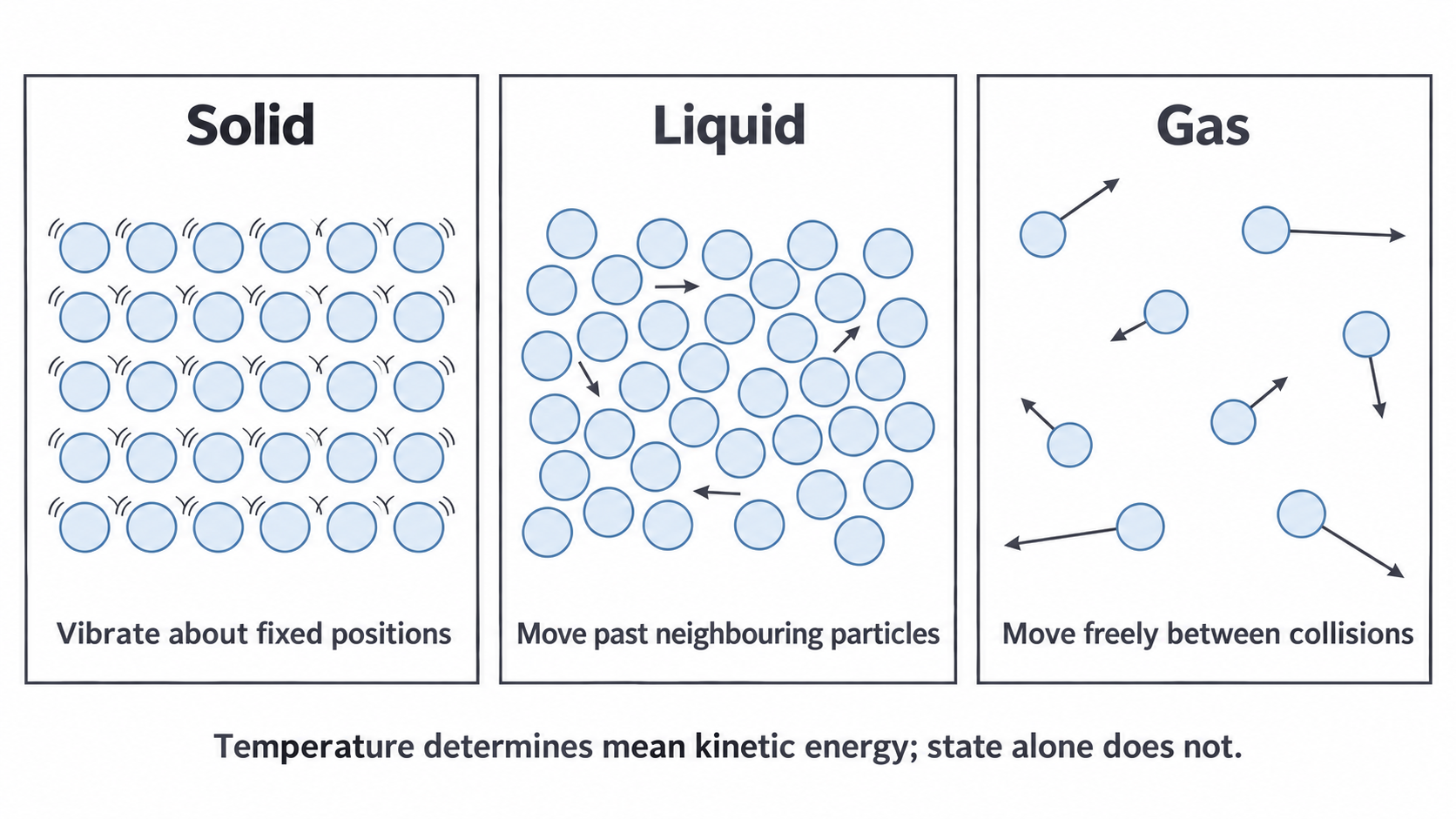
Particle arrangement changes with state. State alone does not rank the mean kinetic energies: temperature also matters.
Heating transfers energy because of a temperature difference. Work transfers energy when a force acts through a displacement, including electrical work and compression. Heat and work name transfers, not two substances stored inside an object. For a system with no change in bulk kinetic or gravitational energy, the first law says that its internal-energy change equals energy transferred in by heating plus work done on it. Reversing either transfer removes energy.
A piston does of work on a gas while leaves it by heating. Its internal energy increases by . If had left, internal energy would remain constant despite two transfers occurring. Energy conservation does not mean every individual transfer is zero.
Why temperature stays constant during a phase change
Energy supplied to a pure substance at its melting or boiling point need not raise its temperature. At constant pressure, while the two phases coexist in equilibrium, the energy changes the particle arrangement and increases the potential energy of the particle ensemble. The mean kinetic energy associated with temperature stays constant. Individual particles still move and exchange energy; their individual energies need not stay fixed.
Melting lets particles leave their fixed lattice positions. Vaporisation separates molecules much further against intermolecular attractions; it does not break the bonds within water molecules. Freezing and condensation reverse these changes and release energy. For water, vaporisation requires much more energy per kilogram than melting; the values depend on the substance and conditions.
[DIAGRAM: asset_slug: 6.2.1 - Thermal Energy Transfer - Diagram 2; caption: Warming and phase-change stages on a heating curve; description: Schematic heating curve showing warming stages and melting and boiling plateaus.]
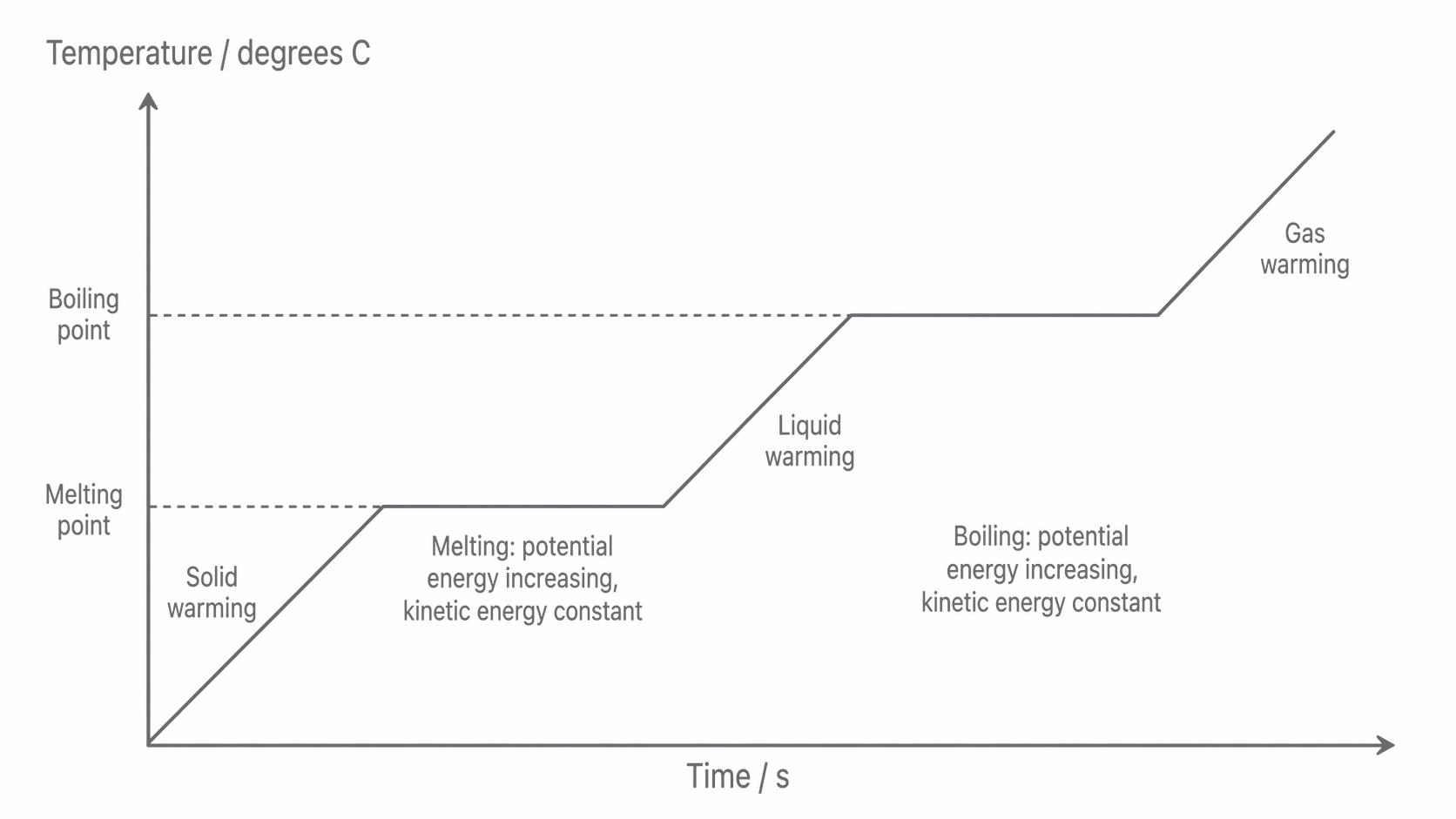
With constant useful heating power, a rising section shows increasing temperature; a plateau shows a phase change at constant temperature. This is a schematic, not a numerical graph.
To investigate a heating curve, place a temperature probe in a pure sample, away from direct contact with the heater. Use a data logger to record temperature at regular intervals while supplying approximately constant electrical power. Keep mass and pressure fixed as far as the phase change allows, stir safely where possible, and insulate. During a plateau the heater still transfers energy: a flat trace does not mean the supply has stopped. Uneven temperature, heat losses or a mixture of substances can blur the ideal plateaus. Repeat the run and compare plateau temperatures and durations, using the probe's calibration and response time when judging differences.
Specific heat capacity and its measurement
Specific heat capacity, , is the energy required per kilogram per kelvin temperature rise without changing state. Its unit is . For a mass , with approximately constant over the interval,
Temperature change
A temperature difference of equals a difference of ; do not add 273 to a temperature difference. The equation applies to the energy actually absorbed by the sample. If some heater energy escapes, using all the electrical energy overestimates .
For example, heating of water from to , with , requires
A heater needs at least . Actual heating takes longer because energy also warms the kettle and escapes to the surroundings.
Measuring specific heat capacity electrically
Measure the sample's mass with a balance, and place a heater and temperature probe in good thermal contact with it. Insulate the sample; for a liquid use an immersed heater, stir, and account for the container. Measure current with an ammeter in series and potential difference across the heater with a voltmeter. Record , , heating time , and initial and final temperatures. At steady electrical power, , giving when other energy terms are negligible.
With a temperature-time trace, the warming gradient is approximately . At the same mass and power a steeper gradient indicates a smaller heat capacity. To compare masses, use the same material and power and a similar temperature range; changing several variables would prevent a fair inference.
Heat loss and neglected container heat capacity bias the calculated high. Improve insulation or include the container's energy change; repeat measurements alone do not remove these effects. Temperature-reading fluctuations cause scatter: repeats and a fitted gradient help. A thermometer zero offset may cancel in the difference if unchanged, whereas scale-calibration error does not. Estimate uncertainty from instrument specifications, resolution and observed spread, not the number of displayed digits alone.
Continue this lesson.
You’re previewing NovaLearn without an account. Create a free account to read the rest.
Create free account