3.12.3.1 - The Michelson-Morley Experiment
Michelson and Morley used interference to test whether motion through a proposed light-carrying ether changed light's round-trip travel time. The important evidence was the absence of the predicted change when the apparatus was rotated.
Ether and absolute motion
The ether was a proposed medium filling space through which light waves travelled. In the stationary-ether model, light had speed relative to that medium. Motion relative to it would identify a preferred reference frame, unlike ordinary motion measured relative to another object.
Absolute motion
Motion relative to a proposed preferred universal frame. In the ether model being tested, that frame was the stationary ether.
If Earth moved through stationary ether, an Earth-fixed instrument would experience an ether wind. In the model, light sent parallel to that motion would make its outward and return journeys under different relative-speed conditions from light sent perpendicular to it. Equal-length perpendicular arms would therefore have different round-trip times.
This is a prediction of the particular ether model, not a statement that every conceivable ether theory must give the same result. Earth's orbital motion provided a reason to expect a measurable effect; Earth need not be absolutely at rest merely because one experiment found no effect.
Splitting and recombining light
An interferometer converts a small change in the relative optical paths of two beams into a shift of interference fringes. A common source supplies both beams so they can interfere coherently.
A half-silvered beam splitter at transmits some light along one arm and reflects some along a perpendicular arm. Mirrors return both beams to the splitter. Components of the returning beams overlap and travel to the same viewing telescope or detector, producing bright and dark fringes.
[DIAGRAM: asset_name: D.3.1 - The Michelson-Morley Experiment - Diagram 1; asset_slug: D.3.1 - The Michelson-Morley Experiment - Diagram 1; recommended_method: generated_png; caption: Perpendicular light paths recombine at a Michelson interferometer; description: Ideal thin beam splitter sends light along perpendicular round trips. Both returning beams meet the splitter and overlap towards the detector.]
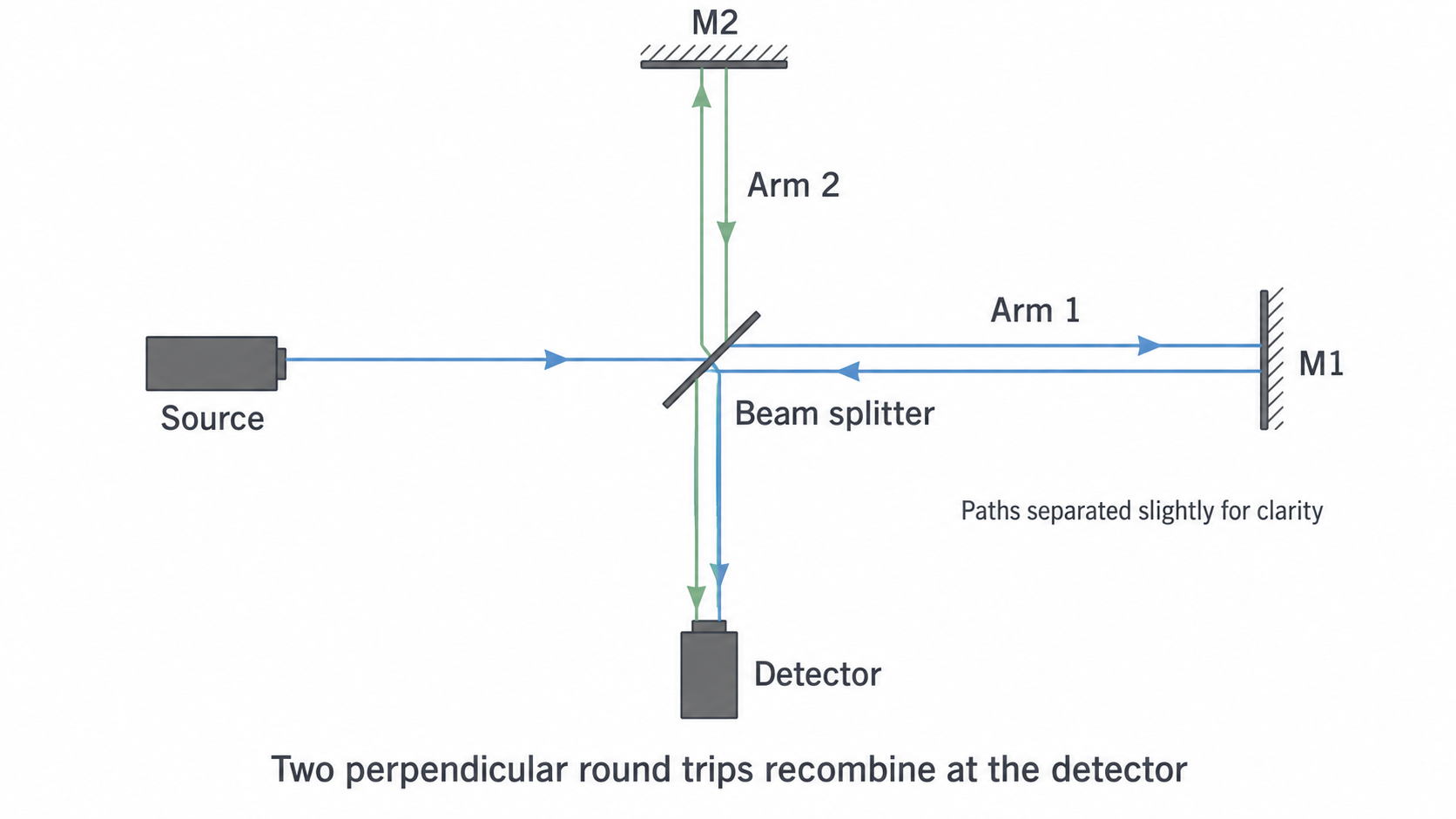
Principle schematic: both returning beams meet the beam splitter. Paths are slightly separated for clarity; the glass compensation used in a real instrument is omitted.
A bright fringe occurs where the beams arrive in phase. A change of optical path difference by one wavelength moves the pattern by one fringe spacing. Thus a predicted change corresponds to a fringe shift
For example, a path-difference change of with wavelength gives fringe spacings. That is detectable by an instrument resolving fringe spacings. Fractional fringe shifts are measurable; an entire bright fringe need not disappear.
In a real glass-plate instrument, a compensating plate makes the beams traverse equal total thicknesses of glass. This compensates the unequal optical delay from glass, particularly helping fringe visibility with a range of wavelengths. It does not make the arms physically equal or remove vibration, temperature drift and other sources of error.
Continue this lesson.
You’re previewing NovaLearn without an account. Create a free account to read the rest.
Create free account