3.2.1.2 - Stable and Unstable Nuclei
In nuclei containing several protons, those protons are packed closely together. Since like charges repel, there must be something powerful enough to overcome this electrostatic repulsion and hold the nucleus together. In this lesson you will learn about the strong nuclear force, understand why some nuclei are stable while others are unstable, and write nuclear equations for alpha decay and beta-minus decay, including the role of the antineutrino.
The Strong Nuclear Force
The nucleus presents a puzzle. Protons are positively charged, so they repel one another electrostatically. Neutrons are uncharged. Yet nuclei hold together, often containing many nucleons in a tiny region only a few femtometres across. The force responsible is the strong nuclear force.
Strong Nuclear Force
The strong nuclear force acts between nucleons. Its attraction over typical nuclear separations binds them; at very small separations it becomes repulsive.
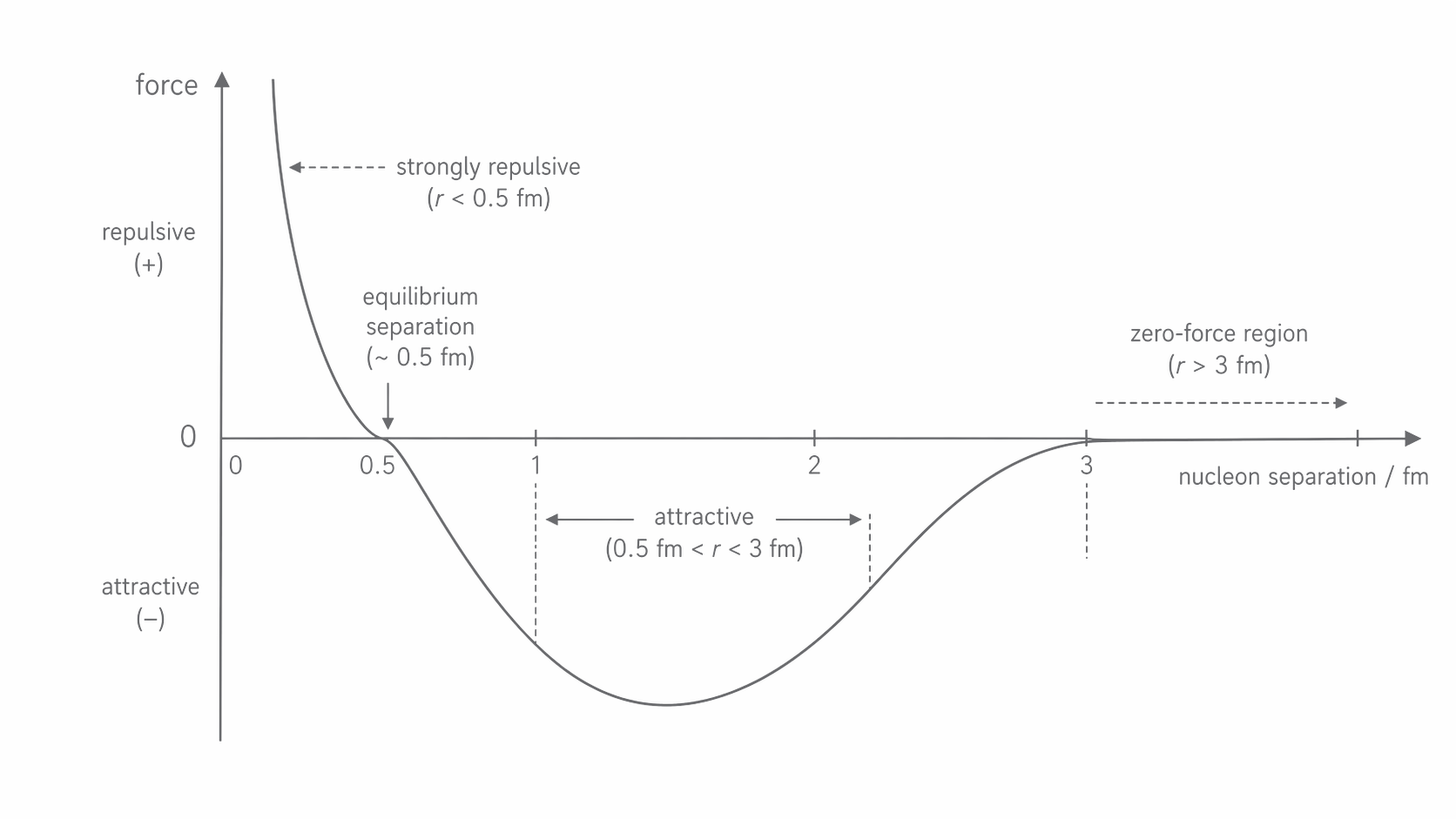
The strong nuclear force acts between proton-proton, proton-neutron, and neutron-neutron pairs. It is attractive for separations up to about 3 fm, but it becomes strongly repulsive when nucleons are pushed closer than about 0.5 fm. A femtometre is , so . Beyond a few femtometres it falls effectively to zero, unlike the electrostatic force, which has infinite range. In the graph, notice the attractive region over typical nuclear separations, the steep repulsion at very short range, and the point where the force crosses zero.
[DIAGRAM: asset_name: 2.1.2 - Stable and Unstable Nuclei - Diagram 1; asset_slug: 2.1.2 - Stable and Unstable Nuclei - Diagram 1; recommended_method: retained_png; caption: Strong nuclear force is repulsive below about 0.5 fm, attractive up to about 3 fm and negligible beyond.; description: Graph of force against nucleon separation. Below about 0.5 fm the force is strongly repulsive, between about 0.5 fm and 3 fm it is attractive, and beyond about 3 fm it falls to zero. Mark an equilibrium separation where the curve crosses the axis.]
Why Some Nuclei Are Unstable
A stable nucleus is one that does not spontaneously disintegrate. The strong force explains binding against proton repulsion, but binding does not guarantee stability: a bound nucleus can still decay to a lower total energy state.
Stable Nucleus
A stable nucleus is one that does not spontaneously decay because no energetically accessible spontaneous decay is available.
Large nuclei can become unstable because the strong nuclear force acts only over short distances, so each nucleon mainly interacts with nearby neighbours. The electrostatic repulsion between protons, however, acts across the whole nucleus. As the number of protons rises, the total repulsion can become too great.
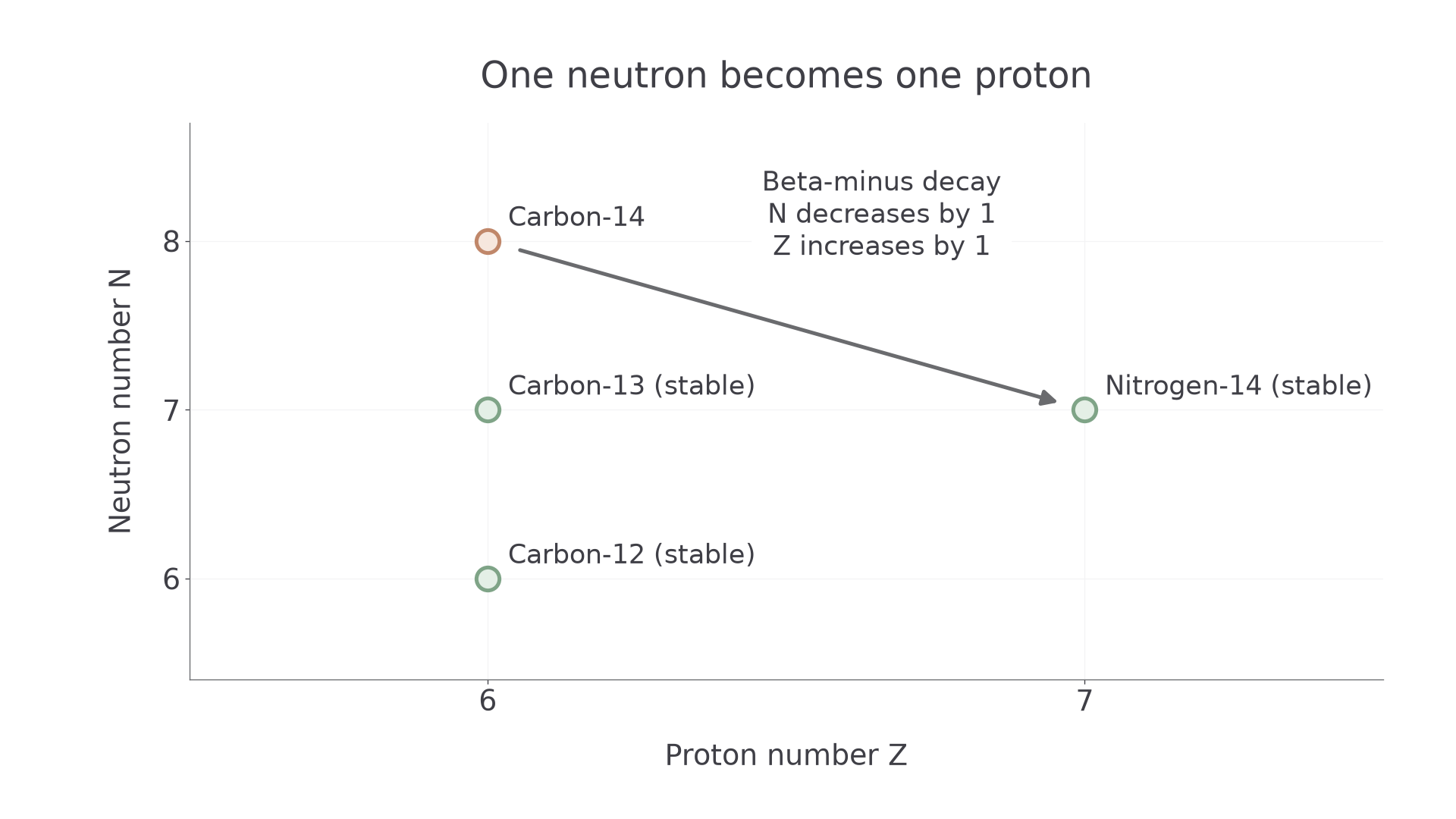
Nuclei can also become unstable if they have the wrong neutron-to-proton ratio. Neutron-rich nuclei often undergo beta-minus decay, while very large nuclei with too many nucleons often undergo alpha decay. For a fixed proton number, adding neutrons changes the isotope. Carbon-14 is neutron rich relative to stable carbon-12 and carbon-13. Its beta-minus decay decreases neutron number by one and increases proton number by one: the point moves down and right on an against plot.
[DIAGRAM: asset_name: 2.1.2 - Stable and Unstable Nuclei - Diagram 2; asset_slug: 2.1.2 - Stable and Unstable Nuclei - Diagram 2; recommended_method: matplotlib; caption: Carbon-14 beta-minus decay moves one step right and one step down on an N against Z plot.; description: Carbon-14 at Z=6 and N=8 changes to nitrogen-14 at Z=7 and N=7 in beta-minus decay; carbon-12 and carbon-13 are shown as stable comparison isotopes.]
Alpha Decay
Alpha decay occurs in large, heavy nuclei. The nucleus emits an alpha particle, which consists of two protons and two neutrons.
Alpha Particle
An alpha particle is a particle consisting of two protons and two neutrons, identical to a helium-4 nucleus, emitted from an unstable nucleus during alpha decay.
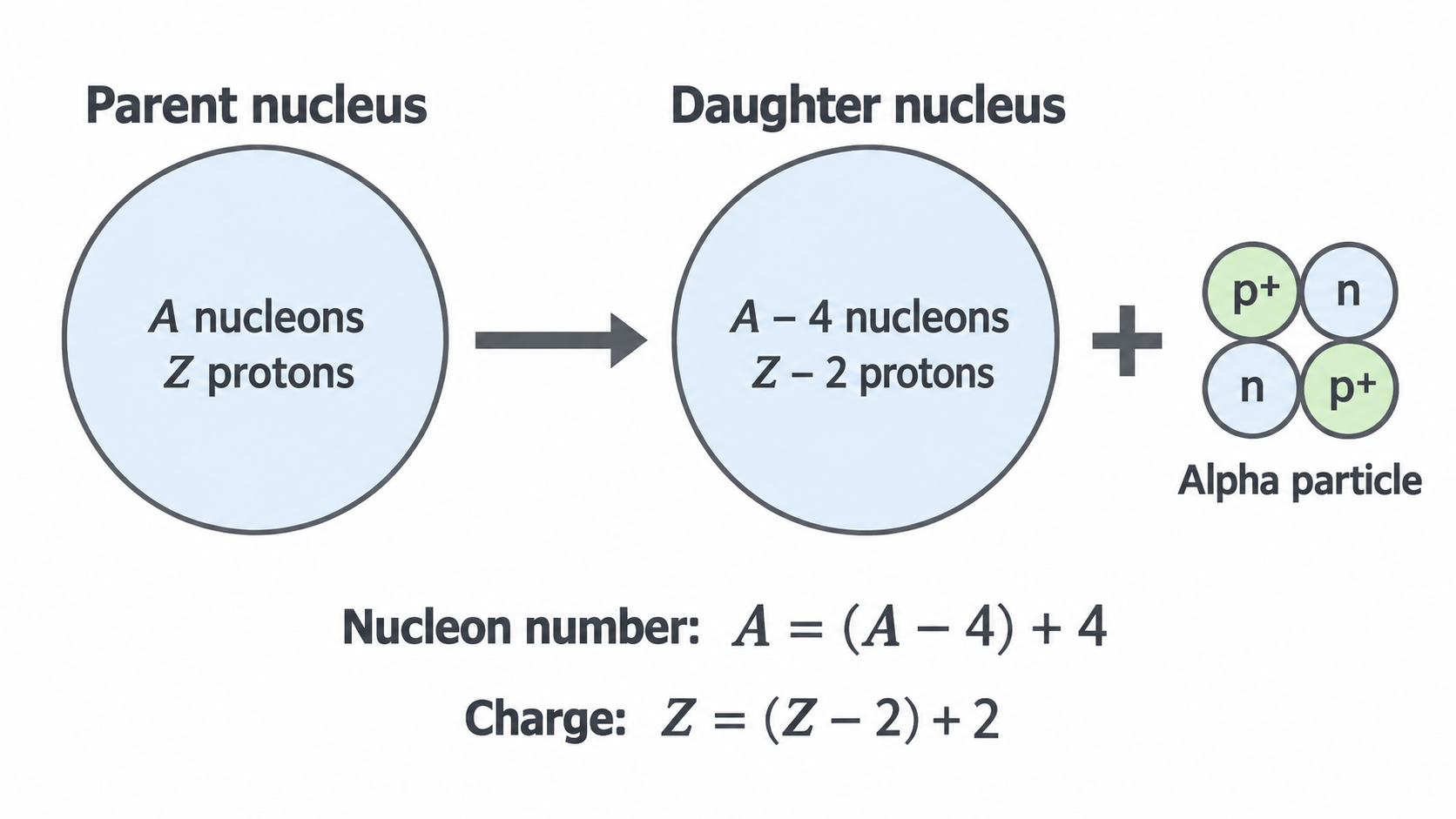
When a nucleus undergoes alpha decay, both its nucleon number and its proton number decrease.
Alpha Decay Equation
This means the daughter nucleus has four fewer nucleons and two fewer protons than the parent nucleus. Charge and nucleon number are both conserved across the equation. In the figure, notice the alpha particle leaving as a cluster of two protons and two neutrons, leaving the daughter nucleus with and .
[DIAGRAM: asset_name: 2.1.2 - Stable and Unstable Nuclei - Diagram 3; asset_slug: 2.1.2 - Stable and Unstable Nuclei - Diagram 3; recommended_method: imagegen; caption: Alpha emission removes two protons and two neutrons, total charge and nucleon number balance.; description: A parent nucleus emitting a cluster of two protons and two neutrons, leaving a daughter nucleus with nucleon number and proton number .]
Beta-Minus Decay and the Antineutrino
Beta-minus decay occurs in nuclei that are neutron-rich. In this process, a neutron in the nucleus changes into a proton and an electron is emitted. That emitted electron is called the beta-minus particle.
Beta-Minus Particle
A beta-minus particle is a fast-moving electron emitted from an unstable nucleus when a neutron changes into a proton.
At the nucleon level, the change is:
Neutron-Level Beta-Minus Decay
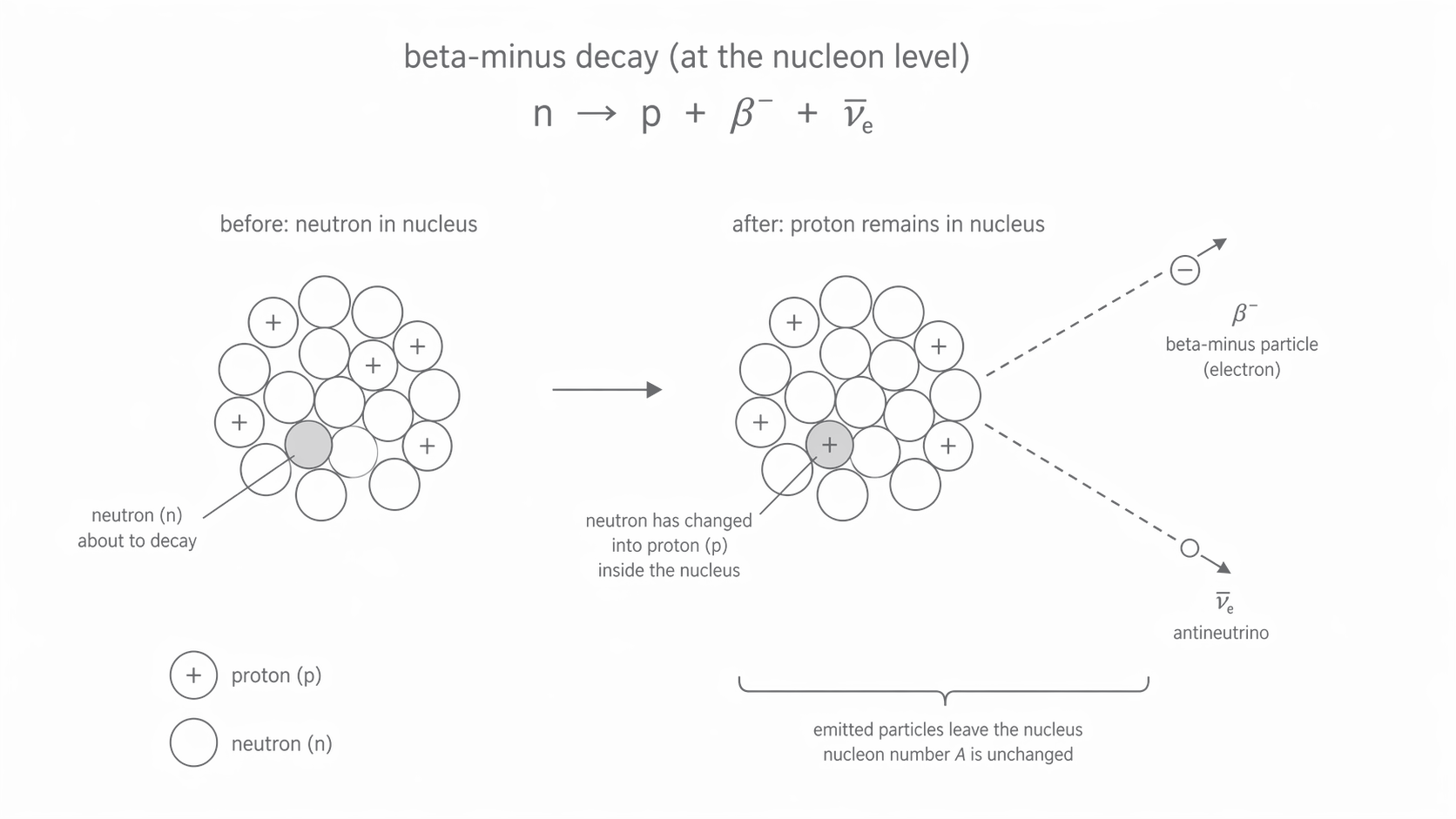
The electron is created during the weak decay; it is not an orbital electron or a particle previously stored inside the neutron. So a neutron becomes a proton, and the nucleus gains one proton while keeping the same total number of nucleons.
For a whole nucleus, the general beta-minus decay equation is:
Beta-Minus Decay Equation
In beta-minus decay, the nucleon number stays the same, the proton number increases by 1, and the daughter nucleus is a different element. Charge is conserved because the extra proton in the nucleus is balanced by the emitted beta-minus particle. In the figure, notice that the neutron changes into a proton inside the nucleus while the electron and antineutrino leave, so the nucleon number stays the same.
[DIAGRAM: asset_name: 2.1.2 - Stable and Unstable Nuclei - Diagram 4; asset_slug: 2.1.2 - Stable and Unstable Nuclei - Diagram 4; recommended_method: retained_png; caption: A neutron changes to a proton inside the nucleus while an electron and electron antineutrino are created.; description: A nucleus with one neutron highlighted. The neutron turns into a proton that remains in the nucleus while an electron and an antineutrino are emitted away from the nucleus.]
When beta decay was first studied, scientists expected the emitted beta particle to carry a single fixed kinetic energy. Instead, they found a continuous range of energies. A two-body decay to the daughter and electron would give a fixed electron energy for a fixed transition, after allowing for recoil. The continuous spectrum required an additional energy-carrying particle.
Wolfgang Pauli proposed that another particle must be emitted and must carry away some of the missing energy. This particle had to be electrically neutral and extremely difficult to detect.
Antineutrino
The antineutrino is an uncharged, nearly massless particle emitted in beta-minus decay. It was proposed to explain how energy is conserved when beta particles are emitted with a range of kinetic energies.
The antineutrino was later detected experimentally, confirming that beta-minus decay conserves energy after all.
Conservation Rules and Decay Equations in Practice
When writing any nuclear decay equation, two conservation rules must always be satisfied. The total nucleon number must be the same on both sides of the equation, and the total charge must also be the same on both sides.
Smoke detectors use americium-241, which undergoes alpha decay. The emitted alpha particles ionise the air inside the detector. If smoke enters, it reduces the ionisation and changes the current, triggering the alarm.
Follow a chain without losing the element
For one alpha decay followed by one beta-minus decay, the net change is and . For example, starting from gives after alpha emission and after beta-minus emission. The emitted particles must still be written in each full equation; a net change alone is not a full decay equation.
Each step works because you are balancing nucleon number and charge, not because you are memorising isolated examples.
Distinguishing Alpha and Beta-Minus Radiation
Alpha emission removes two protons and two neutrons; beta-minus emission changes a neutron into a proton. The nuclear changes and the radiation ranges answer different questions: the short range of alpha particles in air is not the range of the strong nuclear force.
| Decay | Daughter change | Emitted particles |
|---|---|---|
| Alpha | , , | Helium-4 nucleus |
| Beta-minus | unchanged, , | Electron and electron antineutrino |
Investigating alpha range
In a supervised demonstration, place a suitable alpha source and a thin-window Geiger–Müller detector at measured separations in air. Count for the same time at each separation, measure the background for a known time, and subtract the background count rate. A rapid fall to background beyond a few centimetres indicates a finite alpha range. Repeat counts because emission is random; a falling count rate before the cutoff also reflects the detector intercepting a smaller fraction of emitted particles. A thin paper sheet blocks alpha particles; an ordinary detector window may block them too. A cloud chamber instead shows short, dense alpha tracks. Handle sources only using the approved school procedure; this written account is preparation for observing the demonstration.
The force range is of order femtometres inside a nucleus, whereas the radiation range is a distance travelled through matter. Confusing them changes the scale by about thirteen orders of magnitude.