3.1.3 - Estimation of Physical Quantities
Estimation uses approximate inputs and a physical model to predict a useful scale. Learn to state reasonable assumptions, keep powers of ten under control, and use a rough answer to test whether a detailed calculation makes sense.
Orders of magnitude and reference scales
An order of magnitude expresses scale using a power of ten. A factor of ten is one order of magnitude; a factor of one thousand is three. Always state the unit: a length of is the same as .
A value such as is of order . When a task asks for the nearest power of ten, compare multiplicative factors. For , the value is eight times , but only a factor of 1.25 below , so is nearer on a logarithmic scale.
The boundary for this convention is : in , choose below that boundary and above it. This is a precise way to interpret “nearest”; an estimate's defensible assumptions matter more than a boundary decision for a poorly known quantity. Avoid throwing away the coefficient until the end of a calculation.
Useful reference scales include:
| Quantity | Approximate scale |
|---|---|
| Nuclear diameter | to |
| Atomic diameter | |
| Paper thickness or hair width | |
| Person's height | to |
| Earth's diameter | |
| Earth–Sun distance |
These are approximate reference values, not exact measurements of every atom, hair or person.
Reading mathematical comparisons
The symbols in a physical statement tell you how strong a claim it makes:
| Symbol | Meaning and example |
|---|---|
| Equal to: is an exact unit conversion. | |
| Approximately equal to: is a useful estimate, not an exact identity. | |
| , | Less than, greater than: , so . |
| , | Much less than, much greater than: a sheet thickness is much less than its length, so and . There is no universal numerical cutoff; whether a small contribution may be neglected depends on the required accuracy. |
| Proportional to: at fixed width and length, a cuboid's volume obeys . The ratio stays constant, so doubling doubles . | |
| A change in a quantity: . A fall gives a negative change. In an uncertainty expression such as , the context instead defines as a positive absolute uncertainty. |
Compare quantities in the same units before judging their relative size. A small numerical value in metres can be the same physical length as a large value in millimetres.
Choosing a model and reasonable assumptions
A useful estimate answers a clear physical question with assumptions you can explain. Start with the relationship connecting the desired quantity to quantities you can estimate; then choose a simple model and approximate inputs.
For the volume of a classroom, a cuboid model gives . Dimensions such as , and give . This ignores furniture, but is a reasonable starting estimate of the enclosed volume. A height of would need a very different building, so it would be a poor default assumption.
Keep one or two significant figures in the inputs rather than rounding every input to a power of ten. Multiplication, and especially squaring or cubing, can magnify early rounding. Calculate with units and round the final estimate to the precision the question asks for. An estimate of and its nearest power serve different purposes; neither is a claim of exact volume.
Test the assumption that matters most
If the room height could reasonably be between and , keeping the floor dimensions fixed gives volumes from to . Both remain of order . This checks that the scale conclusion is robust without pretending the assumptions are measured uncertainties.
State assumptions that influence the result, not irrelevant details. A different sensible assumption can earn full credit when the physical relationship, arithmetic and conclusion remain consistent with it.
Estimating areas and volumes
A geometrical model turns an estimated length into an area or volume, but the power of the length must also apply to its unit and numerical scale.
A circular cross-section
Treat a fine thread with diameter as circular. Its radius is , so
The nearest power is . Using the diameter in place of the radius would make the area four times too large. Squaring gives , not .
A spherical body
Taking Earth's diameter as , its radius is . A spherical model gives
This is of order . Rounding the radius prematurely to would give roughly , enough to change the nearest-power decision. A rough model does not justify avoidable arithmetic distortion.
Covering every external surface
Surface area estimates how much coating or insulation is needed; volume estimates how much space an object occupies. A rectangular block has three pairs of equal faces, with areas , and , so its total surface area is
A box roughly by by needs
of film to cover all six faces, or about half a square metre before allowing for overlaps and waste. Using would give cubic metres, the wrong quantity for a covering.
For a closed cylinder, imagine unrolling the curved surface into a rectangle. Its width is the circumference and its height is , giving curved area . The two circular ends add , so
A cylindrical container with radius about and height therefore needs a coating area of , of order , for its curved side and both ends. If only the curved side is coated, use ; if one end is open, include only one circular end. Decide which surfaces are present before substituting numbers.
Estimating mass, rates and accumulated totals
A derived estimate combines approximate values with a physical relationship. The model must connect the inputs to the required quantity, rather than merely producing a large or small number.
Mass of air in a classroom
Using the classroom and an approximate air density ,
The nearest power is . Air is much less dense than water, but hundreds of cubic metres still have substantial mass. Furniture and different room dimensions affect the estimate; a few hundred kilograms is a more honest description than an exact mass of 288 kg.
Total from a rate
To estimate the number of heartbeats in a lifetime, suppose the average rate is 70 per minute and the lifetime is 80 years. There are about minutes in a year, so
The units cancel: beats per minute multiplied by minutes gives beats. The assumed rate is a lifetime average, not a claim that the heart always beats at that rate. Different reasonable assumptions can move the result across a nearest-power boundary; show the working that supports your answer.
Comparing scales and checking an answer
A comparison uses a ratio of quantities expressed in the same unit. If an atomic diameter is about and a nuclear diameter about , their ratio is : the atom is about five orders of magnitude wider. The factor is , while the number of orders is 5.
[DIAGRAM: asset_name: 1.3 - Estimation of Physical Quantities - Diagram 1; asset_slug: 1.3 - Estimation of Physical Quantities - Diagram 1; recommended_method: matplotlib; caption: Equal intervals on this length scale represent multiplication by ten.; description: Approximate length scales positioned accurately on a logarithmic axis, with each small interval representing a factor of ten.]
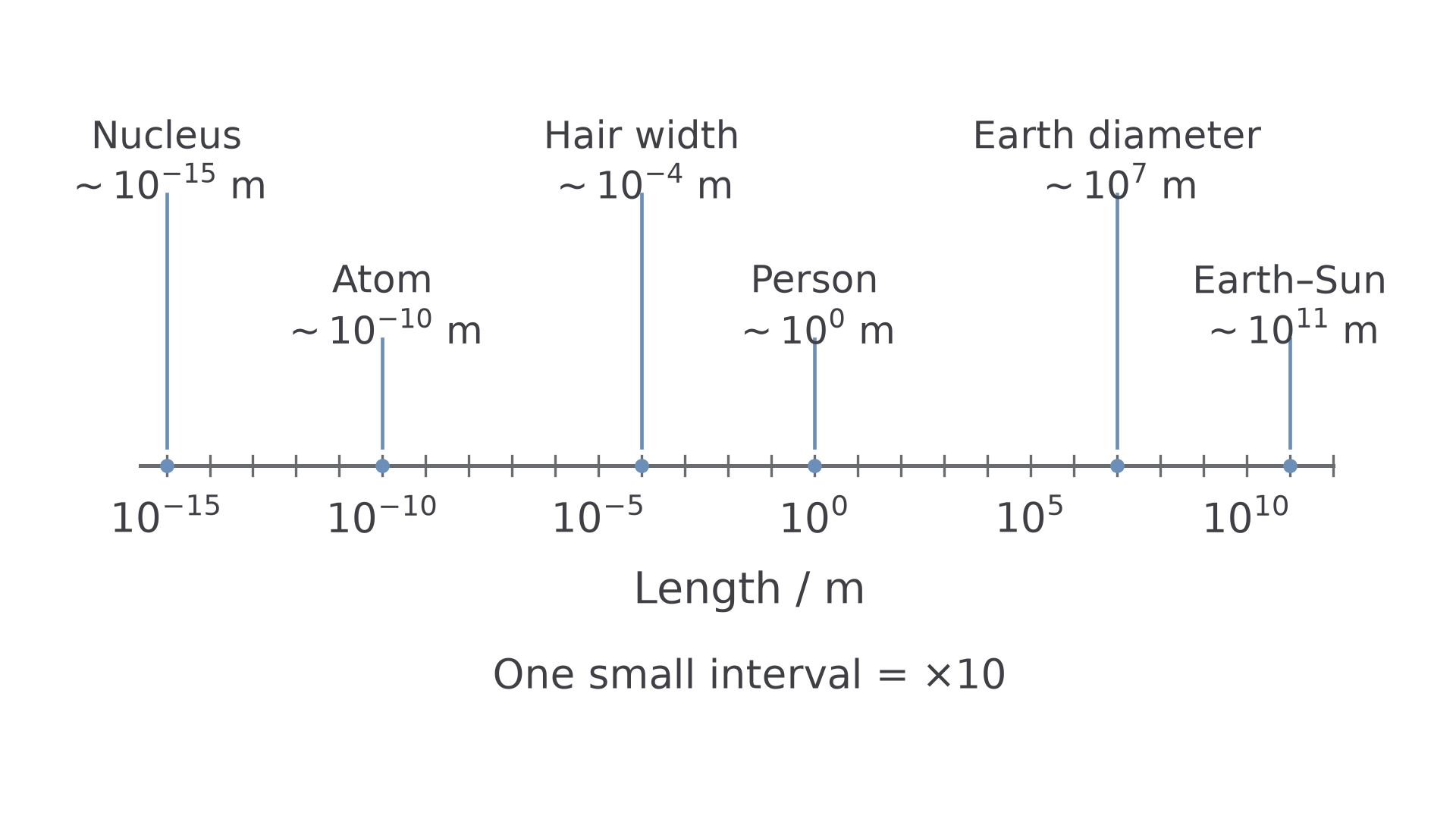
Equal distances along this logarithmic axis mean equal multiplication factors. Five small intervals represent multiplication by , regardless of where you start.
Use a ratio to catch unit errors
A metal block of approximate mass and volume has density about . Since , this is about . A calculator result of is larger by , so a conversion or power-of-ten error is likely. The estimate identifies the size of the discrepancy; it does not by itself prove which input was wrong.
For ratios not equal to an exact power of ten, state the ratio first. For example, , approximately four orders of magnitude when rounded to the nearest power. The more precise logarithmic difference is ; it is unnecessary unless requested. Comparing the actual ratio avoids errors from separately rounding both quantities first.