3.7.2.3 - Gravitational Potential
Gravitational potential describes energy per kilogram relative to a chosen zero. Use it to calculate work, interpret equipotentials and connect a potential graph to the magnitude and direction of the gravitational field.
Potential, the reference zero and work signs
Gravitational potential at a point is the gravitational potential energy per unit mass there. Equivalently, it is the work done per unit mass by an external agent in bringing a small test mass from infinity to the point without changing its kinetic energy. Its unit is .
For an isolated finite source, the conventional zero is at infinity. The zero is a reference choice, not a rule that zero field always means zero potential. Gravity does positive work when a mass moves inward. To bring it inward slowly at constant kinetic energy, an external agent must remove energy: the external work is negative. Therefore finite-distance potential is negative relative to infinity.
Between positions A and B define . For a constant test mass :
The external work against gravity is when there is no change in kinetic energy and no other energy transfer. More generally, under those same no-loss assumptions. Do not call every launch-energy requirement : a launch may also change kinetic energy.
Moving outward makes less negative, so and gravity does negative work. Moving inward makes and gravity does positive work. With gravity alone, ; the loss in potential energy becomes kinetic energy.
For a probe moved slowly from to , and . Gravity does of work on that same move.
Potential outside a spherical mass
For a point mass, or at/outside a spherically symmetric source of mass , the potential with zero at infinity is
Radial gravitational potential
Use the centre distance , not altitude. The expression does not describe the interior of a planet using its entire mass. It is a negative inverse-distance relationship, distinct from the inverse-square field magnitude .
Doubling halves the magnitude of , making its signed value higher: becomes . At the same time becomes one quarter as large. Both tend towards zero far away, but neither vanishes at a finite exterior radius around a single nonzero source.
For Earth, , and give . Moving one kilogram slowly from the surface to infinity requires against gravity in this isolated-Earth model.
Potential is a scalar: add signed potentials from separate sources. Two positive masses both contribute negative potential even at a point where their field vectors cancel. A zero resultant field therefore need not mean zero potential.
Equipotentials and zero gravitational work
An equipotential surface has the same potential at every point. A displacement along it has , so gravity does no work and gravitational potential energy does not change. A force can be present while its work is zero: the gravitational force is perpendicular to the instantaneous displacement.
Around an isolated spherical source, equipotentials are concentric spheres; circles in a cross-section represent those spheres. Their normals are radial, so gravitational field lines meet them at right angles. In a small approximately uniform field they are approximately parallel planes perpendicular to the field.
[DIAGRAM: asset_name: 7.2.3 - Gravitational Potential - Diagram 1; asset_slug: 7.2.3 - Gravitational Potential - Diagram 1; recommended_method: retained_png; caption: Exact equal-step equipotentials outside a spherical source. R is its radius. Field arrows point inward.; description: Exact equipotential cross-section for V = −60R/r in MJ kg⁻¹. The labelled surfaces differ by 10 MJ kg⁻¹, so their spacing grows outward. Radial arrows point inward and meet each circle normally.]
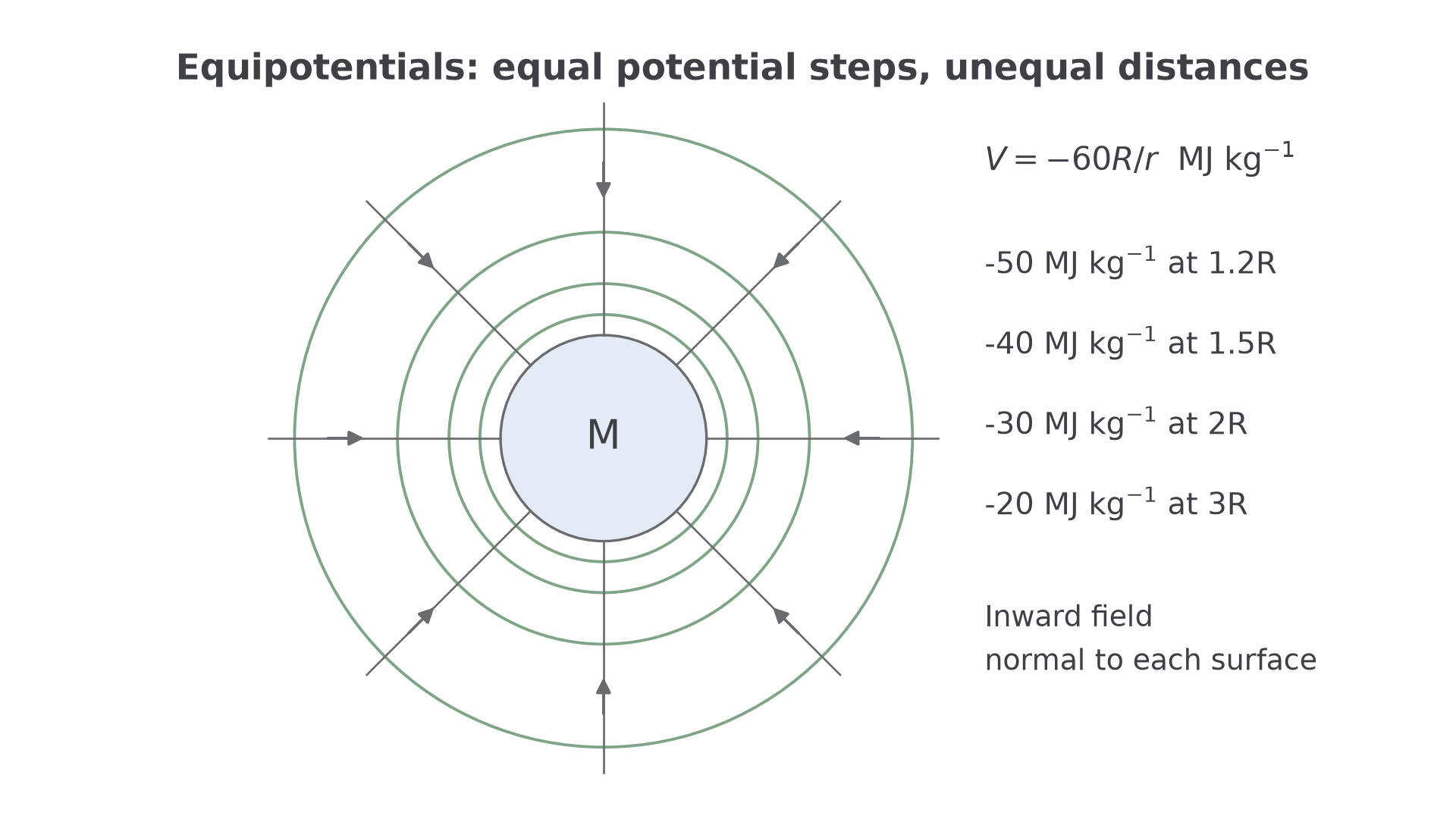
For equal potential steps, closer surfaces indicate a larger field magnitude: the same energy change per kilogram occurs over a shorter distance. This comparison requires equal steps; arbitrary unlabelled contour spacing is insufficient.
Continue this lesson.
You’re previewing NovaLearn without an account. Create a free account to read the rest.
Create free account