3.12.3.4 - Length Contraction
A moving object's length depends on the frame in which its end positions are measured. Use simultaneous measurements in one frame, identify the object's rest length and keep journey distances and times in the same frame.
Measuring the ends at the same time
The proper length of an object is its length in the frame where the object is at rest. A ruler alongside a stationary rod can establish that length directly.
To measure a moving rod in a laboratory, record the positions of its two ends at the same laboratory time and subtract them. Measuring the front and then the back later adds the rod's motion to the apparent separation. A photograph is also not automatically a simultaneous-position measurement, because light from different points may have travelled for different times.
Length contraction is a reduction of the measured dimension parallel to relative motion. A laboratory measures a moving rod to be shorter along its motion than its rest-frame length. Dimensions perpendicular to the motion are unchanged. The rod is not physically compressed in its own frame; the frames use different sets of simultaneous end-position events.
[DIAGRAM: asset_name: D.3.4 - Length Contraction - Diagram 1; asset_slug: D.3.4 - Length Contraction - Diagram 1; recommended_method: generated_png; caption: Length contracts along motion while transverse thickness stays unchanged; description: Rod rest frame and laboratory frame. Parallel length changes from 5.0 m to 3.0 m at 0.80c; transverse thickness is unchanged. End positions must be recorded simultaneously in the laboratory.]
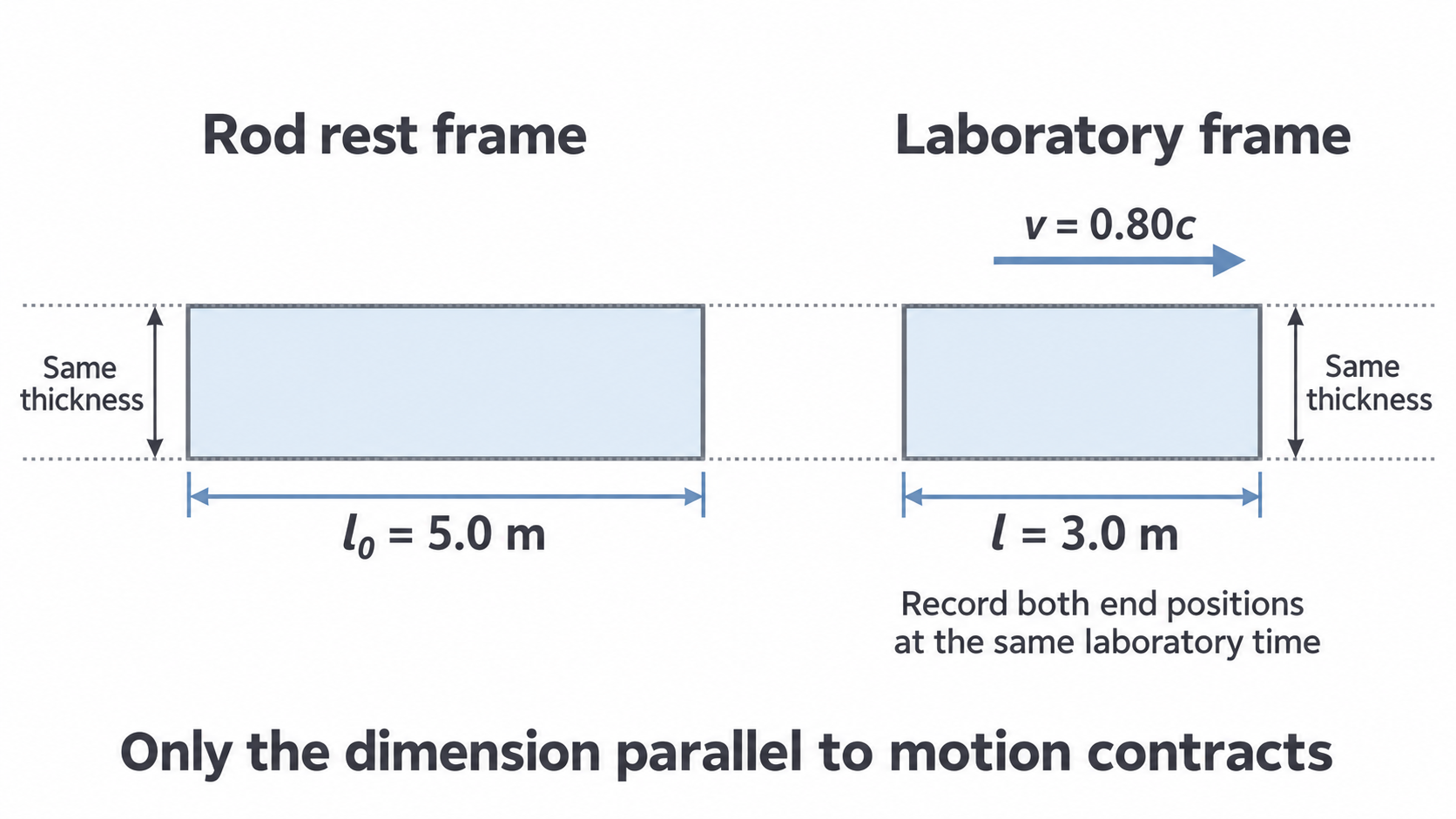
The same rod in two frames, schematically drawn rather than to a numerical scale. Its transverse thickness is identical; only its parallel length contracts.
Calculating a contracted length
The contraction factor is the reciprocal of the Lorentz factor, so proper length is reduced for any non-zero relative speed along the object.
Length contraction
Here is the relative speed between the measuring frame and the object, with . At , . At everyday speeds the factor is extremely close to 1, while at it is .
For a spacecraft with rest length moving along its length at , Earth observers measure . If its rest-frame height is , both frames measure that same height because it is perpendicular to the motion. The astronauts still measure their own ship as long.
To recover a proper length from a measured moving length, divide by the contraction factor. A spacecraft measured as at has , not .
Continue this lesson.
You’re previewing NovaLearn without an account. Create a free account to read the rest.
Create free account