3.7.2.1 - Newton's Law of Gravitation
Newton’s law connects the attractive force between masses to their masses and separation. Learn when the point-mass model applies, estimate the scale of gravity and use force measurements to infer unknown quantities.
Gravity as a universal attractive force
Every mass attracts every other mass in Newtonian gravitation. The interaction does not require charge, contact or a surrounding material. A person and Earth attract one another; so do two small laboratory masses, although their mutual force is much smaller.
The two forces form a Newton’s third-law pair: equal in magnitude, opposite in direction and acting on different objects along their line of centres in the point-mass model. They do not cancel in the force equation for either object. The accelerations need not be equal because ; Earth’s acceleration towards a person is much smaller than the person’s acceleration towards Earth.
Newton’s inverse-square force law
The magnitude of the force between two point masses is proportional to the product of their masses and inversely proportional to the square of their separation.
Newton’s law of gravitation
Use masses in kilograms and separation in metres to obtain force in newtons. The constant is . This equation gives a positive magnitude; attraction determines the direction separately. Do not attach a negative sign to a requested force magnitude.
Rearranging gives , so its units are , equivalently . The constant is universal in this model; it is not the local field strength .
Testing and using inverse-square dependence
Holding both masses fixed gives . If separation changes from to , then
Doubling separation quarters the force; halving separation quadruples it. A graph of against falls steeply near the source and tends towards zero. It does not reach zero at finite separation.
[DIAGRAM: asset_name: 7.2.1 - Newton's Law - Diagram 1; asset_slug: 7.2.1 - Newton's Law - Diagram 1; recommended_method: retained_png; caption: Exact inverse-square force graph with dimensionless ratios. F₀ is the force at separation d.; description: Exact inverse-square graph: at separations d, 2d and 3d the force is F₀, F₀/4 and F₀/9. Both axes use ratios, so they are dimensionless.]
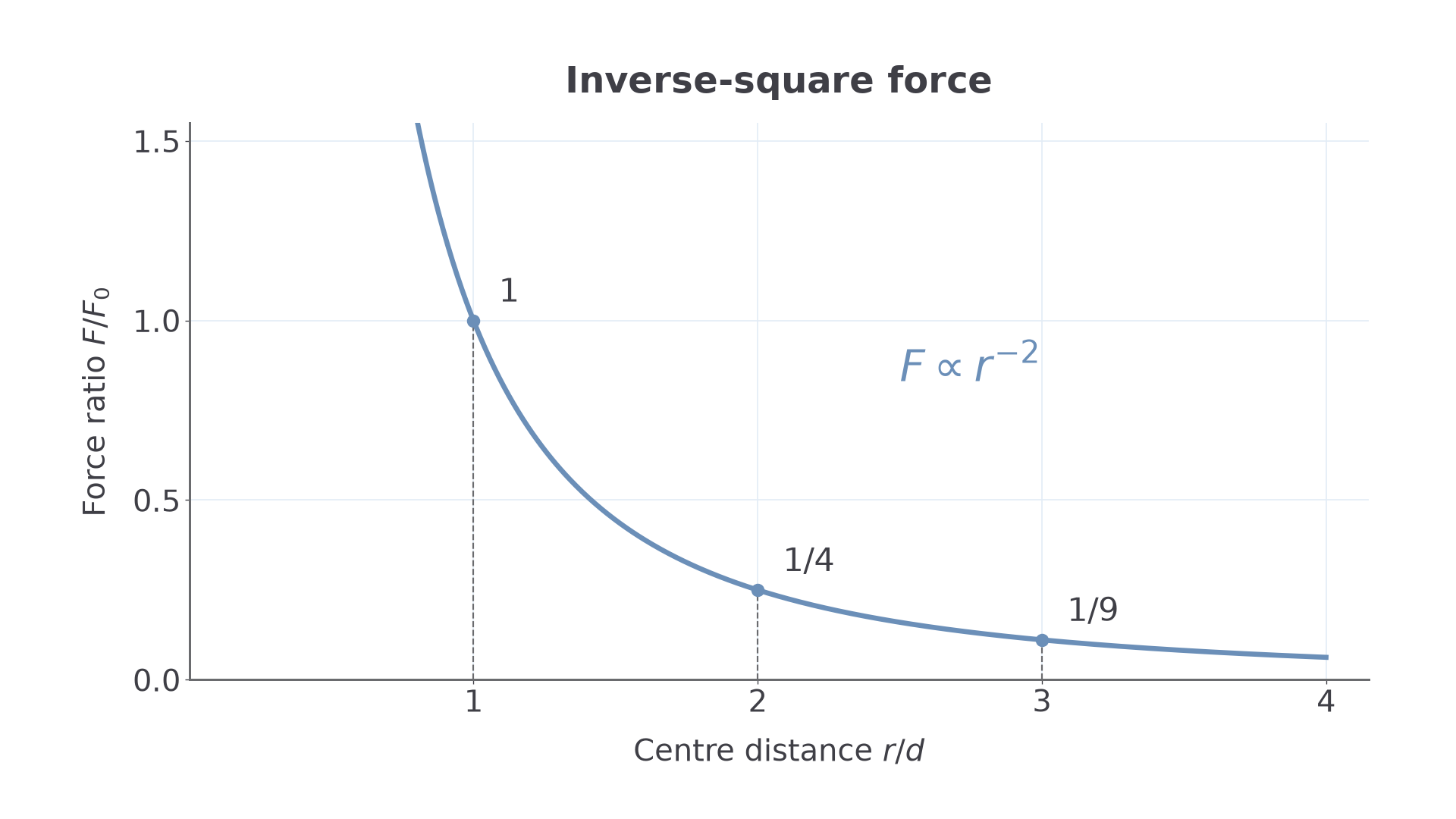
To test the law from measurements, plot against . A straight line through the origin supports inverse-square dependence for fixed masses; its gradient is . Alternatively, calculate for each row and check whether it is constant within measurement uncertainty. A falling – graph alone does not establish the exponent: inverse and inverse-cube laws also fall.
Point masses and spherical sources
A point mass is an idealisation whose size is negligible compared with the relevant separation. For irregular objects this approximation is good only sufficiently far away. Treating all the mass as concentrated at the centre is not generally exact near an irregular object.
There is an exact Newtonian result for a spherically symmetric mass distribution: at or outside its surface its field equals that of the same mass concentrated at its centre. Density may change with radius, provided it is the same in every direction at a given radius. Thus the point-mass force law applies to two non-overlapping spherically symmetric bodies using their centre-to-centre separation.
Continue this lesson.
You’re previewing NovaLearn without an account. Create a free account to read the rest.
Create free account