3.7.3.1 - Coulomb's Law
Use Coulomb's law to calculate interactions between charges, decide their directions, and test whether a point-charge model is appropriate. Then compare electric and gravitational forces for subatomic particles without confusing force magnitude with charge sign.
Charge, separation and force magnitude
Two stationary point charges exert electric forces on each other along the line joining them. A point charge is a model in which the size of the charged object is negligible compared with the distances of interest.
Coulomb's law in a vacuum
Here is the force magnitude, and are signed charges in coulombs, and is their separation in metres. Absolute-value bars make the magnitude non-negative. The permittivity of free space, , sets the vacuum interaction strength, giving . Direction is decided separately from the charge signs.
Doubling one charge doubles the force. Doubling the separation spreads the interaction over the inverse-square factor and reduces the force to one quarter. For simultaneous changes, use a ratio before substituting numbers:
For example, doubling both charges while tripling the distance gives , not .
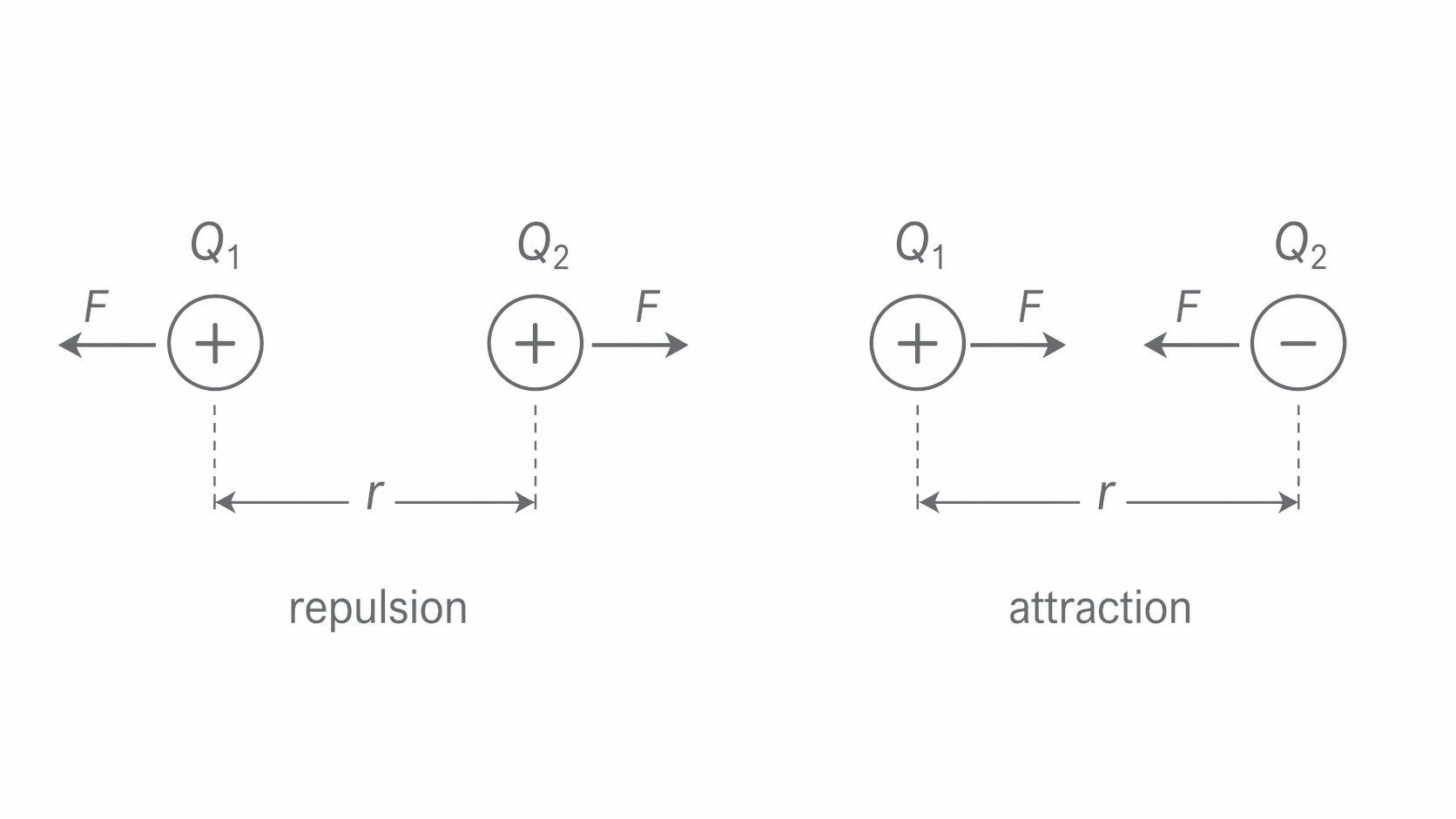
[DIAGRAM: asset_name: 7.3.1 - Coulomb's Law - Diagram 1; asset_slug: 7.3.1 - Coulomb's Law - Diagram 1; caption: Equal and opposite forces for like and unlike charges; description: Like positive charges repel and unlike charges attract. The marked separation is centre to centre and each force pair has equal magnitude.]
Directions and vector addition
Like charges repel and unlike charges attract, irrespective of which charge has the larger magnitude. Each interaction forms a Newton's-third-law pair: equal force magnitudes on different objects, in opposite directions. These two forces do not cancel on either object because they act on different objects.
For several source charges, find the force on the same chosen charge from each source and add those forces as vectors. Do not add their magnitudes until you know their directions. A negative source charge does not automatically mean a negative force component: an axis and a target charge must first be specified.
For example, a test charge is at . A source at repels it to the right with magnitude . A source at repels it to the left with the same magnitude. Taking right as positive gives zero resultant force. Replacing the right-hand source with makes its force attractive, also to the right, so the resultant becomes .
When two contributions are perpendicular, resolve them along two axes and use . Determine the quadrant from the signs before using . Vector cancellation requires equal and opposite contributions, not merely opposite source-charge signs.
When a sphere can be a point charge
Air has a permittivity close to that of a vacuum, so ordinary calculations for charges in air use . This is a modelling approximation, not a claim that every insulating medium behaves like a vacuum.
Outside a spherically symmetric charge distribution, the electric interaction is the same as if its total charge were concentrated at the centre. The observation point must be outside the sphere. An isolated conducting sphere has this symmetry, but another nearby charged conductor can redistribute its surface charge by induction. Treating two charged conducting spheres as central point charges is therefore most reliable when their radii are small compared with their separation and that redistribution is negligible.
Continue this lesson.
You’re previewing NovaLearn without an account. Create a free account to read the rest.
Create free account