3.6.2.3 - Molecular Kinetic Theory Model
Explain gas pressure using molecular momentum transfers, derive the kinetic-theory equation, and connect molecular motion to temperature. Use the model carefully: mean square speed is not the square of mean speed, and translational energy is not every possible internal-energy contribution.
Brownian motion as molecular evidence
Tiny smoke particles viewed with a microscope move irregularly even in still air. This Brownian motion is the erratic motion of particles suspended in a fluid, caused by uneven bombardment by much smaller molecules. The visible specks are smoke particles containing many atoms; the individual air molecules are too small to be resolved.
At any instant the impulses from the surrounding molecules do not exactly balance. The resultant force on a smoke particle changes as new collisions occur, changing its velocity. Over time there is no preferred direction, although any short section of its path may point one way. Steady drift caused by a draught or convection is different and can be superimposed on the irregular motion.
[DIAGRAM: asset_slug: 6.2.3 - Molecular Kinetic Theory Model - Diagram 1; caption: Uneven molecular impacts cause Brownian motion; description: Schematic of molecular impacts and irregular suspended-particle motion.]
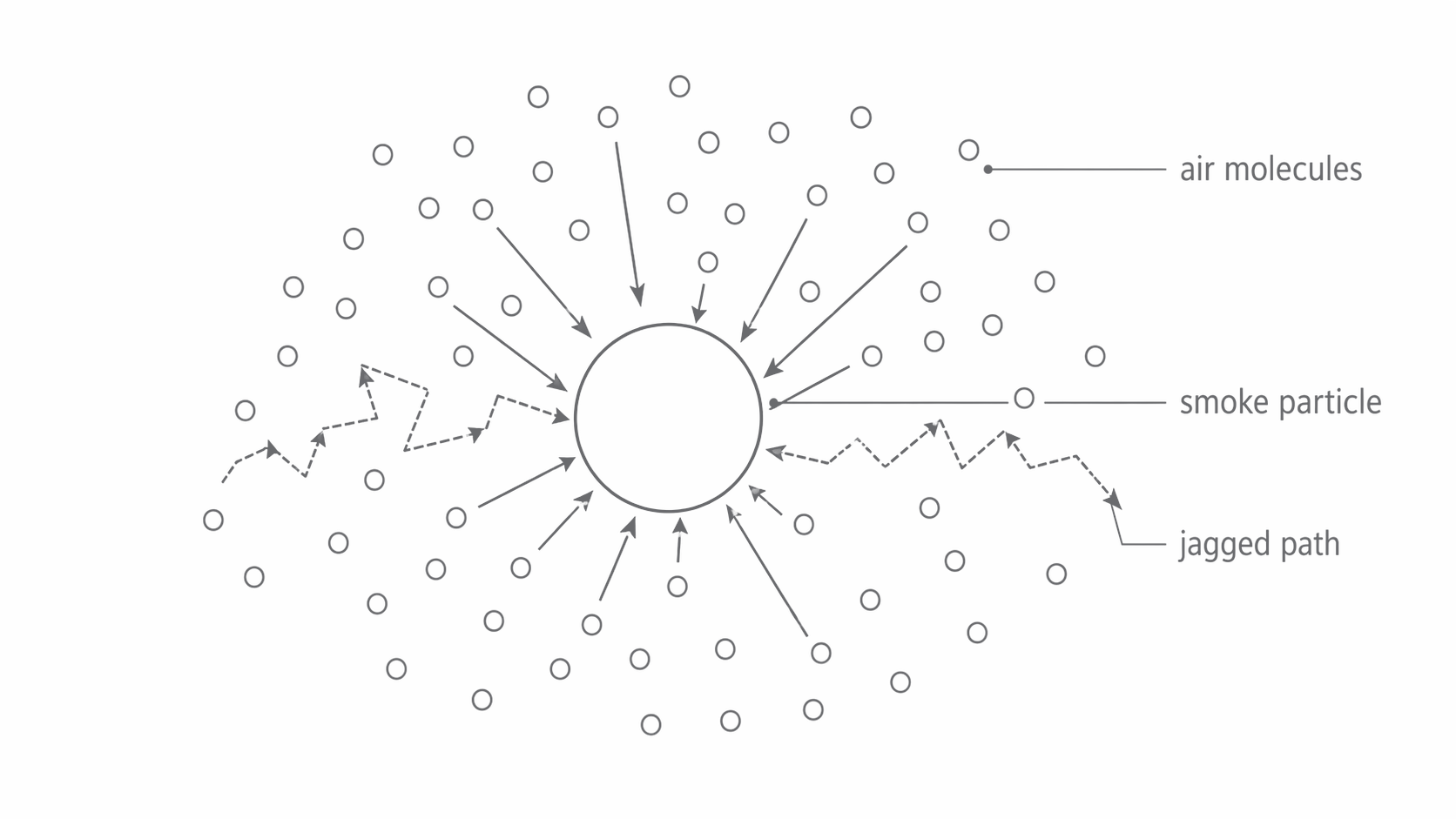
Small circles represent unseen air molecules; the large circle represents a visible smoke particle. Solid arrows depict impacts and dashed segments illustrate irregular motion, not molecular trajectories to scale.
Brownian motion is evidence for atoms and molecules because it reveals a measurable effect of their collisions without imaging them directly. It is stronger evidence than simply observing that a gas expands: a macroscopic expansion alone does not identify the microscopic mechanism.
Explaining the gas laws through collisions
An empirical law summarises measurements. A theoretical model starts with assumptions and uses physical laws to predict observations. Boyle's law, Charles's law and the pressure law were found experimentally; kinetic theory explains their relationships through particle motion and collisions with walls.
When a molecule rebounds from a wall its momentum changes. The wall receives an equal and opposite impulse. Many impulses each second produce a mean force, and pressure is that force per unit area. The useful chain is temperature or geometry → molecular impacts → momentum transferred per second per unit area → pressure.
At constant temperature, reducing the volume of a fixed amount of gas leaves its speed distribution unchanged. Molecules have shorter journeys between walls and there are more molecules per unit volume. The rate of impacts per unit wall area rises, so pressure rises: this explains Boyle's law.
At fixed volume, raising temperature raises mean kinetic energy and typical speeds. Molecules hit walls more frequently and reverse a larger normal momentum per impact. Both effects increase momentum transfer per second per unit area, so pressure rises. Saying only that collisions are “harder” leaves out the rate and momentum reasoning.
At constant pressure, heating would initially increase pressure for those same reasons if volume stayed fixed. A movable boundary expands; the lower number density and longer journeys reduce wall-impact rate per unit area until pressure again balances the external pressure. The final volume is larger. Do not say molecules themselves expand, or that mean velocity increases: in an isotropic gas the vector mean velocity is zero even though its mean speed is positive.
Deriving pressure from molecular momentum
A simple ideal-gas model connects pressure to the random translational motion of many identical particles. It assumes:
- molecular volume is negligible compared with gas volume;
- no intermolecular forces act except during collisions;
- molecules follow Newton's laws between collisions and move randomly with no preferred direction;
- collisions with molecules and stationary walls are perfectly elastic;
- collision duration is negligible compared with time between collisions.
The speeds have a distribution; “random” does not mean every molecule has the same speed or that Newton's laws cease to predict an individual trajectory.
One molecule and one wall
Consider a cube of side , volume . A molecule has mass and positive velocity component towards the right-hand wall. Only the component perpendicular to that wall changes sign on rebound; the tangential components are unchanged.
[DIAGRAM: asset_slug: 6.2.3 - Molecular Kinetic Theory Model - Diagram 2; caption: Normal molecular motion towards one wall of a cube; description: Cubic box with a molecule's normal velocity component towards one wall.]
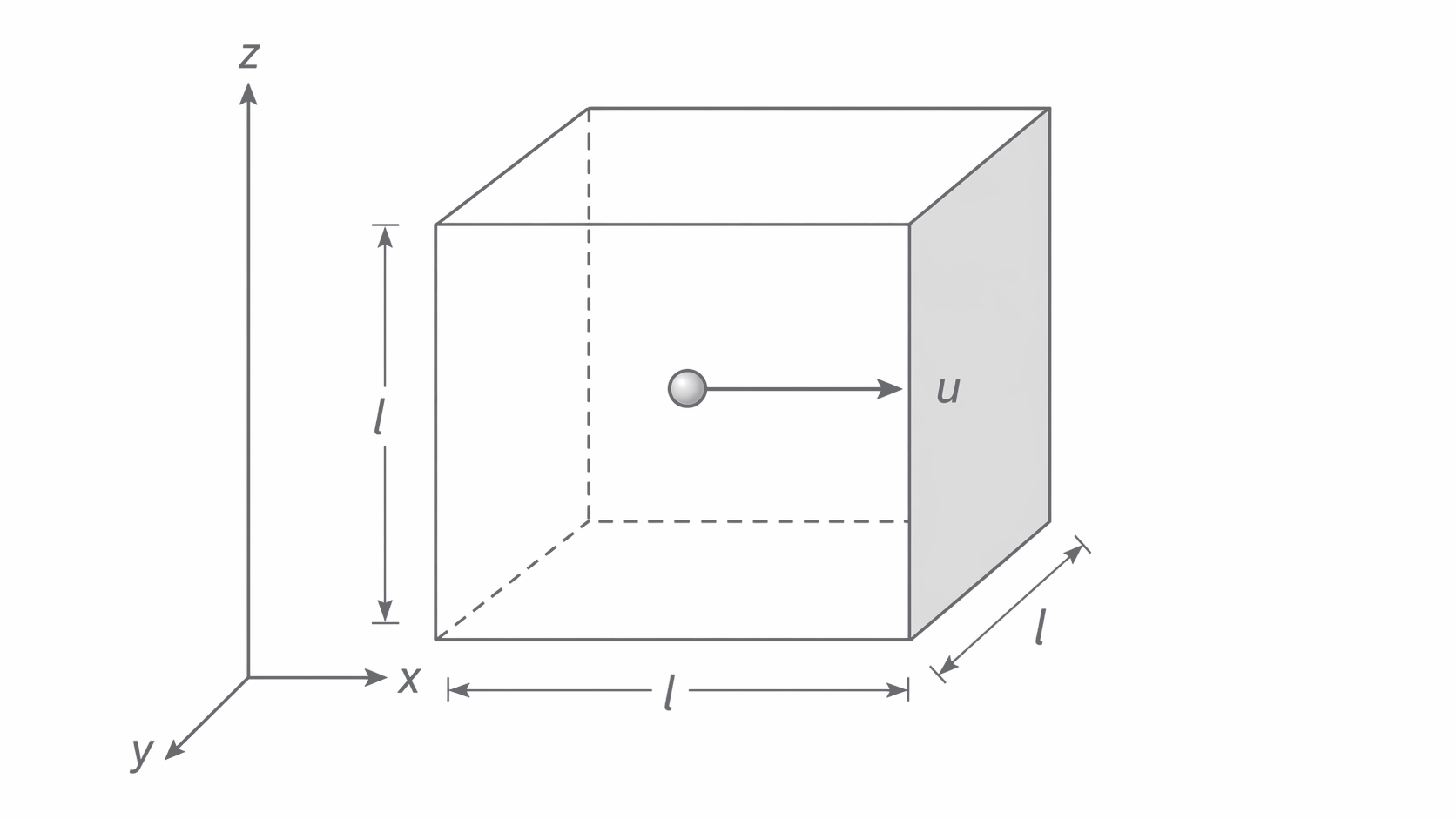
The arrow is the -component , not necessarily the full velocity. The drawing labels each side ; this derivation writes the same side length as .
The molecule's momentum change is , so the impulse delivered to the wall is . In the simple straight-flight construction, the time between hits on this same wall is , not . Consequently its average force contribution is
Dividing by wall area gives . Intermolecular collisions redistribute velocities; in equilibrium the ensemble average leads to the same result. The straight-flight construction is a way to obtain the mean momentum flux, not a claim that all real molecules repeatedly follow one uninterrupted path.
Sum first, then average in three dimensions
For particles with different normal components,
Here is the mean of the squared components. It is not : when directions balance, but squared components are nonnegative and have a positive mean.
For each molecule, . Average this identity over the ensemble. With no preferred direction, the three mean squares are equal, so
The factor follows from equality of the mean squares, not equal components for each individual molecule.
Kinetic-theory equation
Continue this lesson.
You’re previewing NovaLearn without an account. Create a free account to read the rest.
Create free account