3.10.4.3 - Magnetic Resonance Scanner
Magnetic resonance imaging uses strong magnetic fields and radio-frequency signals from hydrogen nuclei to build a cross-sectional image. Separate the roles of the main magnet, gradient coils, RF transmitter, receiver and computer.
Proton alignment and precession
An MR scanner places the patient in a strong, approximately uniform magnetic field produced by a superconducting magnet. The signal comes mainly from hydrogen nuclei in water and fat. An ordinary hydrogen nucleus is a proton, not an electron.
A proton has spin and a magnetic moment, so it behaves in some respects like a tiny magnet. Before the main field is applied, orientations have no preferred direction and the magnetic effects cancel on average. In the field, there are slightly more protons in the lower-energy alignment parallel to the field than in the opposite state. This gives a small net magnetisation parallel to the field. The simple statement 'the protons align' refers to this net alignment; it does not mean every proton points identically.
Precession describes motion of the spin direction about the external field direction, pictured like the tilted axis of a spinning top sweeping around the vertical. The diagram is a classical visual model of spin, not a claim that a proton is a tiny rigid ball mechanically spinning. Precession is distinct from merely rotating around its own axis.
[DIAGRAM: asset_name: B.4.3 - Magnetic Resonance (MR) Scanner - Diagram 1; asset_slug: B.4.3 - Magnetic Resonance (MR) Scanner - Diagram 1; caption: A classical model of precession: the tilted spin direction turns about the external magnetic field.; description: Single tilted spin axis, external field and circular precession path. Illustrative angular relationship, not a numerical or literal mechanical model.]
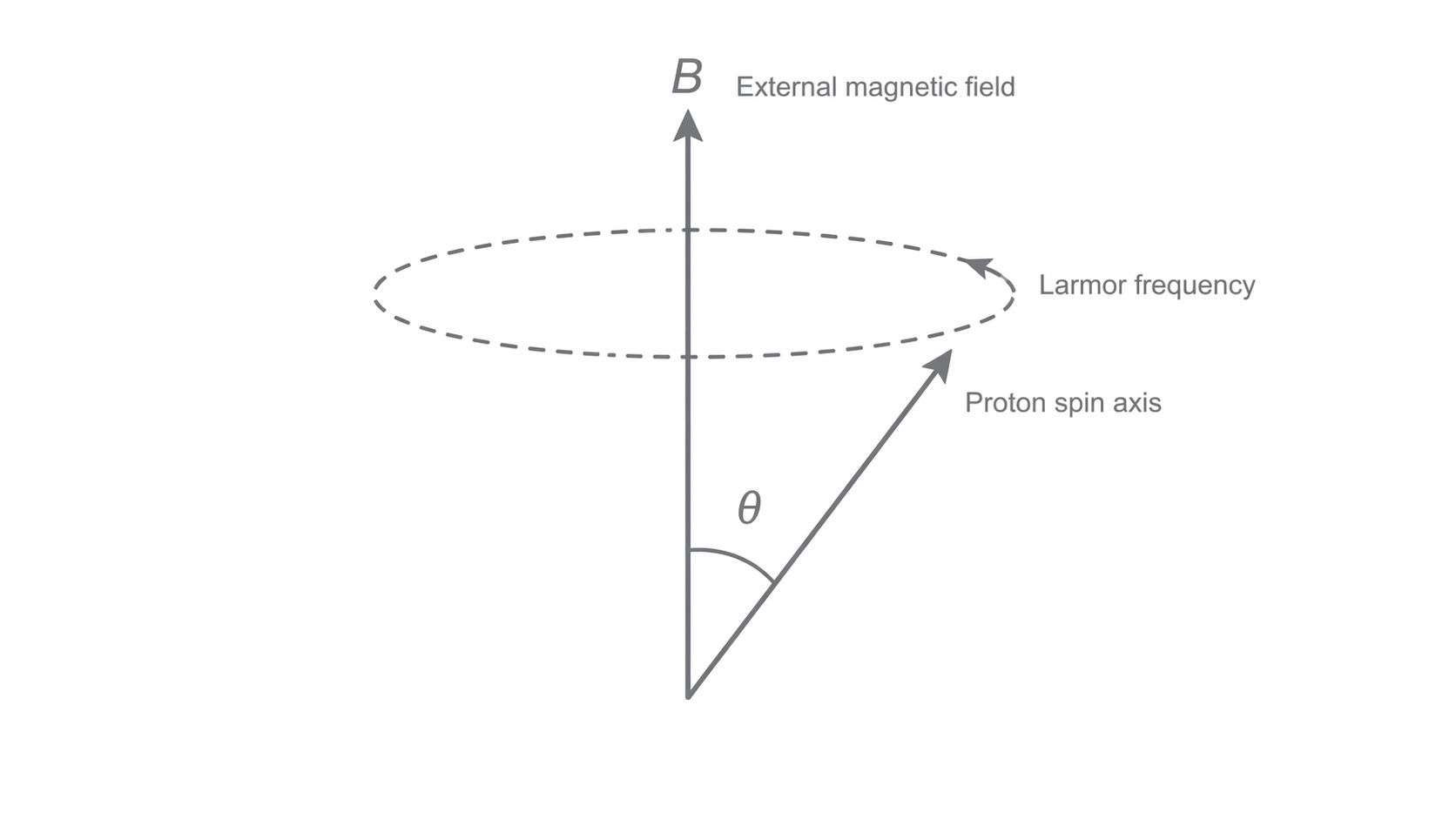
For a given nucleus, a stronger magnetic flux density gives a higher precession frequency, also called the Larmor frequency. In the basic model, this frequency is proportional to the field strength. This link between magnetic field and resonance frequency is what allows the scanner to distinguish positions.
Using gradients to encode position
A strong uniform field establishes alignment, but it does not by itself distinguish where an RF signal originated. In the simple model, protons at different positions in the same field have the same precession frequency. A receiver could detect a combined signal without knowing its spatial distribution.
Gradient field coils superimpose a small controlled variation on the main field. Position then determines the total field strength, and the field strength determines precession frequency. For example, along a direction in which the total field increases, the resonance frequency increases too.
[DIAGRAM: asset_name: B.4.3 - Magnetic Resonance (MR) Scanner - Diagram 2; asset_slug: B.4.3 - Magnetic Resonance (MR) Scanner - Diagram 2; caption: A field gradient makes resonance frequency vary with position. A matching RF pulse selects the central region.; description: Abstract tissue regions with increasing field-arrow lengths. Field direction and direction of increasing strength are explicitly different arrows.]
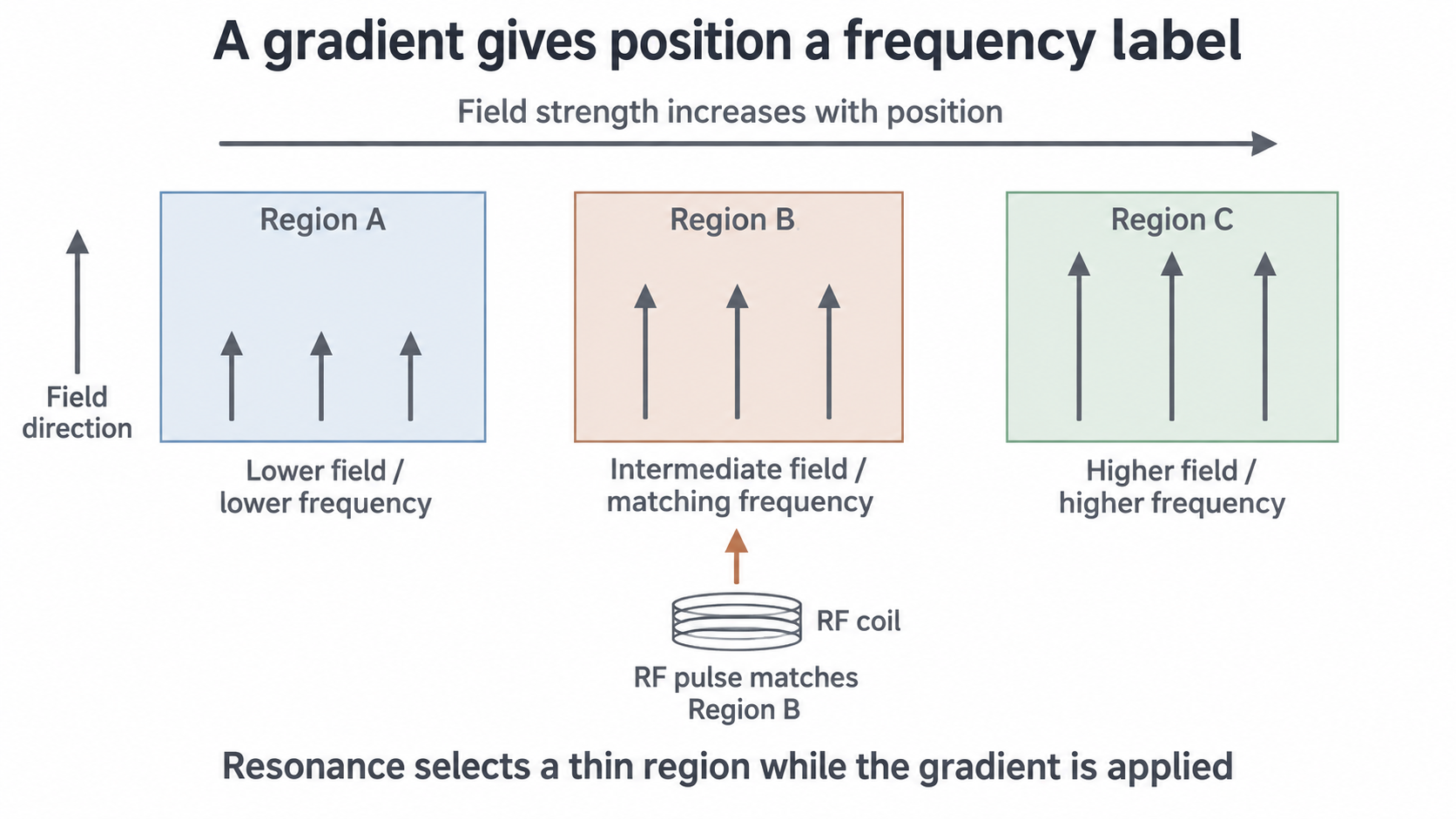
A narrow range of RF frequencies can therefore select a thin region whose protons have matching precession frequencies. A single gradient distinguishes positions along one direction: it does not give every point in a three-dimensional body a unique frequency. Controlled gradients in different directions, used with the RF sequence, allow the scanner to select a slice and encode positions within it. At this level, the key chain is
position determines the local field strength, which determines the precession frequency.
The gradients supply spatial information; they do not replace the RF pulse that excites the protons. Reversing a gradient reverses which side has the higher resonance frequency. Removing all deliberate gradients removes the simple frequency-to-position code, even though protons can still respond to RF.
Continue this lesson.
You’re previewing NovaLearn without an account. Create a free account to read the rest.
Create free account