3.12.3.3 - Time Dilation
A clock moving relative to an inertial laboratory records less elapsed time than the laboratory assigns to the same pair of tick events. Learn to identify those events, derive the relationship with a light clock and test its consequences using muon survival.
One clock and two events
The proper time between two events is the interval measured in the inertial frame where those events occur at the same position. One clock at that position can register both. For a spacecraft clock, two ticks occur at one position in the spacecraft frame, even though they occur at different Earth-frame positions.
Earth-frame observers can measure the interval using synchronised clocks at rest at the two event positions. They obtain when the spacecraft moves at non-zero speed relative to them. This is time dilation: a longer frame-measured interval between successive ticks means the moving clock runs more slowly relative to that frame's clocks.
“An observer is at rest” does not identify proper time: every observer is at rest in their own coordinates. First name the two events, then ask whether they share a position in that frame. Two distant lamps flashing simultaneously in a laboratory are not a pair of ticks on one clock, so the elementary time-dilation equation cannot be applied to their zero laboratory interval.
These are measurements corrected for light's travel time from the events to the observer. Simply watching a receding clock adds signal-travel and Doppler effects, which are different from the comparison made here.
Deriving time dilation with a light clock
A light clock sends a pulse from its lower mirror to an upper mirror and back. The mirrors are separated by , perpendicular to the clock's horizontal motion. A tick is the entire round trip, from emission at the lower mirror to return to that same mirror.
[DIAGRAM: asset_name: D.3.3 - Time Dilation - Diagram 1; asset_slug: D.3.3 - Time Dilation - Diagram 1; recommended_method: generated_png; caption: A light clock: vertical rest-frame path and diagonal laboratory path; description: Light clock rest-frame vertical round trip and laboratory-frame diagonal round trip through emission A, reflection B and return C. Half-trip sides are d, vt/2 and ct/2.]
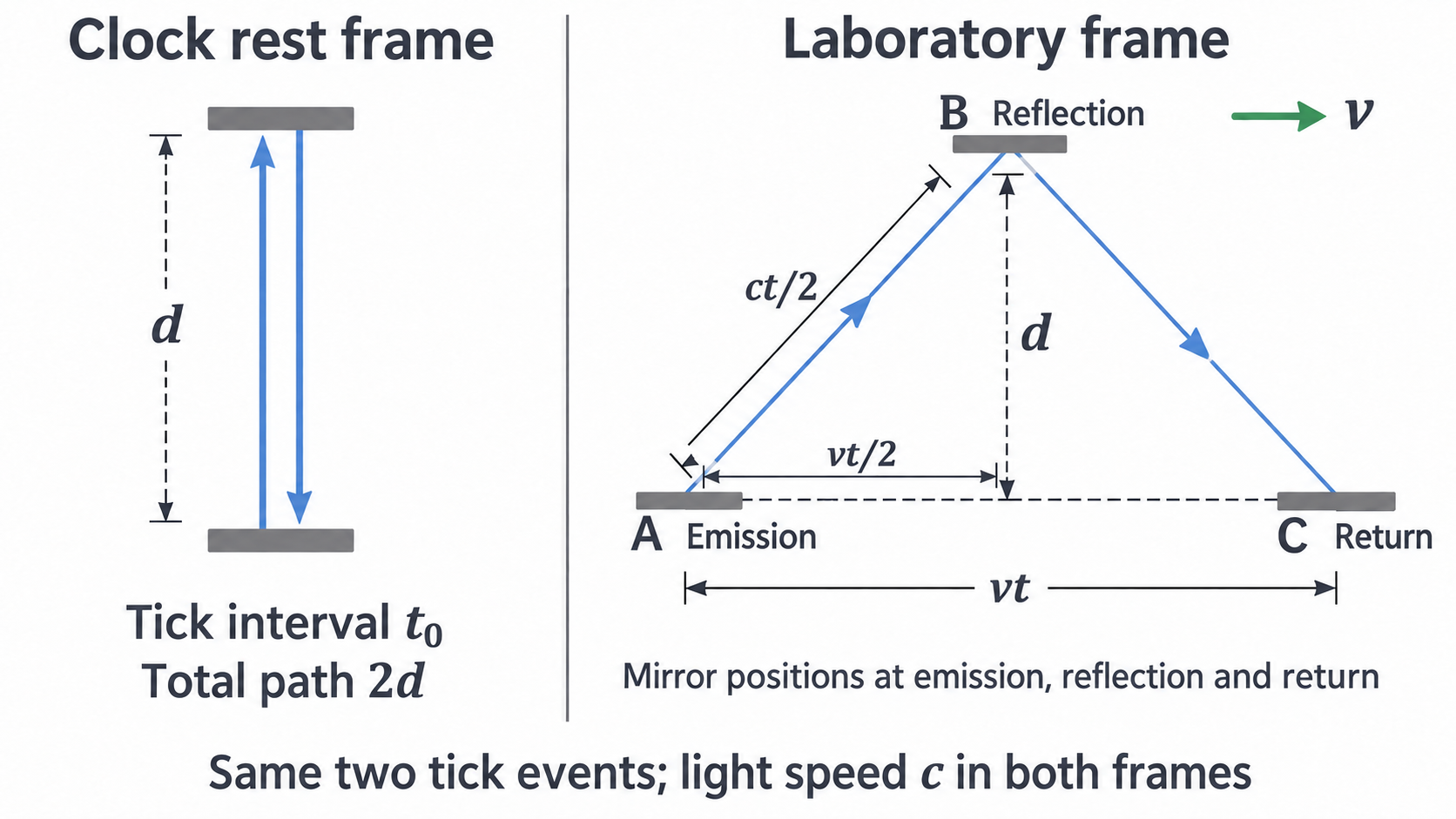
The right panel shows mirror positions at three different events, not three fixed mirrors. The two panels are schematic; their common transverse separation is .
In the clock frame, . In the laboratory frame, the lower mirror moves horizontally by during the tick. On each half-trip the pulse travels a diagonal distance , while the mirror moves . The speed of light is in both frames. Pythagoras gives
Substituting gives . Rearrangement therefore yields
Time dilation
The Lorentz factor is dimensionless. It equals 1 at , exceeds 1 for , and grows without limit as approaches . At , : the tick interval increases by about , a small but measurable effect with suitable equipment. At , : the moving clock advances by per laboratory second. A percentage increase in the interval is not the same percentage decrease in the clock rate.
Calculating intervals and journey times
Frame labels determine which way to use the equation. Multiplying a proper interval by gives the laboratory interval; dividing a laboratory interval by gives the elapsed time on the moving clock.
From ticks to relative speed
An onboard clock advances between two events, while synchronised laboratory clocks assign between those same events. Both happen at the onboard clock, so
Only a ratio of times occurs, so matching units cancel. Do not put inside that square root.
A delivery deadline travels with the cargo
Two stations at rest in one inertial frame are apart. A spacecraft coasts between them at . Ignore acceleration stages. The station-frame time is
The cargo clock records . Cargo lasting on its own clock survives because . Comparing its deadline directly with the station time would mix frames. State the numerical comparison as well as “yes”.
Continue this lesson.
You’re previewing NovaLearn without an account. Create a free account to read the rest.
Create free account