3.9.1.3 - Radio, Infrared, Ultraviolet and X-ray Telescopes
Radiation outside visible light reveals cool dust, hot gas and energetic sources that an optical view can miss. A telescope's collecting surface, detector and location must suit both the wavelength and the way that radiation interacts with matter.
Single-dish radio detection
A single-dish radio telescope uses a conducting parabolic dish to concentrate incoming radio waves onto a receiving antenna at its focus.
A distant source produces approximately parallel wavefronts across the aperture. The parabolic surface reflects waves arriving parallel to its axis towards a common focus. The receiving antenna converts the radio signal into an electrical signal, which is amplified and processed. The dish collects and focuses the radiation; it is not the detector by itself.
[DIAGRAM: asset_name: A.1.3 - Single Dish Radio Telescopes, I-R, U-V and X-ray Telescopes - Diagram 1; asset_slug: A.1.3 - Single Dish Radio Telescopes, I-R, U-V and X-ray Telescopes - Diagram 1; recommended_method: retained_png; caption: Calculated parabolic radio reflection with axial input rays focused onto the receiver.; description: Calculated parabolic radio reflection with axial input rays focused onto the receiver.]
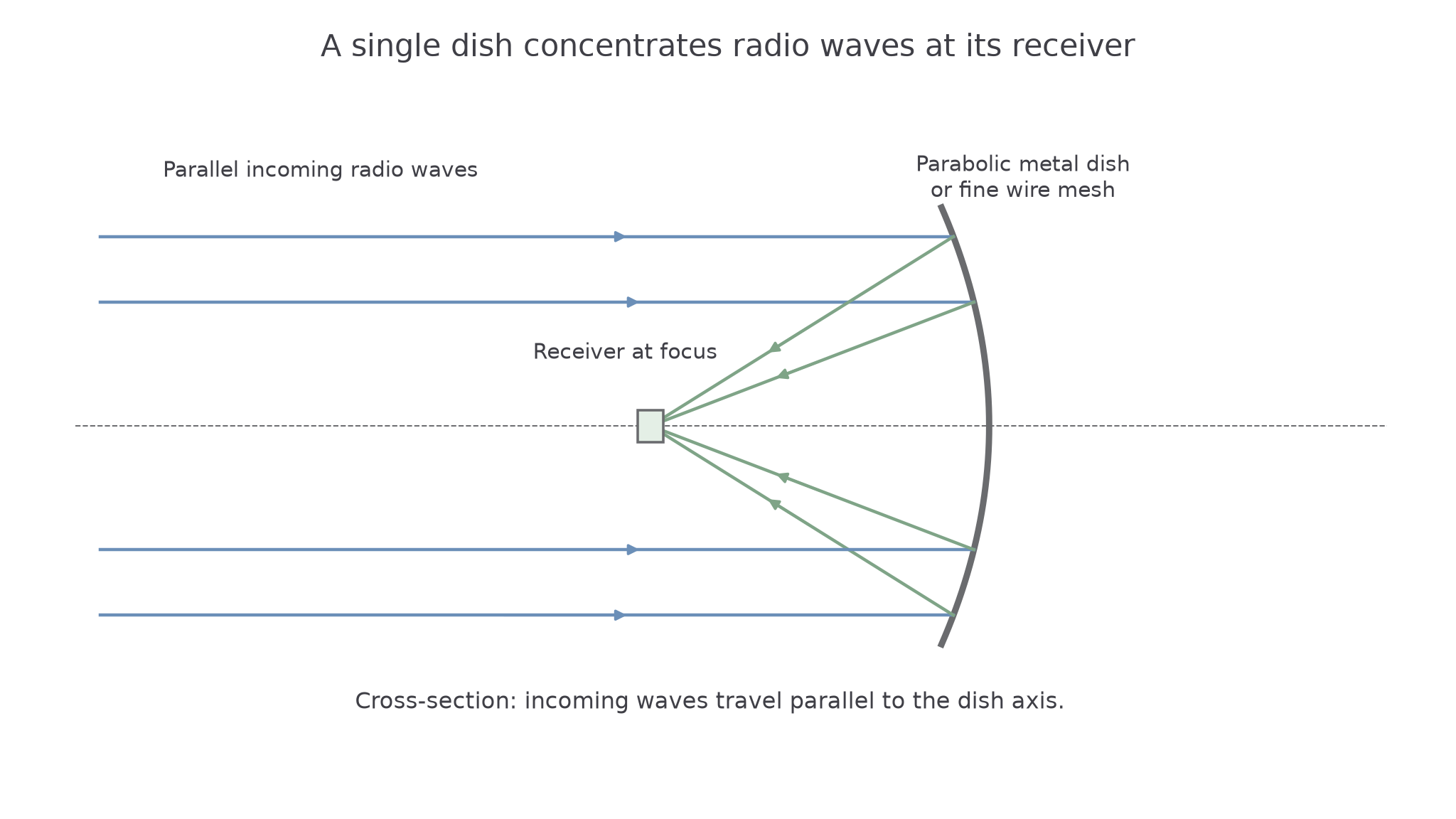
In this cross-section the incoming waves run parallel to the dish axis. Reflected waves meet at the receiver, not on an arbitrary support strut.
Many useful radio wavelengths lie within an atmospheric transmission window, so observations can be ground-based and can often continue by day or through cloud. This does not mean that every radio wavelength passes through the atmosphere or that weather never matters. Remote sites reduce radio-frequency interference from transmitters and electrical equipment, which can overwhelm weak astronomical signals.
A metal mesh may replace a continuous reflecting sheet when its openings are much smaller than the observing wavelength. Surface errors must also be small compared with that wavelength. Radio dishes can therefore use much coarser construction than visible-light mirrors. There is no single required mesh-gap number for this specification; if a design criterion is supplied, apply that criterion.
The telescope can scan different directions and map received intensity against direction to build an image. A receiver is not a human eye and need not form a simultaneous visible picture. Radio observations reveal sources such as pulsars, radio galaxies and interstellar hydrogen; they complement rather than reproduce a visible-light view.
Collecting area and radio resolution
A large dish can collect a strong signal while still failing to separate nearby sources, because collecting power and resolving power depend differently on wavelength and diameter.
For circular apertures, collecting power is proportional to area, hence . A larger area intercepts more incident power for the same incident intensity and efficiency. A comparison across different wavelength bands is a comparison of collecting areas, not proof that the source emits equally strongly or that the detectors have the same efficiency.
The approximate diffraction limit is
where is in radians. A smaller minimum angle means better resolving power. Radio wavelengths are enormously longer than optical wavelengths, so even a much larger dish can have a larger minimum angle.
For example, an dish at has . A optical mirror at has . The radio minimum angle is 4000 times larger, although its geometrical collecting area is times larger.
| Feature | Single-dish radio telescope | Optical telescope |
|---|---|---|
| Focusing | Conducting parabolic dish or sufficiently fine mesh | Lens or accurately polished mirror |
| Detection | Receiving antenna and electronics; scanning can map intensity | Eye or imaging detector at a suitable focus |
| Location | Radio-quiet site for a transmitted band | Dark site with low cloud and turbulence; often high and dry |
| Same-diameter comparison | Similar geometrical collecting area; much larger diffraction angle | Much smaller diffraction angle because wavelength is shorter |
Arrays can combine signals from separated dishes to improve angular resolution using their separation as a baseline. Their collecting area is the sum of the effective dish areas, not the area of a filled circle as wide as the baseline. Detailed interferometry is outside this single-dish lesson.
Infrared: absorption and thermal background
An infrared telescope must both receive the wanted radiation and suppress infrared radiation emitted by its own equipment and surroundings.
Reflecting optics focus infrared onto a suitable detector. Relatively cool objects, including dust and planets, emit strongly in infrared compared with visible light. Infrared can also reveal stars obscured by dust at visible wavelengths; which structures become visible depends on wavelength.
Continue this lesson.
You’re previewing NovaLearn without an account. Create a free account to read the rest.
Create free account