3.5.1.2 - Current-Voltage Characteristics
A characteristic graph shows the operating current and pd of a component. Read the axes before interpreting resistance, then connect each curve to temperature, direction of conduction and how the measurements are made.
Ohm’s law and constant resistance
An ohmic conductor has current directly proportional to pd while its physical conditions, particularly temperature, remain constant. Doubling pd then doubles current and stays constant. This conditional proportionality is Ohm’s law.
alone is the definition of resistance at an operating point. It can be used for a lamp or diode at that point even though neither has one constant resistance across its whole characteristic.
[DIAGRAM: asset_name: 5.1.2 - Current–Voltage Characteristics - Diagram 1; asset_slug: 5.1.2 - Current–Voltage Characteristics - Diagram 1; caption: The same illustrative 10 ohm resistor plotted with either current or pd vertical. Both lines pass through the origin. Their gradients are reciprocals.; description: The same illustrative 10 ohm resistor plotted with either current or pd vertical. Both lines pass through the origin. Their gradients are reciprocals.]
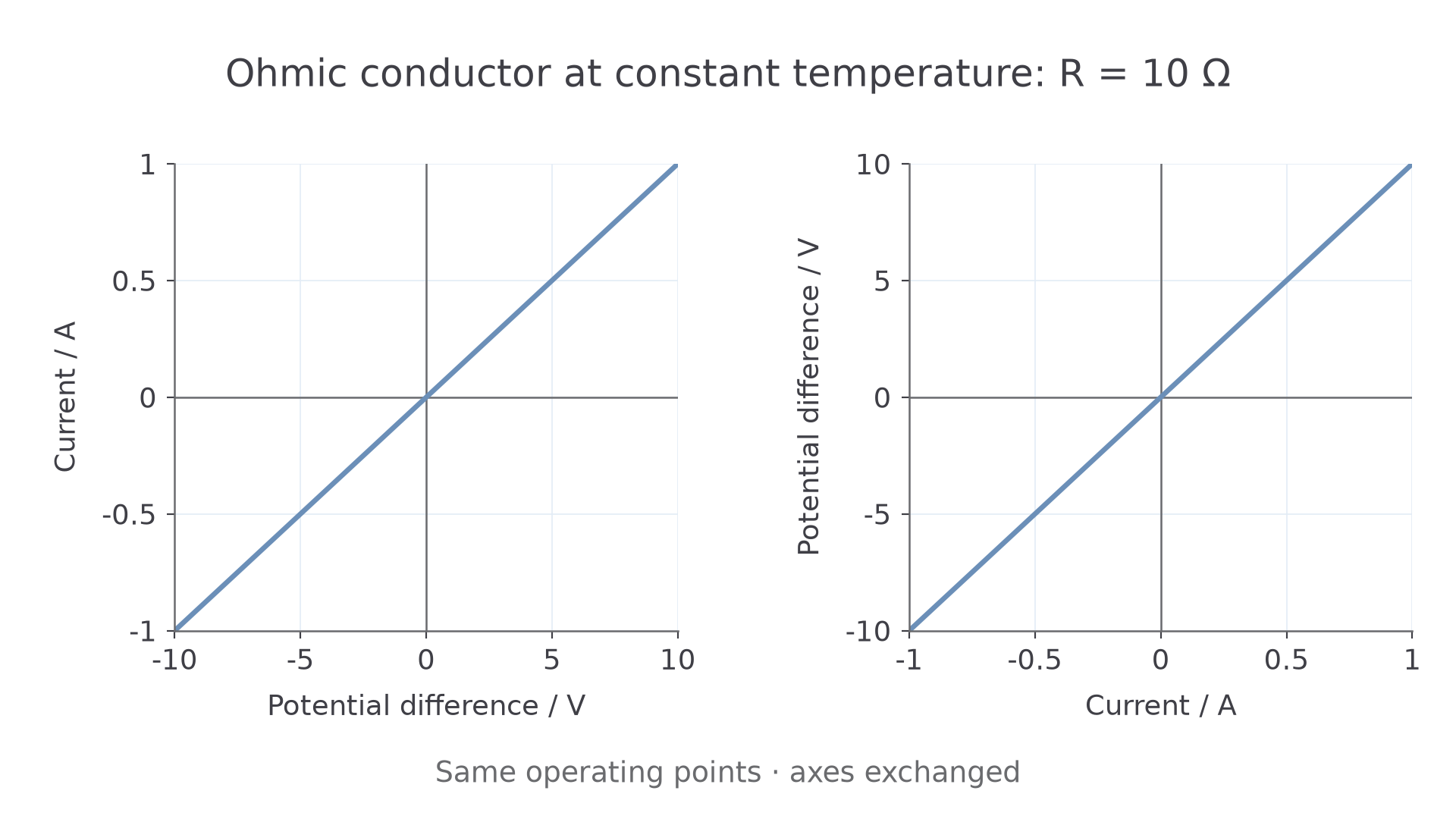
On an -against- graph the gradient is , in . On a -against- graph it is , in . A straight line that misses the origin does not show direct proportionality.
For example, an -against- gradient of gives , not .
Why a filament lamp’s characteristic curves
A filament lamp heats itself as electrical energy is transferred to its filament. The hotter metal lattice vibrates more strongly and scatters conduction electrons more frequently. Its resistance therefore increases as the magnitude of its operating current increases.
[DIAGRAM: asset_name: 5.1.2 - Current–Voltage Characteristics - Diagram 2; asset_slug: 5.1.2 - Current–Voltage Characteristics - Diagram 2; caption: Illustrative filament characteristic on both axis orientations: current rises more slowly with pd as the filament heats. The reversed-polarity behaviour is symmetric about the origin.; description: Illustrative filament characteristic on both axis orientations: current rises more slowly with pd as the filament heats. The reversed-polarity behaviour is symmetric about the origin.]
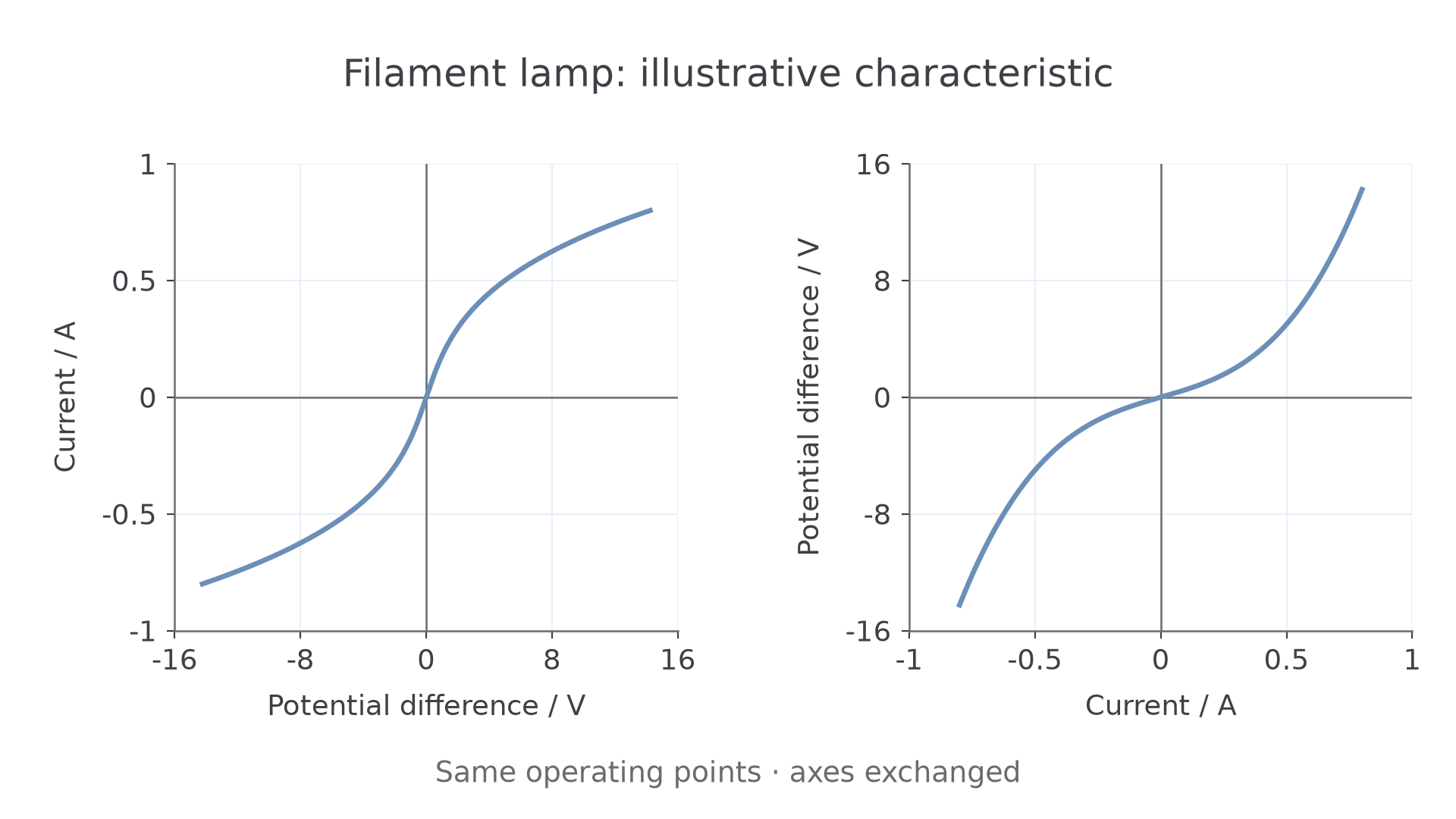
With current vertical, the curve becomes less steep at larger . With pd vertical, it becomes steeper at larger . Reversing both current and pd gives the same heating behaviour, so the curve has rotational symmetry about the origin. It is not a mirror image across just one axis.
At and , the resistance is . At and , it is . Current increases, but less than in proportion to pd. The cold filament has a lower resistance than the operating filament, which explains its initially larger current when switched on at a fixed voltage.
A diode responds differently to polarity
A semiconductor diode conducts much more readily in its forward direction than in reverse. Forward bias connects its anode to the more positive potential and its cathode to the more negative potential. The cathode is the bar end of the circuit symbol. Reversing those connections gives reverse bias.
[DIAGRAM: asset_name: 5.1.2 - Current–Voltage Characteristics - Diagram 3; asset_slug: 5.1.2 - Current–Voltage Characteristics - Diagram 3; caption: Illustrative silicon-diode characteristic: forward current rises steeply around the knee. Reverse current is tiny on this scale. This is not a fixed threshold or a breakdown graph.; description: Illustrative silicon-diode characteristic: forward current rises steeply around the knee. Reverse current is tiny on this scale. This is not a fixed threshold or a breakdown graph.]
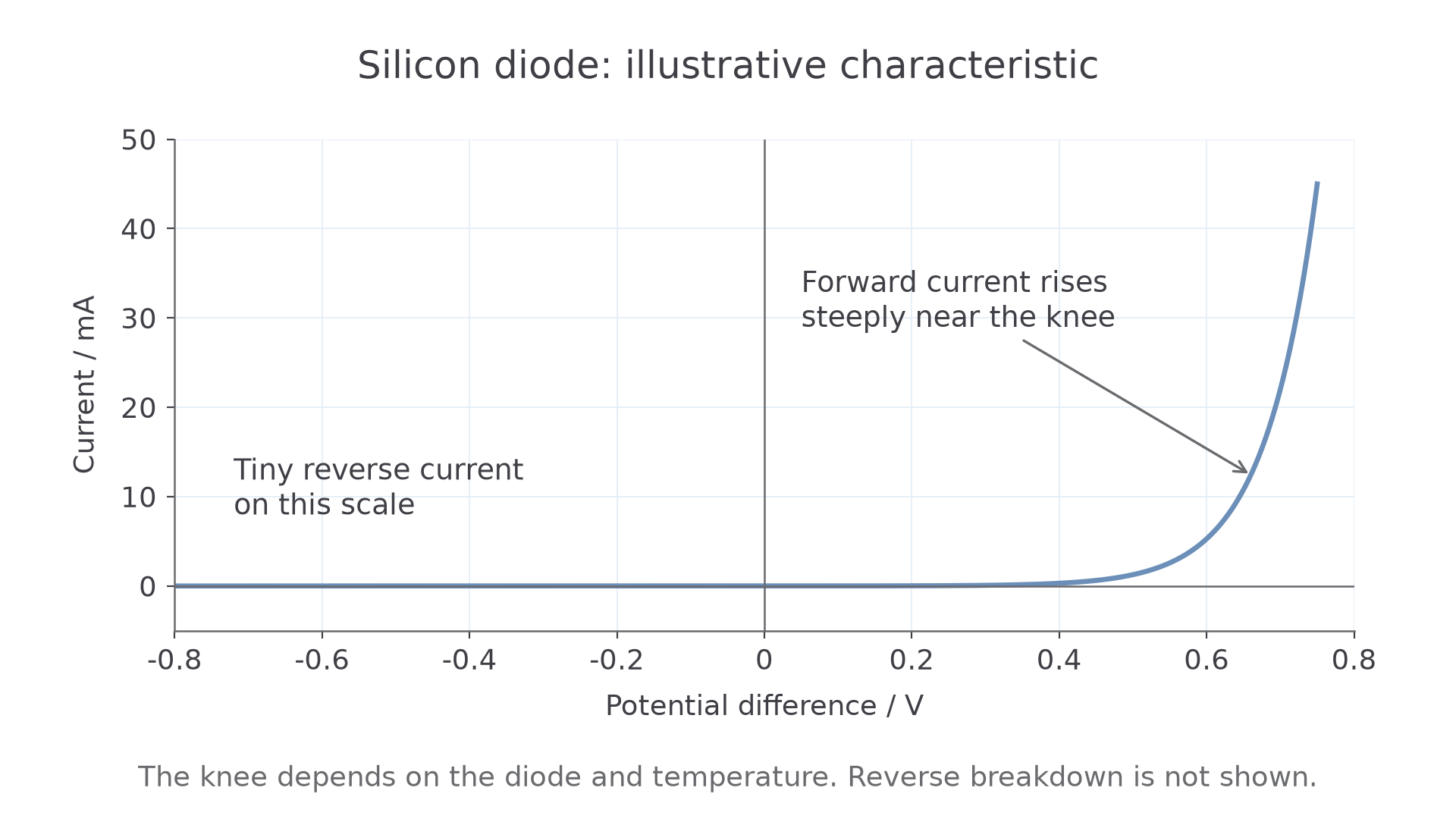
For a silicon diode, appreciable forward current often occurs around –, depending on the diode, current and temperature. This knee is not an exact switch at one universal voltage: small forward currents occur below it. At higher forward current, a small extra pd can cause a large increase in current. A series resistor limits the current.
Reverse current is very small over the normal range considered here. The diode is not ohmic: changes with operating point and depends strongly on polarity. For instance, at means at that point; it does not mean a diode behaves as a resistor at all pds.
Reading a curved characteristic correctly
Resistance at a point on a curved graph comes from the coordinates, not generally the tangent. Read the current and pd belonging to the same point, convert the units, then calculate .
On a -against- graph, a line drawn from the origin to the operating point has gradient . A tangent there measures the small-change ratio , which is generally different. On an -against- graph, the origin-to-point gradient is , so take its reciprocal to obtain resistance. The tangent measures .
Comparing components
An ohmic line passes through the origin with constant gradient. A heated filament has a symmetric curved characteristic, with resistance increasing at larger operating magnitudes. A diode has a strongly asymmetric characteristic. These physical statements survive swapping the axes; “the curve becomes shallower” does not survive without naming the axes.
Two lamp points have and . Their resistances are and . The chord between the two points has gradient , which is neither of those resistances.
Measuring a characteristic with ideal meters
An ideal ammeter has zero resistance and an ideal voltmeter has infinite resistance. Treat meters as ideal unless the question states otherwise. A series ammeter therefore adds no pd drop, while a parallel voltmeter draws no current.
[DIAGRAM: asset_name: 5.1.2 - Current–Voltage Characteristics - Diagram 4; asset_slug: 5.1.2 - Current–Voltage Characteristics - Diagram 4; caption: A complete measuring circuit: series ammeter and variable resistor, with the voltmeter across only the test component.; description: A complete measuring circuit: series ammeter and variable resistor, with the voltmeter across only the test component.]
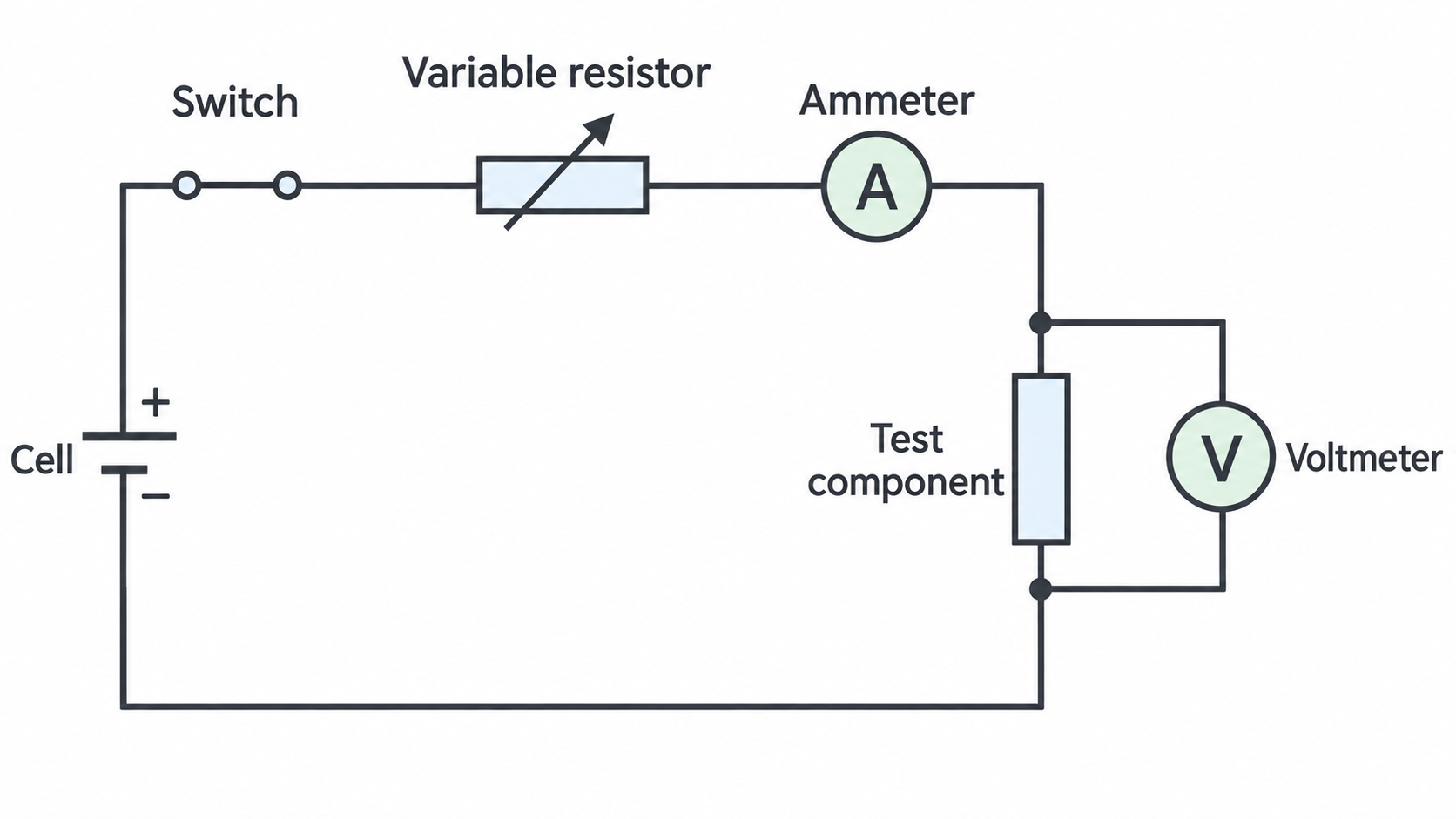
Vary the supply or series resistance and record paired current and component-pd readings across a useful range. For negative values, reverse the supply polarity and meter connections appropriately, or use signed meters; keep one defined positive direction in the table. A resistor intended to remain ohmic needs low heating and time to cool. A lamp’s characteristic instead records steady operating values after its temperature settles. Limit forward diode current and remain within component ratings.
With a finite-resistance voltmeter in the illustrated arrangement, the ammeter reads . Using then underestimates the component resistance. This is negligible when the voltmeter resistance is much greater than the component resistance. A non-ideal series ammeter changes the operating current, although the simultaneous measured component can still be used when the relevant current is measured correctly.