3.10.6.5 - Use of Radioactive Implants
A beta-emitting source placed in or beside a small tumour can concentrate dose near the target. Relate source position, beta range and treatment duration, while keeping this AQA model distinct from the wider range of clinical implants.
Delivering radiation from beside the target
A radioactive implant is a source placed inside or immediately next to the tissue being treated. In the beta-emitting implant model required here, a source delivers radiation locally rather than sending a beam through a long entrance path from outside the body.
Beta-minus radiation consists of electrons emitted in nuclear beta decay. These electrons lose kinetic energy as they ionise and excite matter. Ionisation can damage DNA and stop cells dividing. It acts on healthy as well as tumour cells, so accurate placement is essential.
[DIAGRAM: asset_name: B.6.5 - Use of Radioactive Implants - Diagram 1; asset_slug: B.6.5 - Use of Radioactive Implants - Diagram 1; caption: An implant gives a high local dose with lower dose farther from the source; description: An implant gives a high local dose with lower dose farther from the source.]
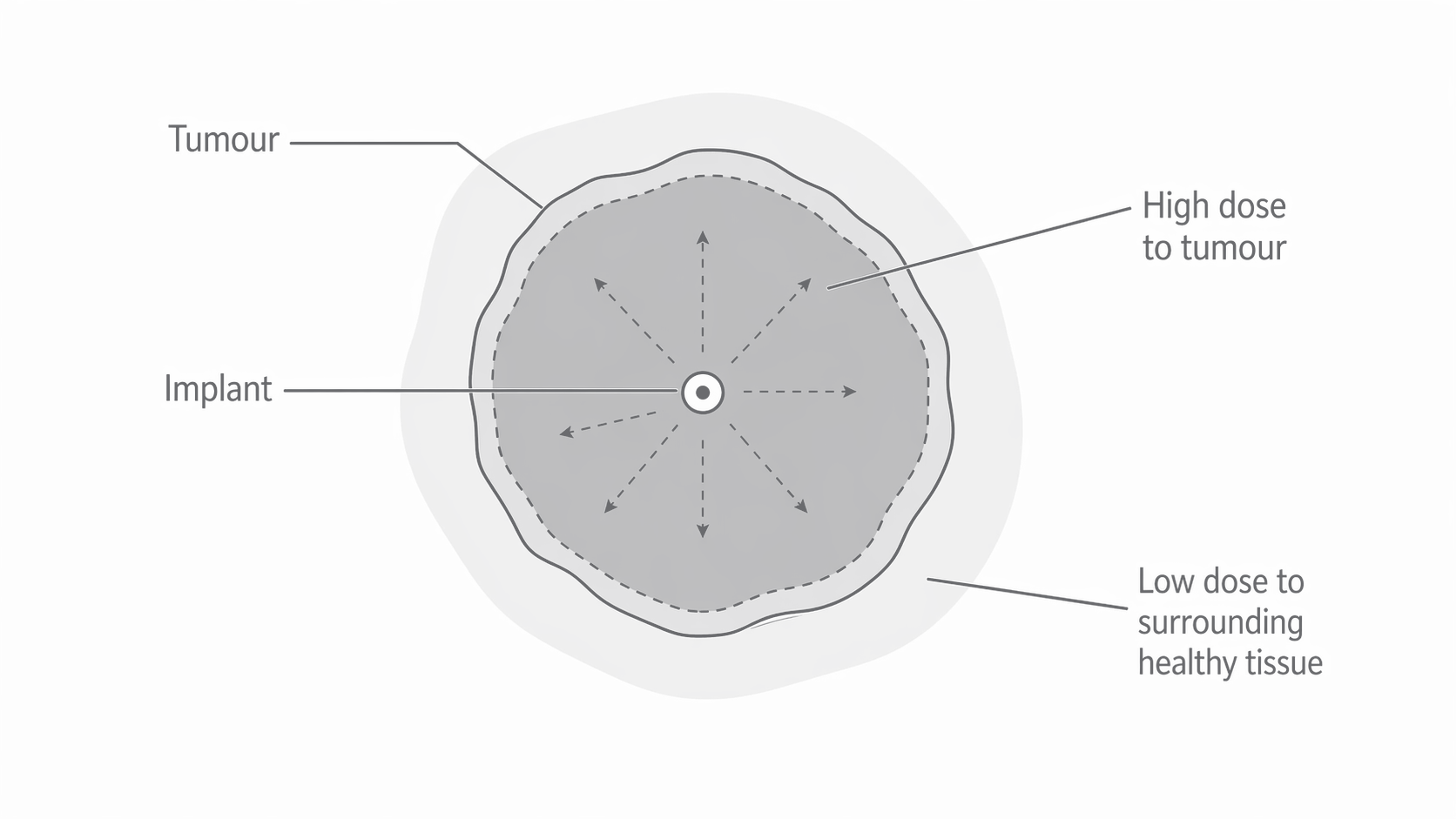
The shading is qualitative: there is no sharp dose boundary exactly at the tumour edge and dose is not uniform throughout the tumour. Tissue close to the source receives a large dose; more distant tissue receives less as radiation spreads and beta particles lose their energy. An implant must be designed and positioned so that the intended tumour volume is covered. Nearby healthy tissue can still be damaged.
Range, localisation and limits of the model
Beta particles have a finite range in tissue, depending on their energy and the tissue. Typical therapeutic beta ranges can be of millimetre order, not one universal distance. They can therefore treat a small volume around a source while limiting irradiation much farther away.
Compared with a source of alpha particles, a suitably energetic beta source reaches a larger nearby volume: alpha particles have a much shorter tissue range. Compared with penetrating gamma photons, beta particles deposit their energy over a more local region. This is a useful choice when the required treatment volume fits the beta range. It does not prove beta is always the best radiation type for every tumour.
An external photon beam can reach a deep tumour without inserting a source, but it irradiates healthy tissue on entrance and exit paths. An implant avoids that long external path but needs access and accurate placement; a beta source's limited range can leave a large target insufficiently treated.
Continue this lesson.
You’re previewing NovaLearn without an account. Create a free account to read the rest.
Create free account