3.12.2.2 - Young's double-slit evidence
Young’s experiment turned the debate about light into a question about a surprising observation: adding light from a second slit can produce darkness. Follow the superposition argument and distinguish persuasive evidence from immediate acceptance.
What the models must explain
Newton's corpuscular model and Huygens' wave model both described familiar ray behaviour. A useful experiment therefore had to produce an observation that the models did not explain equally well. Refraction offered opposite predictions about speed in water, but those speeds were difficult to compare.
A simple corpuscular picture treats the two slit contributions as independent streams whose illumination adds. Opening a second slit should add light wherever its particles arrive. The wave model allows something different: two disturbances at a point can reinforce or cancel. Young's experiment tested this contrast without having to measure light's enormous speed.
The conclusion concerns Newton's simple corpuscular picture. It does not rule out the later photon description: modern photons also exhibit interference. Calling Young's experiment proof that light can never have particle properties confuses two different historical models.
How the fringes form
Light from one source illuminates two narrow, closely spaced slits. Each slit diffracts the light, so the emerging waves spread and overlap on a distant screen. Using the same incident light makes the slit sources coherent: they have the same frequency and a constant phase difference. Two independent lamps usually have rapidly changing relative phase, so any fringes average out instead of forming a steady pattern.
At the centre of a symmetric arrangement, the waves travel equal distances from the slits. For slit sources in phase, they arrive in phase and reinforce, producing the central bright fringe. At other positions, the distances travelled differ. This path difference determines whether crests arrive with crests or with troughs.
[DIAGRAM: asset_name: D.2.2 - Significance of Young's Double Slits Experiment - Diagram 1; asset_slug: D.2.2 - Significance of Young's Double Slits Experiment - Diagram 1; caption: Coherent slit waves reinforce at bright fringes and cancel at dark fringes; description: Scientific teaching diagram with geometry and labels checked against the owning explanation.]
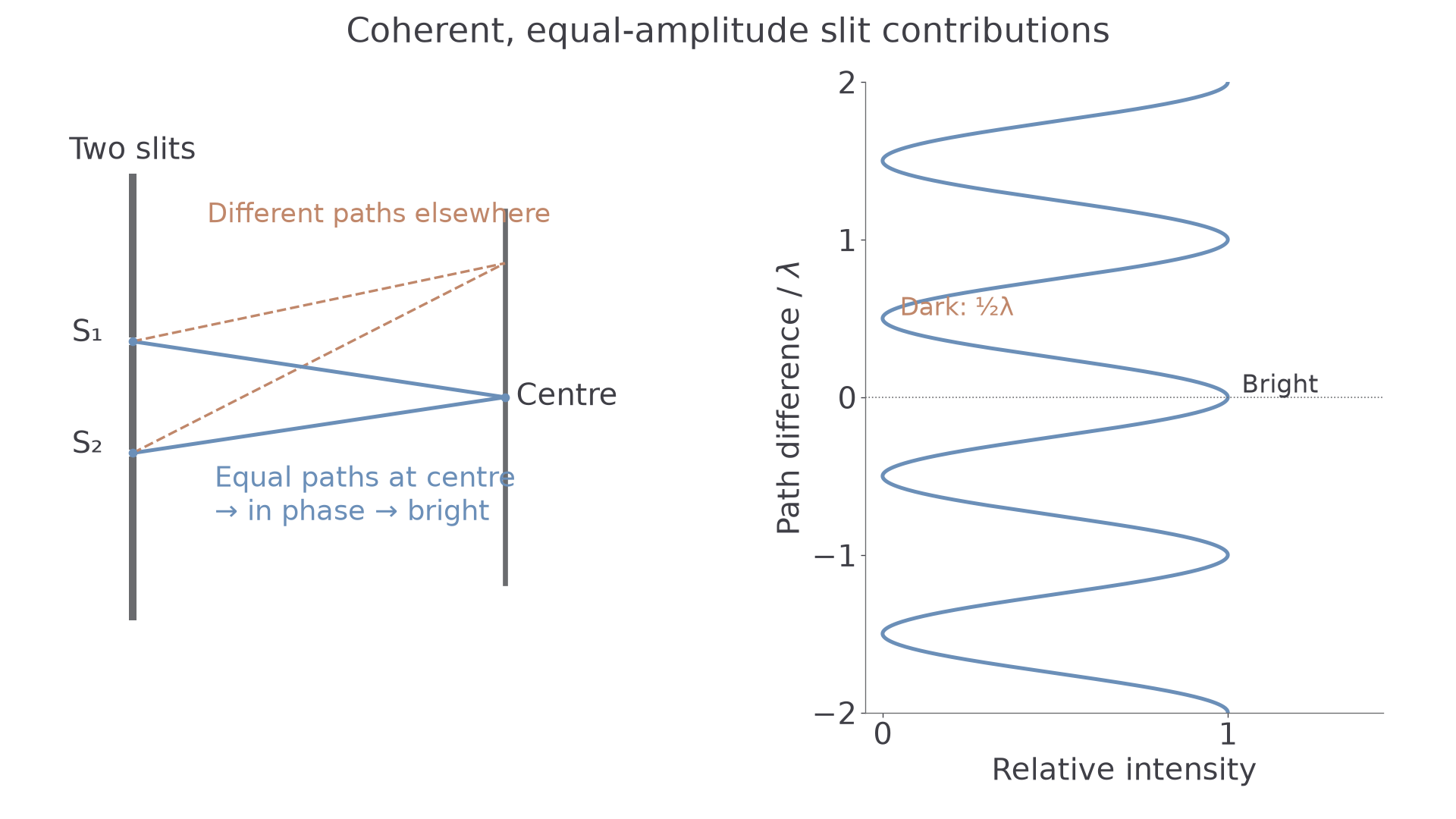
At a bright fringe, the path difference is a whole number of wavelengths: the waves arrive in phase and their amplitudes add by constructive interference. At a dark fringe, the path difference is an odd multiple of half a wavelength: the waves arrive in antiphase and cancel by destructive interference. Complete cancellation assumes equal amplitudes. Energy is redistributed into the bright regions, not destroyed at the dark ones.
Continue this lesson.
You’re previewing NovaLearn without an account. Create a free account to read the rest.
Create free account