3.13.6.3 - Time-Division Multiplexing
Time-division multiplexing lets several information streams share one link by taking turns. Follow the slots through a frame, explain how timing preserves their identities, and calculate how the finite capacity is shared.
Sharing a channel in time
Several conversations can share one optical fibre without their data becoming inseparable. Multiplexing combines streams for transmission over a shared channel. In time-division multiplexing (TDM) each stream uses the channel during an allocated interval, then another takes its turn.
In the simple fixed-slot system studied here, the allocation repeats. Only one stream occupies a given data slot; several streams appear to be carried simultaneously to their users because the switching is rapid and data can be buffered and reassembled. TDM organises existing capacity; it does not create bandwidth or increase the speed at which the wave travels.
Frames and reconstruction
The multiplexer selects successive inputs and places a short piece of each on the output. A frame is one complete repeating cycle of slots. For four inputs, a simple sequence is , then : the letter identifies the source and the subscript identifies its next piece, not the binary value being transmitted.
[DIAGRAM: asset_name: E.6.3 - Time-Division Multiplexing - Diagram 1; asset_slug: E.6.3 - Time-Division Multiplexing - Diagram 1; caption: Four inputs interleaved into two successive TDM frames; description: Four inputs interleaved into two successive TDM frames]
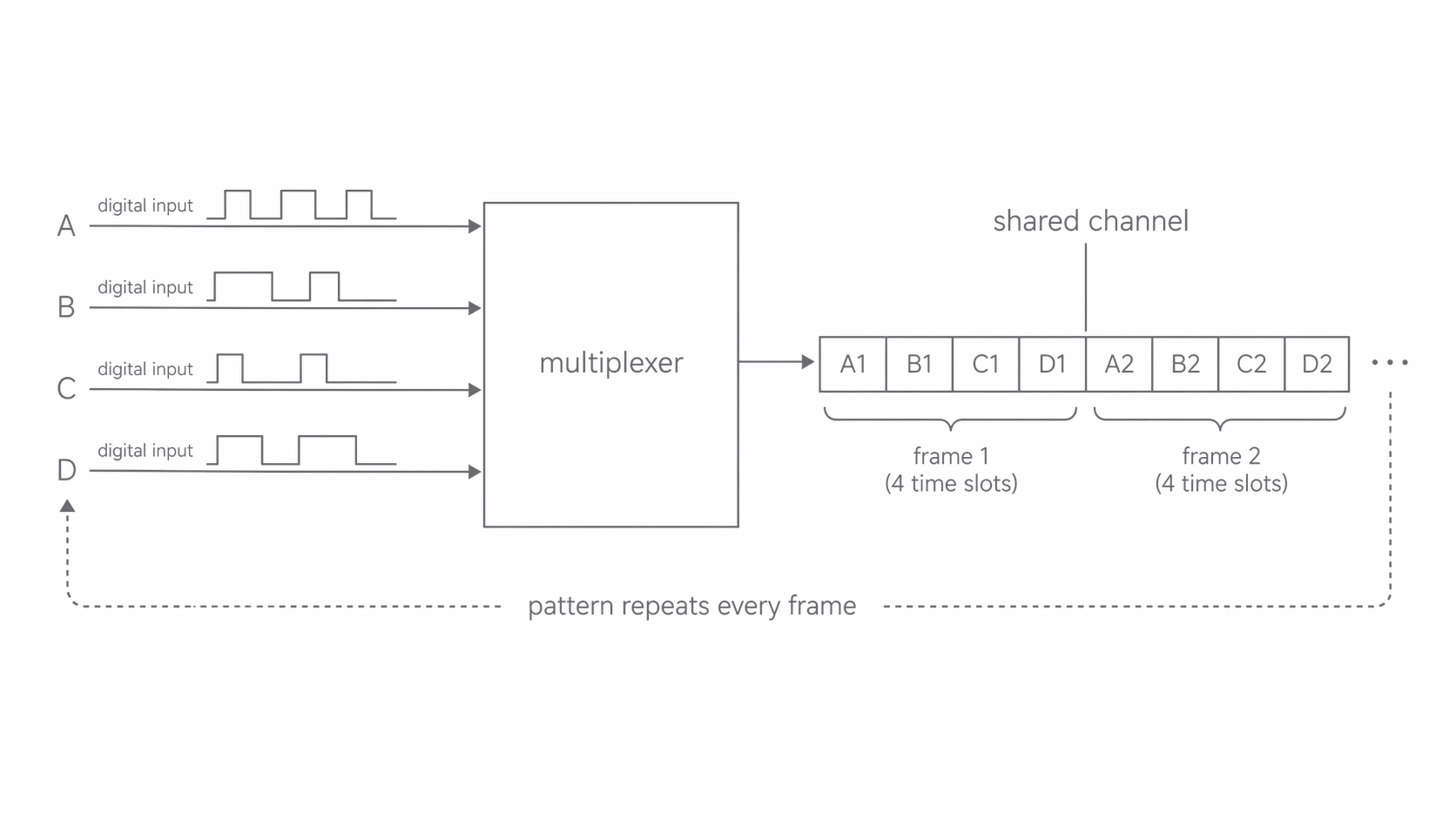
At the far end, the demultiplexer routes the first input's slots to output A, the second's to B, and so on. Receiver electronics then rebuild each stream in order. The dashed loop in the schematic means that the allocation repeats; it is not a physical feedback wire. Real frames can also contain synchronisation or control information, so a frame need not consist only of the user-data slots.
Continue this lesson.
You’re previewing NovaLearn without an account. Create a free account to read the rest.
Create free account