3.9.3.1 - Doppler Effect
A shifted spectral line measures motion along the line of sight. Use optical and radio lines to calculate that motion, then explain the changing spectra of binary stars and distinguish small Doppler shifts from cosmological redshift.
What changes when a source moves
A source approaching an observer emits successive wavefronts from progressively nearer positions, so they arrive closer together in time. The observed frequency rises and the wavelength falls. Recession reverses those changes.
Doppler effect
The Doppler effect is a change in observed frequency or wavelength caused by relative motion between the source and observer. Radial velocity is the component of relative velocity along their line of sight.
Astronomers first identify a recognisable pattern of spectral lines, then compare each observed line with its rest wavelength or rest frequency, measured in a laboratory. A shorter wavelength is a blueshift; a longer wavelength is a redshift. These names also apply to radio waves: the radiation need not be visible or actually blue or red.
For light in vacuum, . The speed does not change when a source approaches. Instead, increases while decreases. At the small speeds considered here, transverse motion produces no first-order Doppler shift: a large sideways speed can therefore have a very small measured radial velocity.
An optical hydrogen line and the radio line of neutral hydrogen probe the same type of motion. Radio observations are useful for gas that does not emit much visible light, but the comparison must still be with the correct laboratory line.
Equations and sign convention
A sign convention is a definition, not a physical disagreement. Here means motion towards the observer, as in the AQA frequency equation. Define changes as observed minus rest:
Small-speed Doppler shift
The definition of is exact. The velocity relations are approximations for small shifts. Use the rest value in each denominator. Frequency and wavelength shifts have opposite signs because .
| Motion | Signed | and | |
|---|---|---|---|
| Towards observer | Positive | Positive | Negative |
| Away from observer | Negative | Negative | Positive |
[DIAGRAM: asset_name: A.3.1 - Doppler Effect - Diagram 2; asset_slug: A.3.1 - Doppler Effect - Diagram 2; caption: A small blueshift and redshift around a 600.0 nm rest line; description: Numerical wavelength axis with a rest line at 600.0 nm, approaching line at 599.8 nm and receding line at 600.2 nm.]
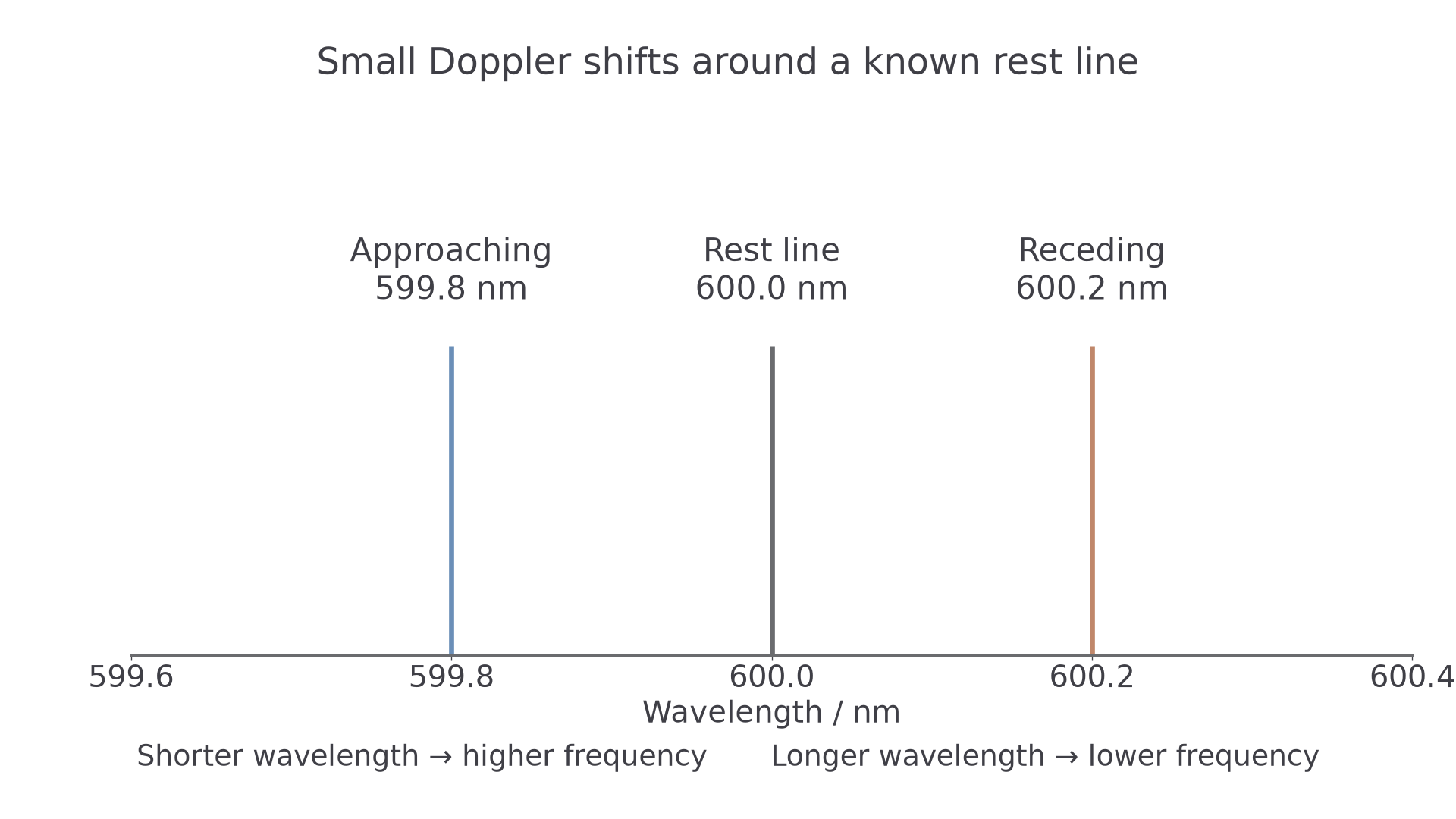
For example, an optical line shifts from to . Then , so : recession. Nanometres cancel in the ratio. The result is only , consistent with the approximation. A speed answer is the positive magnitude together with its direction.
Binary stars viewed in the plane of orbit
Two binary stars orbit their common centre of mass. A spectroscopic binary is recognised from periodic changes in spectral lines even when the stars cannot be resolved in an image. If both spectra are visible, the two line systems move in opposite directions about their mean positions.
Continue this lesson.
You’re previewing NovaLearn without an account. Create a free account to read the rest.
Create free account