3.12.1.4 - Millikan's Oil-Drop Experiment
A falling oil drop reveals its mass through viscous drag. Balancing that same drop with an electric field then reveals its charge. Repeating the measurement tests whether charge varies continuously or comes in discrete units.
The apparatus and measurement sequence
Millikan's apparatus lets a single tiny charged oil droplet be followed between horizontal parallel plates. An atomiser sprays drops through a hole in the upper plate. Side illumination makes them visible through a microscope, whose calibrated graticule provides known distances. A variable supply sets the potential difference across the measured plate separation .
[DIAGRAM: asset_name: D.1.4 - Principle of Millikan's Determination of the Electronic Charge, e - Diagram 1; asset_slug: D.1.4 - Principle of Millikan's Determination of the Electronic Charge, e - Diagram 1; caption: A negative oil drop between oppositely charged plates; description: Top plate connects to positive terminal and bottom plate to negative terminal. The electric field is downward; the electric force on the negative drop is upward. This apparatus view is not a complete force diagram.]
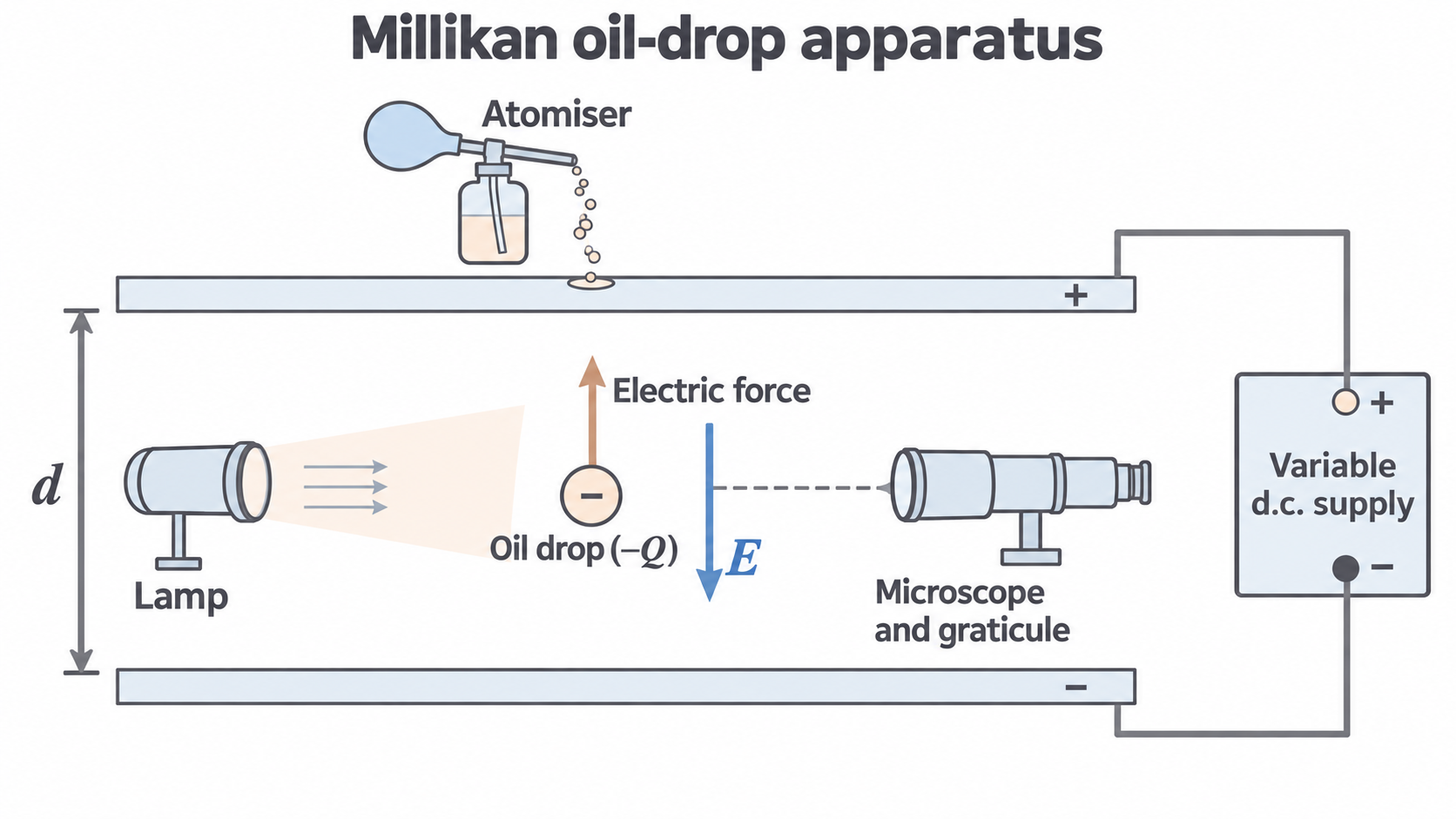
Choose one drop and keep track of it through both stages. With the field off, time its fall over a known graticule distance after it reaches constant speed. With the field on, adjust until that same drop is stationary. The first stage determines its radius and mass; the second determines its charge. Averaging results from unrelated drops would be invalid because their masses and charges differ.
Use oil of known density and air of known viscosity. A stable temperature keeps viscosity approximately constant; slow evaporation helps the drop keep the same radius. The model used below treats the drop as spherical, the air as still, the flow as slow enough for Stokes' law, and air buoyancy as negligible compared with weight. The drop is not in vacuum: viscous drag is essential to the measurement.
Finding mass from terminal speed
With the field off, a falling drop experiences weight downwards and viscous drag upwards. Drag increases with speed, until the forces balance. At terminal speed the drop still moves, but its acceleration and resultant force are zero.
Stokes' law
Here is dynamic viscosity in , is drop radius and is speed relative to the air. Drag opposes the relative motion. The law applies to a small sphere in slow, laminar flow.
[DIAGRAM: asset_name: D.1.4 - Principle of Millikan's Determination of the Electronic Charge, e - Diagram 2; asset_slug: D.1.4 - Principle of Millikan's Determination of the Electronic Charge, e - Diagram 2; caption: Equal drag and weight at downward terminal speed; description: Equal upward drag and downward weight for field-off terminal motion. Air buoyancy is neglected.]
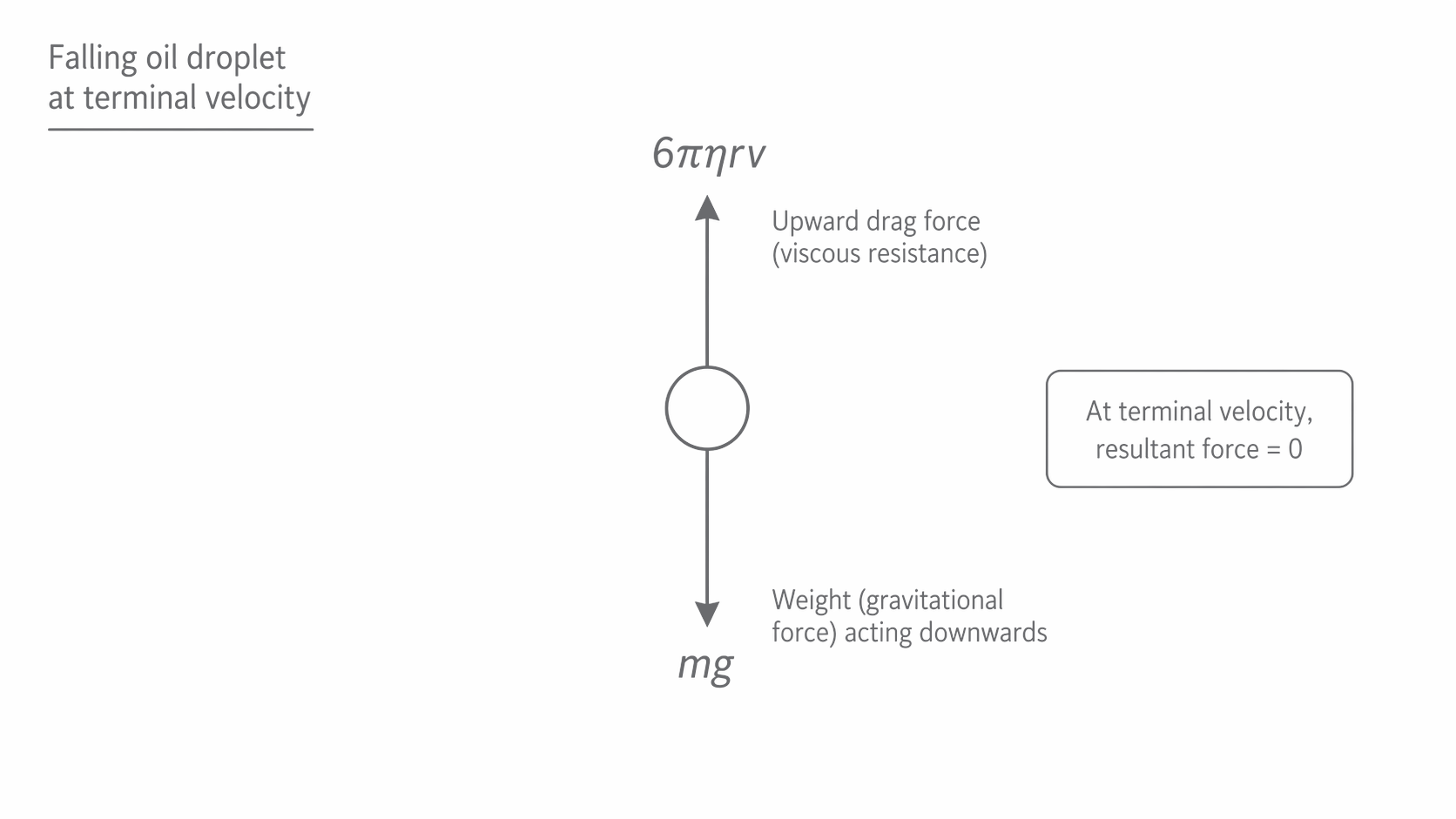
Measure terminal speed as . Similar times for successive equal distances give evidence that the speed is constant. Longer timed distances reduce the percentage effect of a fixed timing uncertainty; repeat suitable timings of the same drop to estimate random variation. Do not assume repeated timing removes graticule calibration error.
Using oil density , the spherical drop's mass is . Combine this with the field-off force balance:
Cancel and rearrange:
The square root matters: has units of area. If buoyancy is included, the radius equation contains in place of ; do not include that correction in one force balance and omit it in another without justification.
Holding the drop stationary
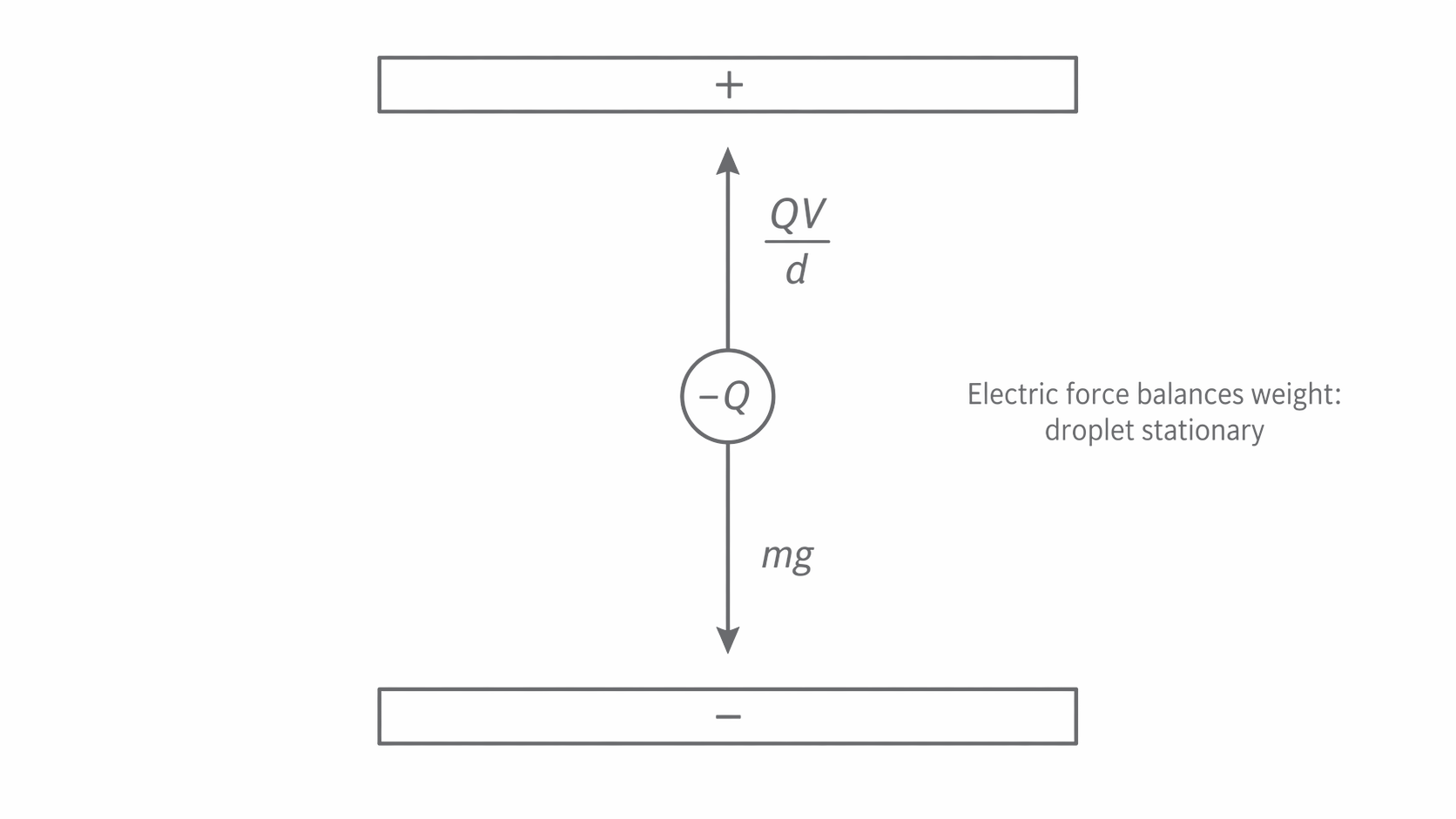
For a negative drop, make the upper plate positive and the lower plate negative. The field points downwards, so the electric force on the drop acts upwards. Write the actual charge as , where is its positive magnitude.
A stationary drop has no motion relative to still air, so its Stokes drag is zero. Neglecting buoyancy, only electric force and weight balance:
Stationary drop
[DIAGRAM: asset_name: D.1.4 - Principle of Millikan's Determination of the Electronic Charge, e - Diagram 3; asset_slug: D.1.4 - Principle of Millikan's Determination of the Electronic Charge, e - Diagram 3; caption: Electric force balances weight for a stationary negative drop; description: The drop has signed charge -Q, with Q positive. Equal opposite forces QV/d upward and mg downward, and no drag in still air. Air buoyancy is neglected.]
Continue this lesson.
You’re previewing NovaLearn without an account. Create a free account to read the rest.
Create free account