3.12.2.4 - The discovery of photoelectricity
Black-body radiation challenged continuous energy exchange, and photoelectric observations challenged a purely classical wave account of light. Separate Planck’s quantised oscillators from Einstein’s light quanta, then use energy conservation to test the photon explanation.
The ultraviolet catastrophe
A black body is an ideal absorber of all incident electromagnetic radiation. At a fixed temperature its emitted thermal spectrum depends on temperature, not the material. A cavity with a small hole approximates a black body because incident radiation undergoes repeated absorption inside it.
Measurements give a continuous spectrum with a finite peak. Intensity is very small at sufficiently short wavelengths, rises to a maximum, then decreases at long wavelengths. Increasing temperature increases the emitted intensity and shifts the peak to shorter wavelength. Here the important comparison is between theory and experiment at the same temperature.
The classical Rayleigh–Jeans prediction agrees with the measured spectrum in the long-wavelength limit. At short wavelengths it predicts that spectral intensity increases without bound as wavelength tends to zero. Integrating that prediction would give an infinite energy output at any nonzero temperature. Experiments instead show a finite spectrum with negligible short-wavelength intensity. This disagreement is the ultraviolet catastrophe.
[DIAGRAM: asset_name: D.2.4 - The Discovery of Photoelectricity - Diagram 1; asset_slug: D.2.4 - The Discovery of Photoelectricity - Diagram 1; caption: At a fixed temperature the classical prediction diverges at short wavelength; description: Scientific teaching diagram with geometry and labels checked against the owning explanation.]
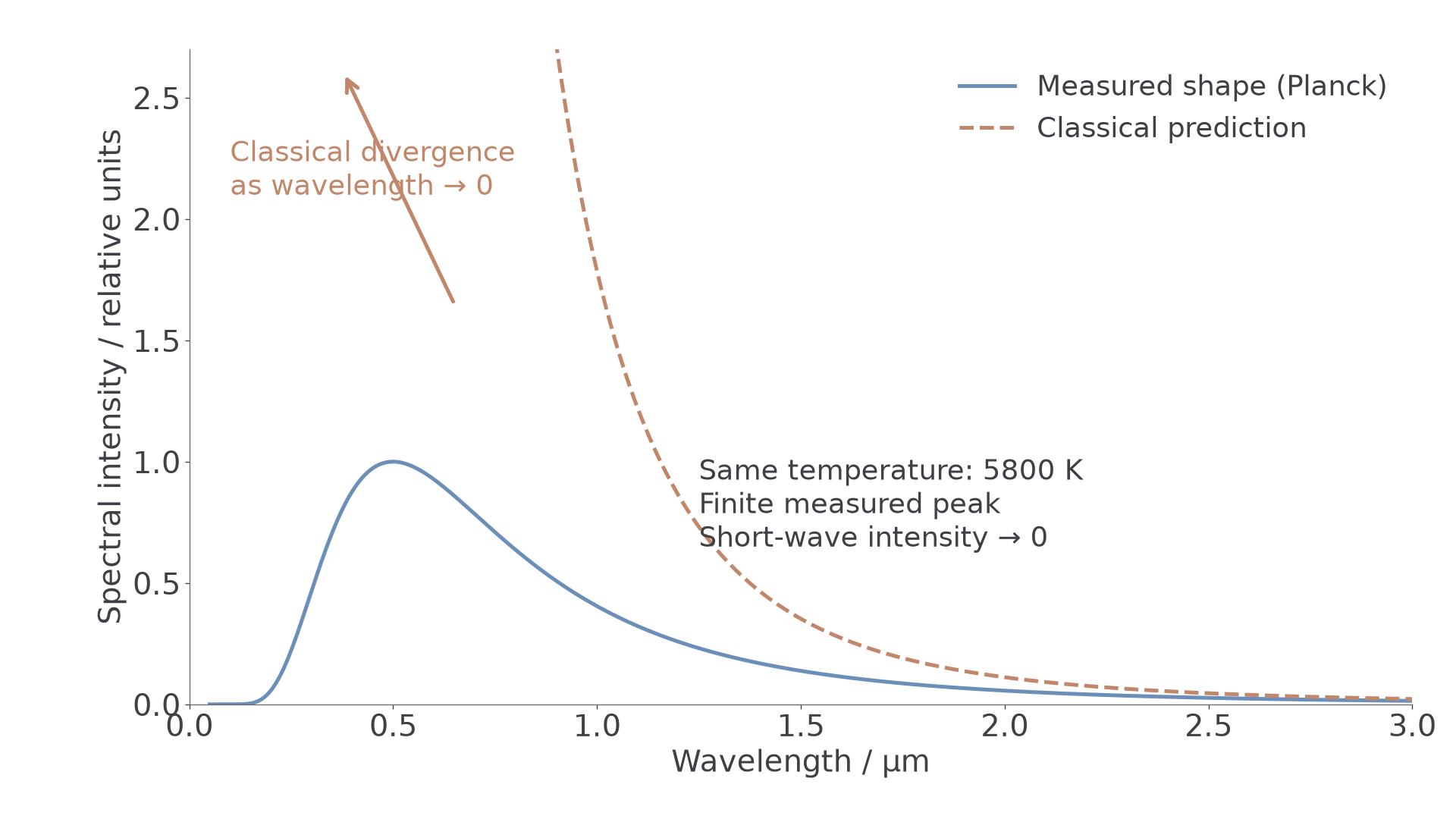
The catastrophe is not the observation that hotter bodies radiate more energy, or that ultraviolet light is dangerous. It is a failure of the classical short-wavelength prediction. In a sketch the measured short-wavelength tail appears to lie on the wavelength axis before rising to a peak; physically it approaches zero smoothly, rather than having a strict positive-wavelength cut-off.
What Planck quantised
Planck resolved the spectrum problem by treating the energy of the material oscillators exchanging radiation as quantised. For an oscillator of frequency , the allowed energies in this model are integer multiples of :
Adjacent levels differ by . Energy is emitted or absorbed in discrete amounts rather than continuously variable amounts. The energy of one quantum is , with . A transition involving several steps exchanges an integer multiple of this quantum.
At high frequency, the energy step is large. At a fixed temperature, high-energy oscillator excitations are much less probable, suppressing high-frequency emission. This produces a finite spectrum instead of the classical divergence. It does not mean that every oscillator has one identical energy or that radiation above a sharp frequency is forbidden.
For example, at , one quantum has energy . Doubling the frequency doubles the energy step. Doubling the amount of radiation at unchanged frequency does not double that step.
Planck's original contribution concerned quantised energy exchange with matter. Einstein's later light-quantum hypothesis made the stronger claim that radiation itself transfers localised packets of energy. Do not attribute Einstein's photoelectric explanation to Planck.
What photoelectric experiments showed
The photoelectric effect is the emission of electrons from a material when incident radiation transfers enough energy for them to escape. In the metal experiments considered here, the escaping particles are photoelectrons. Their rate of emission and their maximum kinetic energy are different observables.
| Observation | Difficulty for a simple classical continuous-energy account |
|---|---|
| Below a metal's threshold frequency, no emission occurs even when intensity is increased. | An electron should eventually accumulate enough energy from a continuous wave of any frequency. |
| Above threshold, emission has no measurable build-up delay, even at low intensity. | Energy spread over the wavefront would need time to accumulate at an individual electron. |
| At fixed frequency above threshold, increasing intensity increases emitted electron rate but not maximum kinetic energy. | Increasing wave intensity was expected to increase the energy acquired by electrons. |
| Increasing frequency above threshold increases maximum kinetic energy. | A frequency-dependent maximum energy is not explained by that continuous-energy account. |
The intensity statements assume ordinary single-photon photoemission, unchanged illuminated area and otherwise unchanged conditions. A photocurrent measures electrons collected per second, so it also depends on the collection voltage. It is not always identical to the emission rate. At sufficiently positive collector potential, essentially all emitted electrons are collected and the saturation current reflects that rate.
Continue this lesson.
You’re previewing NovaLearn without an account. Create a free account to read the rest.
Create free account