3.6.1.1 - Circular Motion
A constant speed can hide a changing velocity. Use radians to describe rotation, then identify the real forces whose inward resultant bends the path.
Radian measure of angle
An angle in radians compares an arc length with the radius of its circle. One radian subtends an arc whose length equals the radius.
Both lengths must use the same unit. A full circumference is , so one turn is . Multiply degrees by to obtain radians, or radians by to obtain degrees. Thus , while .
[DIAGRAM: asset_name: 6.1.1 - Circular Motion - Diagram 1; asset_slug: 6.1.1 - Circular Motion - Diagram 1; caption: One radian subtends an arc equal to the radius; description: One radian subtends an arc equal to the radius]
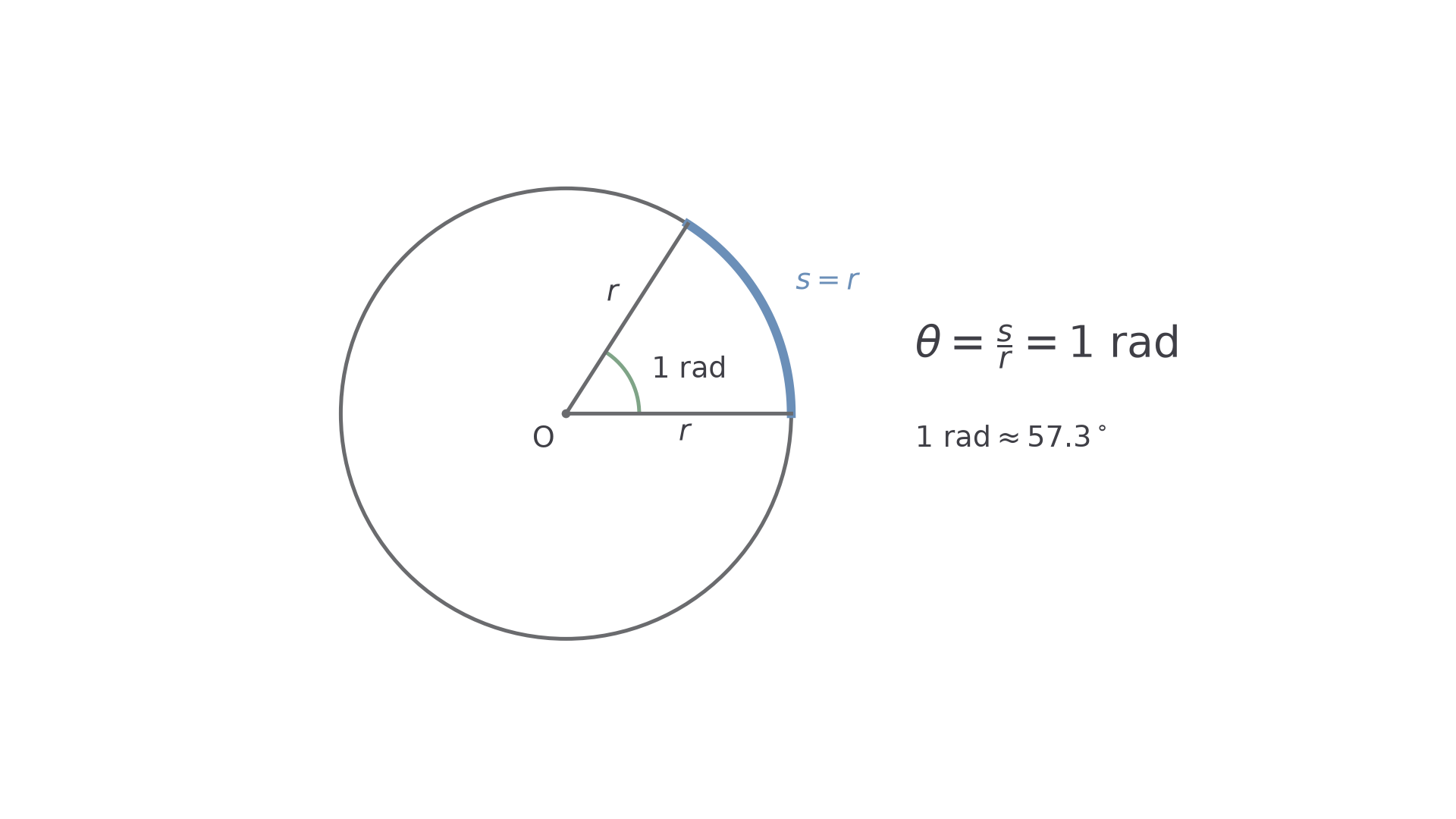
For a wheel of radius , a rotation of sweeps an arc . Using 120 directly in would mistake degrees for radians. The ratio is dimensionless, but writing rad identifies an angle.
Angular speed and linear speed
Angular speed is the angle swept out per unit time, in . Frequency counts complete turns per second, in hertz; period is the time for one turn.
The speed equation follows by dividing by time at fixed radius. Points on a rigid wheel share , but a point twice as far from the axis has twice the linear speed. Its velocity is tangent to the circle.
A disc turns at . Divide by 60 to obtain , then . At , . The angular speed is a magnitude here; the direction of an angular-velocity vector is outside this specification point.
Centripetal acceleration
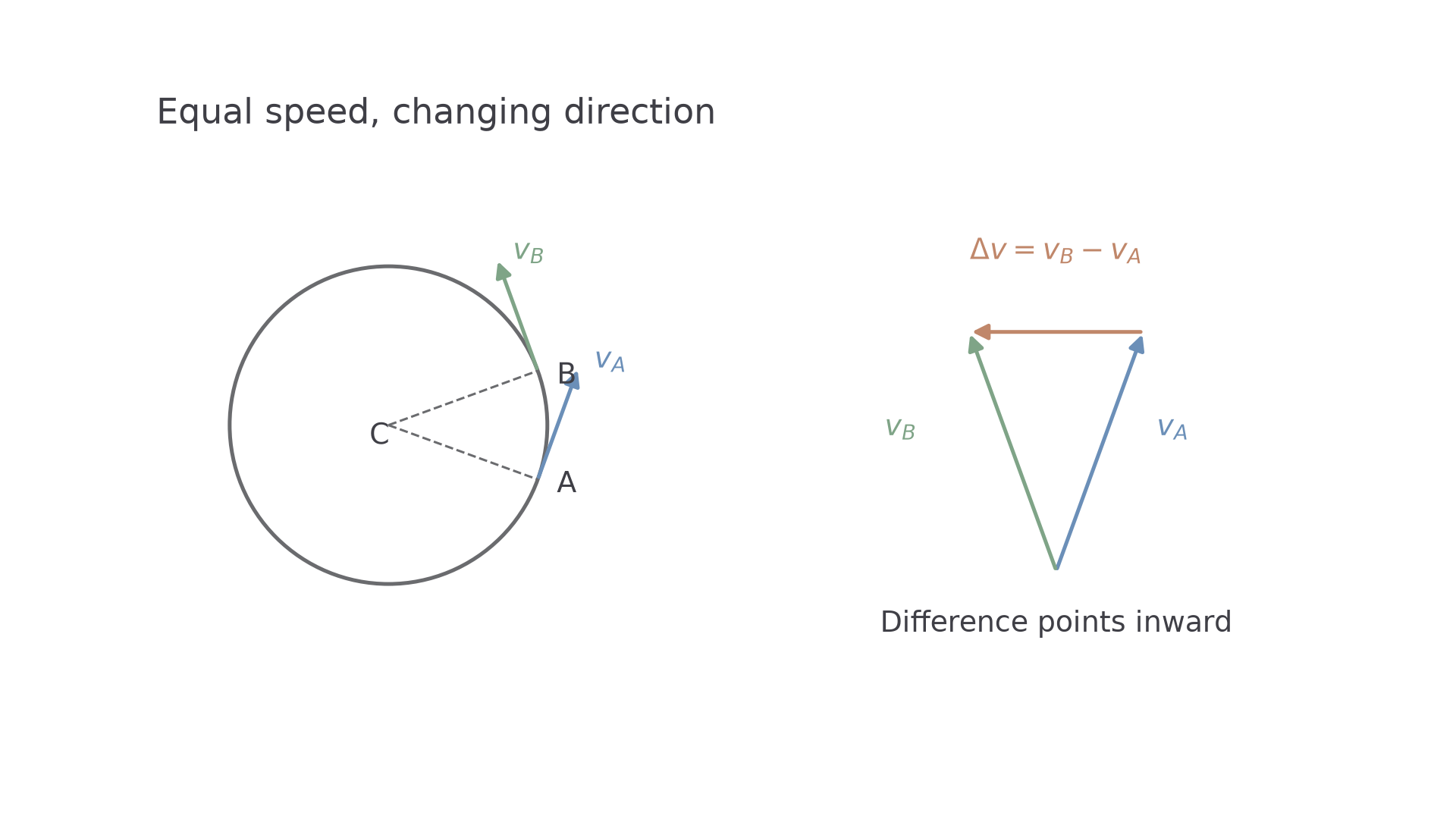
Velocity changes when its direction changes, even if its magnitude is constant. Uniform circular motion therefore has an acceleration directed towards the centre, perpendicular to the instantaneous velocity.
The second form follows by substituting . A derivation of the first formula is not required. The diagram compares equal-length tangential velocity vectors at two nearby points; their difference points inward at the midpoint of the short arc. In the limit of a very short interval this is the instantaneous radial direction.
[DIAGRAM: asset_name: 6.1.1 - Circular Motion - Diagram 2; asset_slug: 6.1.1 - Circular Motion - Diagram 2; caption: Tangential velocities and their inward vector difference; description: Tangential velocities and their inward vector difference]
At fixed radius, doubling speed makes the acceleration four times as large. At fixed speed, doubling radius halves acceleration. At fixed angular speed, however, doubling radius doubles acceleration because the linear speed also doubles. Always identify what is held constant before using a proportionality.
Continue this lesson.
You’re previewing NovaLearn without an account. Create a free account to read the rest.
Create free account