3.8.1.2 - Alpha, Beta and Gamma Radiation
Different nuclear radiations deposit energy and penetrate matter differently. Use these properties to identify a source, explain shielding and thickness control, and investigate how the count rate from a gamma source changes with distance.
Nature and properties of alpha, beta and gamma radiation
Ionising radiation transfers enough energy to remove electrons from atoms. Ionisation can damage living tissue, but the same interactions let us detect radiation and measure absorption.
| Radiation | Nature and charge | Typical penetration and energy loss |
|---|---|---|
| Helium-4 nucleus: two protons and two neutrons, charge | Strong ionisation along a short track. Usually travels a few centimetres in air and is stopped by paper or the outer dead layer of skin. | |
| / | Fast electron / positron, charge / | Less densely ionising than alpha. Greater range, depending on energy. A suitable thickness of plastic or a few millimetres of aluminium stops typical school-source beta particles. |
| Electromagnetic photon, zero charge and zero rest mass | Penetrating and indirectly ionising through interactions that produce charged particles. Thick lead or concrete attenuates it; no finite thickness guarantees removal of every photon. |
These are comparisons for typical nuclear energies, not universal ranges. Gamma radiation has no sharp maximum range like an alpha particle: its chance of transmission falls with absorber thickness. “Penetrating” does not mean harmless, and geometric spreading is different from absorption.
[DIAGRAM: asset_name: 8.1.2 - α, β and γ Radiation - Diagram 1; asset_slug: 8.1.2 - α, β and γ Radiation - Diagram 1; caption: Typical absorbers stop alpha and beta particles but only attenuate gamma radiation; description: Schematic comparison. The dashed gamma arrow after lead represents transmitted radiation, not a guarantee that all photons pass.]
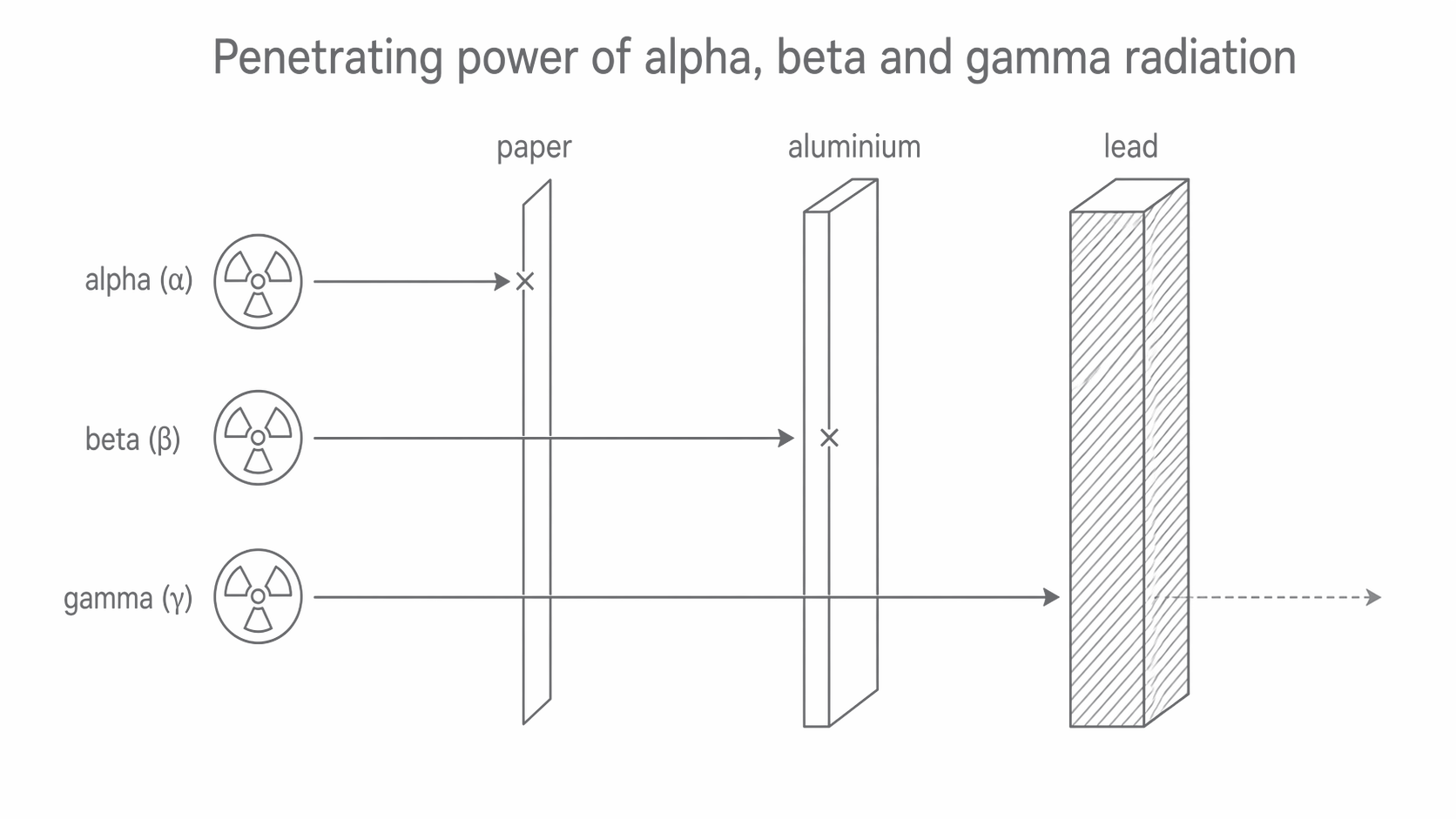
Alpha particles from one nuclear transition have approximately the same initial kinetic energy, so their ranges are fairly definite. An isotope can have several transitions. In beta decay, energy is shared in varying proportions with a neutrino or antineutrino, giving a continuous beta-energy distribution and a spread of ranges. Gamma photons from a given transition have a discrete energy.
Electric fields exert . Alpha and beta-plus bend towards a negative plate; beta-minus bends towards a positive plate. In a magnetic field perpendicular to the initial velocity, opposite charges curve oppositely; gamma is undeflected in either field. The bending depends on charge and momentum, not charge sign alone: in a magnetic field . A collimator selects a narrow range of directions by absorbing off-axis radiation; it does not focus the particles.
Experimental identification using absorption experiments
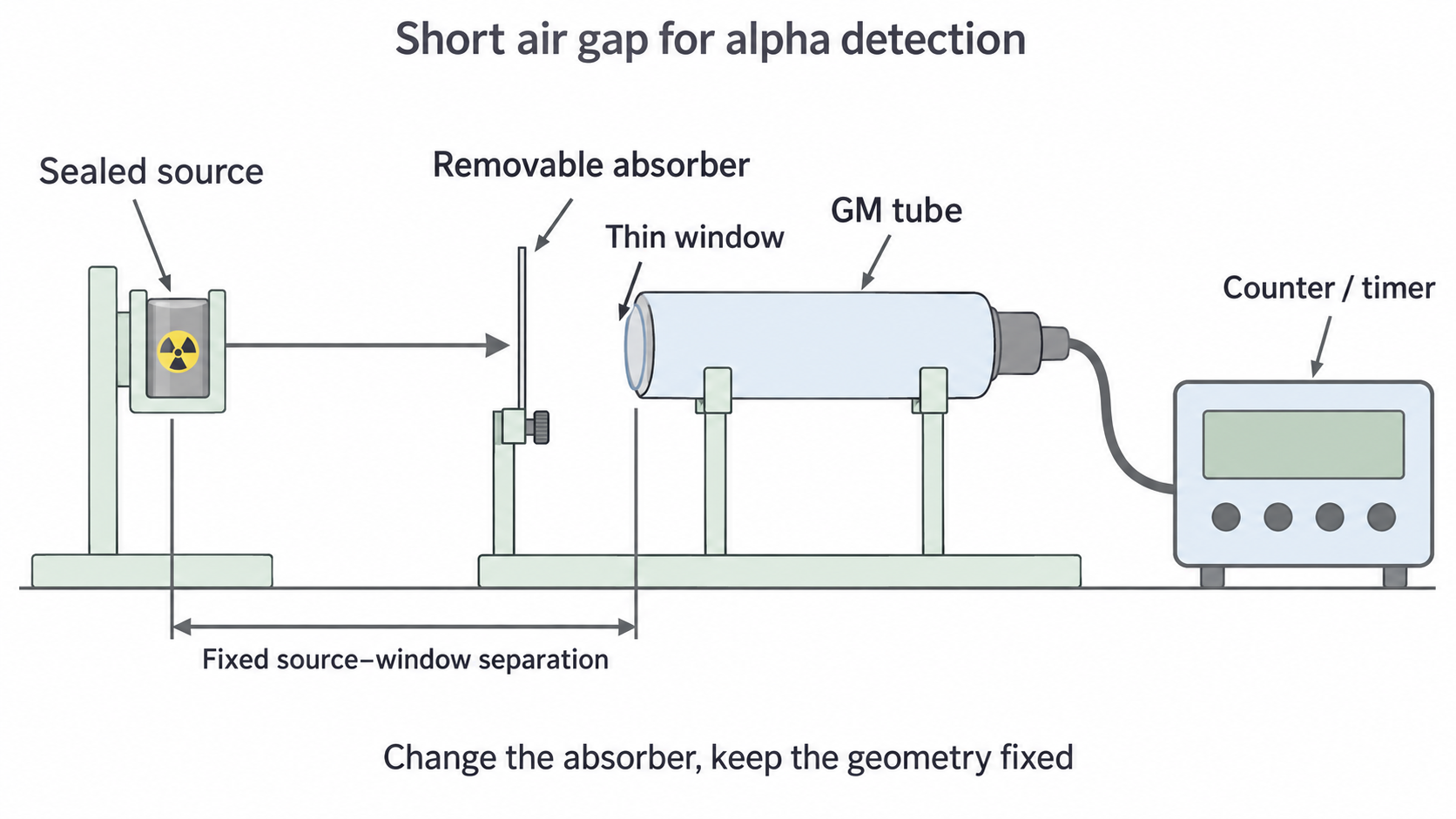
An absorption experiment compares count rates with different materials between a source and detector. Use a detector with an appropriate thin window, align it with the source, and keep their separation and orientation fixed. Alpha detection needs a short air gap within its range; no alpha count at a large separation does not prove the source emits none.
[DIAGRAM: asset_name: 8.1.2 - α, β and γ Radiation - Diagram 2; asset_slug: 8.1.2 - α, β and γ Radiation - Diagram 2; caption: Absorption measurement with a fixed short source-to-window separation; description: Change only the absorber during a comparison. Source, detector and counter are schematic and not to scale.]
Background radiation includes cosmic radiation and terrestrial radioactivity in rocks, soil and radon, as well as contributions from artificial contamination where present. Measure a background count with the source removed to its storage location. Divide count by duration before comparing measurements made for different times:
Record a no-absorber count, then repeat with paper, increasing aluminium thickness and suitable lead shielding. A statistically significant decrease with paper indicates an alpha component; a further large decrease with aluminium indicates beta; a penetrating remainder reduced by lead is evidence of gamma. Mixed sources can show more than one change. A corrected rate consistent with zero means the source contribution is not resolved above the background uncertainty, not that a negative physical rate exists.
Counts fluctuate randomly. Longer collection times reduce fractional counting uncertainty. A useful statistical estimate for a count is , so . When independent background is subtracted, a statistical uncertainty estimate is
This estimate describes random counting scatter; detector calibration, geometry and dead time can cause systematic error. Repeating does not remove those effects. For example, counts in is , with counting uncertainty about before background subtraction. The square-root estimate is supplied when needed in questions; do not confuse absolute and percentage uncertainty.
The inverse square law for gamma radiation
A small source emitting uniformly in all directions distributes the same emitted power over a spherical area at distance . With negligible absorption and scattering between source and detector,
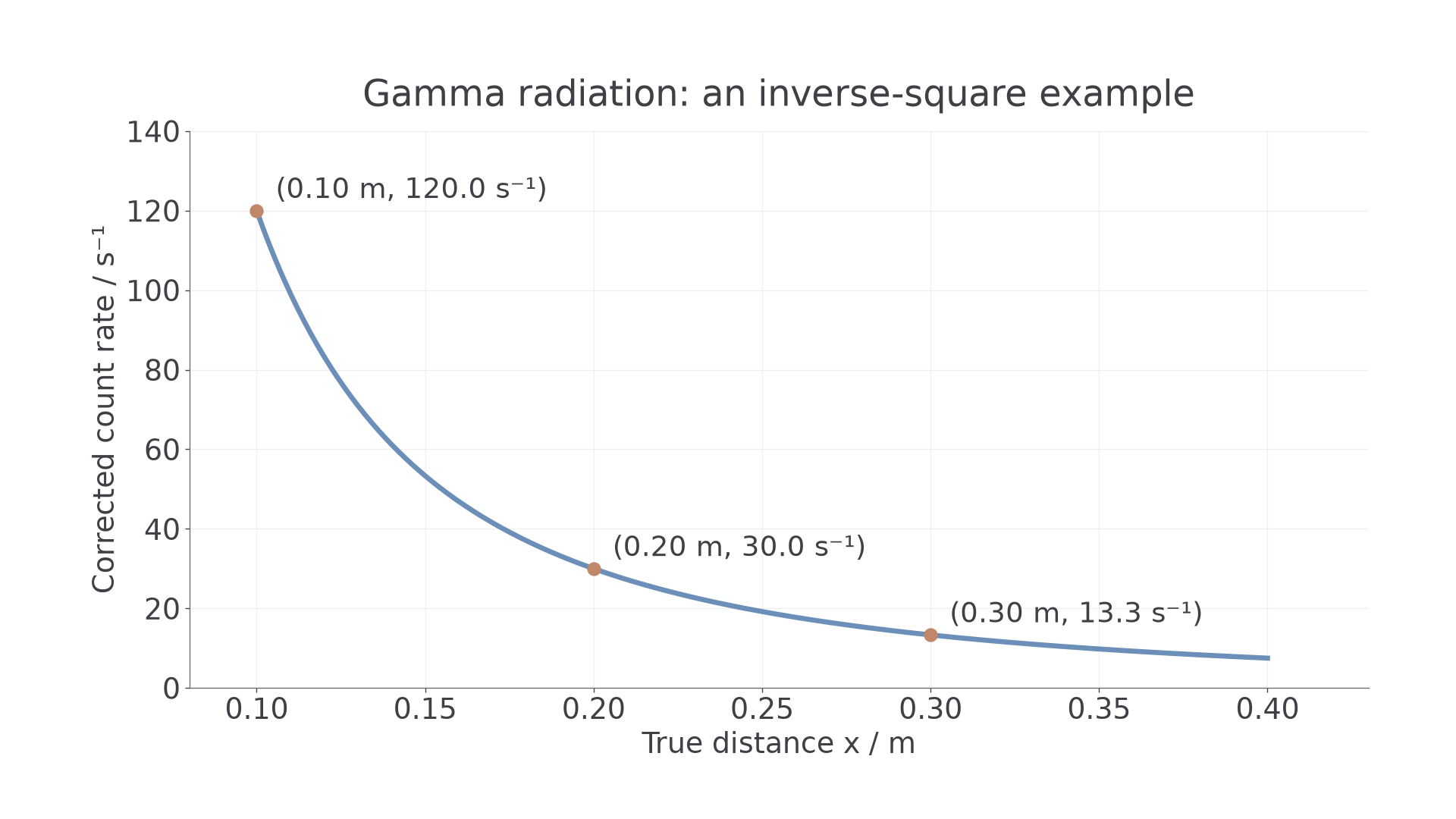
Intensity is power per unit area, in . A fixed small detector intercepts a fixed fraction per unit area, so its background-corrected count rate also follows , provided detector efficiency and source activity remain effectively constant. Doubling distance reduces the source contribution to one quarter. It does not reduce the background to one quarter.
[DIAGRAM: asset_name: 8.1.2 - α, β and γ Radiation - Diagram 3; asset_slug: 8.1.2 - α, β and γ Radiation - Diagram 3; caption: Ideal corrected gamma count rate falls with the square of the true distance; description: Exact example Cnet equals 120 divided by the square of x divided by 0.10 metres. Values at 0.10, 0.20 and 0.30 metres are 120, 30 and 13.3 counts per second.]
Continue this lesson.
You’re previewing NovaLearn without an account. Create a free account to read the rest.
Create free account