3.8.1.7 - Induced Fission
A thermal reactor sustains fission by managing what happens to its neutrons. Follow neutron absorption through successive fission generations, then distinguish the roles and material choices of moderator, control rods and coolant.
Inducing fission with thermal neutrons
Induced fission occurs when a heavy nucleus absorbs a neutron and then splits into lighter fragment nuclei, releasing energy and additional neutrons. For uranium-235, absorption forms an excited uranium-236 nucleus. The fragments need not be equal in mass, and several different product combinations are possible.
[DIAGRAM: asset_name: 8.1.7 - Induced Fission - Diagram 1; asset_slug: 8.1.7 - Induced Fission - Diagram 1; caption: One U-235 fission channel conserves charge and nucleon number; description: One U-235 fission channel conserves charge and nucleon number.]
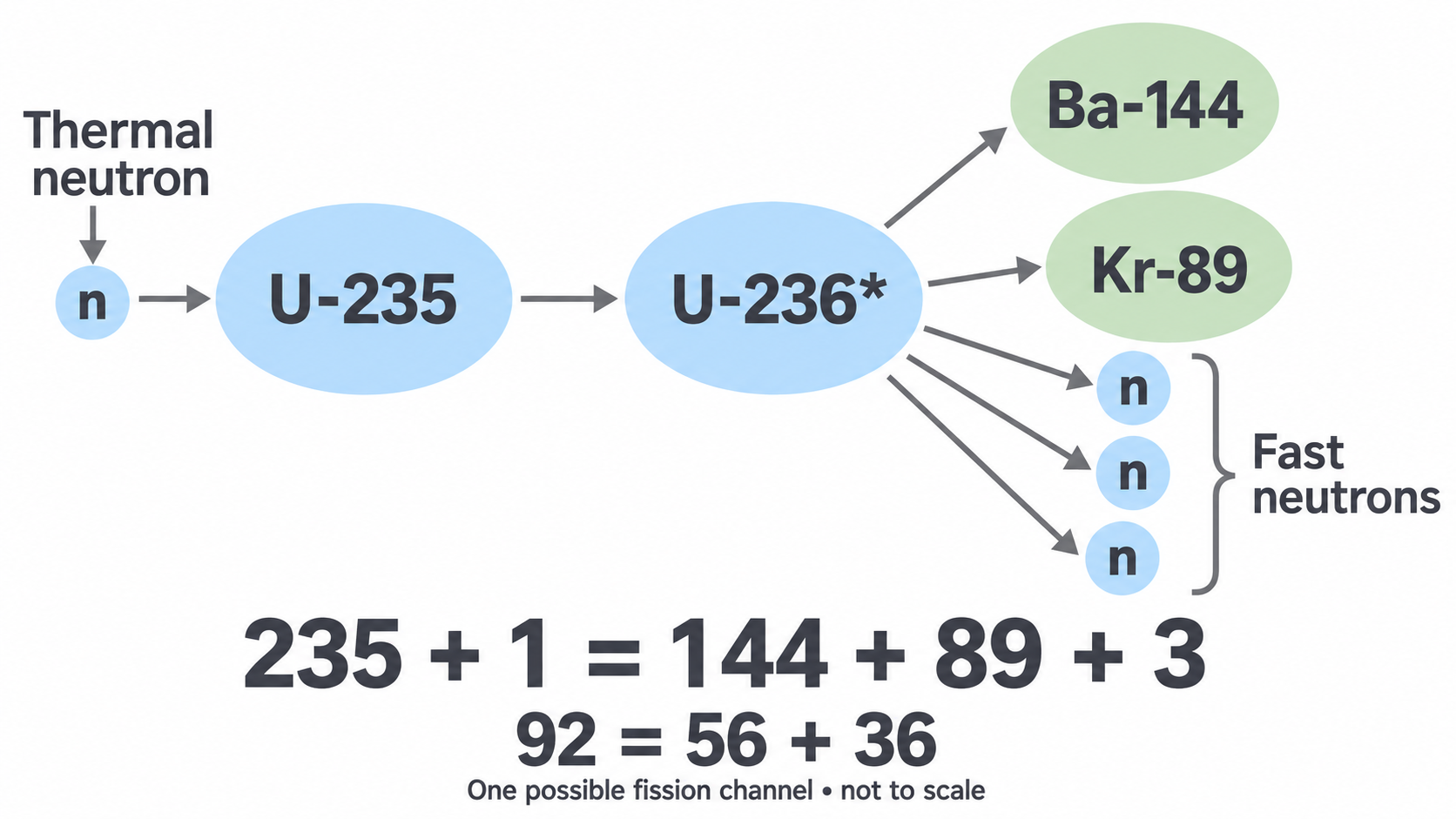
The illustrated channel is
The asterisk means excited. Charge and nucleon number balance: and . Much of the released energy becomes fragment kinetic energy, which transfers to the surrounding fuel as the fragments stop. Gamma radiation and neutron kinetic energy also carry energy.
Thermal neutrons have kinetic energies comparable with those of the surrounding matter, approximately at room temperature. Newly emitted fission neutrons typically have energies of order MeV. Thermal neutrons have a much greater probability of inducing fission in uranium-235 than fast neutrons in the thermal-reactor context. Fast-neutron fission is possible: 'only thermal neutrons cause fission' is false. Plutonium-239 is another important fissile fuel.
Chain reactions and criticality
A chain reaction is sustained when neutrons from fission cause further fissions. Emitting two or three neutrons is not enough by itself: some escape, and some are absorbed without fission.
Let be the average number of next-generation fissions produced per fission. If , successive generations shrink (subcritical). If , the average fission rate is steady (critical). If , it grows (supercritical). 'Critical' is the normal condition for steady power, not a synonym for an accident.
[DIAGRAM: asset_name: 8.1.7 - Induced Fission - Diagram 2; asset_slug: 8.1.7 - Induced Fission - Diagram 2; caption: An ideal generation model distinguishes subcritical, critical and growing chains; description: An ideal generation model distinguishes subcritical, critical and growing chains.]
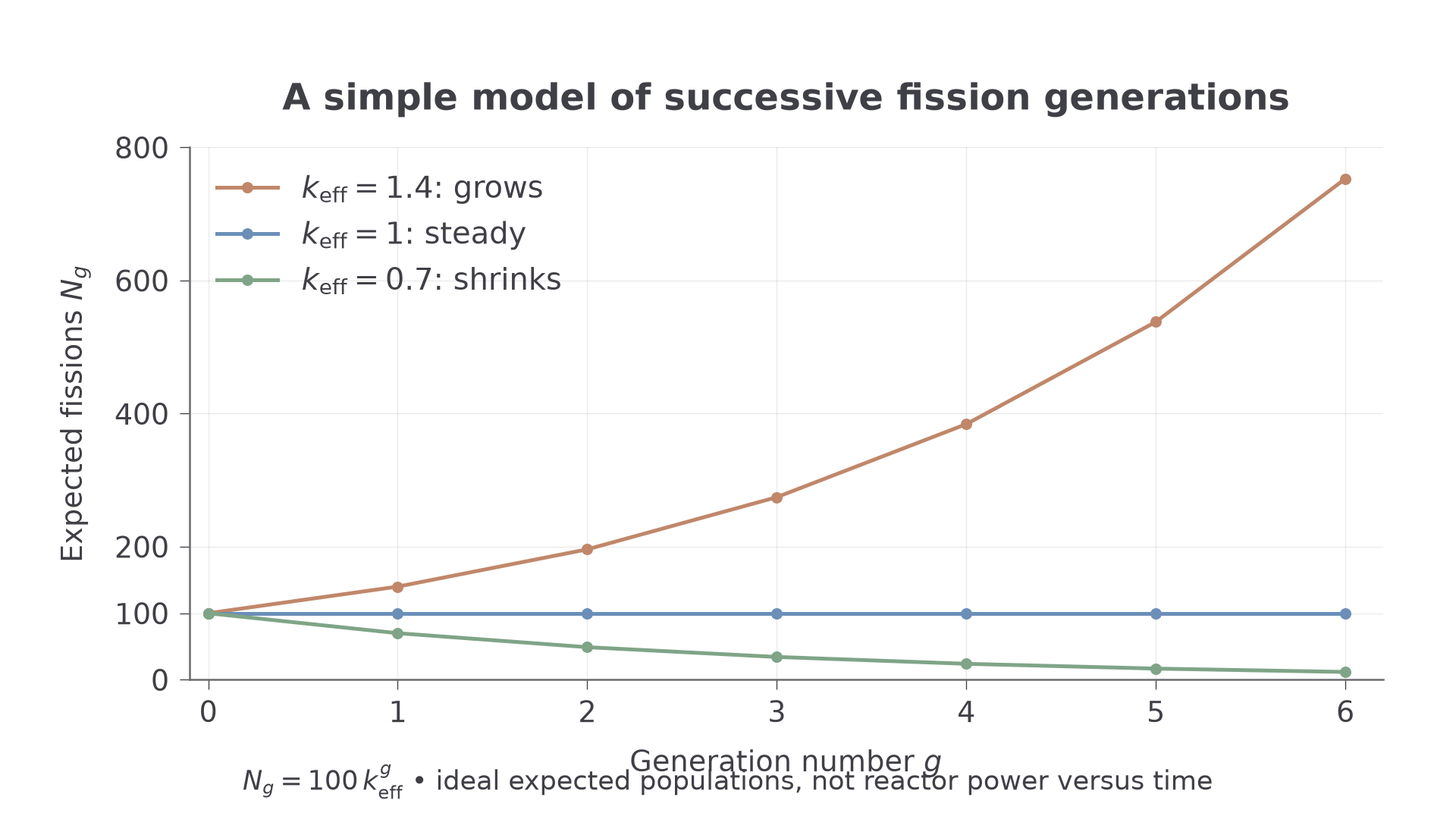
In the simple model , is the expected number of fissions in generation . If each event emits an average of neutrons and the fraction that cause another fission is , then . The graph is a generation model, not a prediction of real reactor power versus seconds: neutron energies and delayed neutron emission affect the timing.
For an ideal growing chain, suppose generations take equal time and stays fixed. Then and
With dimensionless variables and , this is the pure growing exponential . For , successive equal-time values are , , and : the ratio stays , while the increases grow from to to . This is the growing branch of the graph above, with rescaled axes.
To sketch , mark and , keep the curve positive, and draw an increasing gradient as increases. It has no upper horizontal asymptote. A saturating rise such as instead becomes less steep and approaches . Unbounded growth is a property of this fixed-factor model, not a prediction that a real reactor can keep growing indefinitely: fuel changes, feedback and control change the neutron balance. A controlled steady reactor has , not this growing behaviour.
For a specified material and arrangement, critical mass is the minimum mass that can sustain the chain. A smaller sample has a greater surface-area-to-volume ratio, making neutron escape more likely. Shape, density, enrichment, surrounding reflectors and absorbers all matter; there is no universal mass independent of configuration. A large reactor can still be made subcritical by adding absorbers.
Continue this lesson.
You’re previewing NovaLearn without an account. Create a free account to read the rest.
Create free account