3.10.1.2 - Defects of Vision and Their Correction Using Lenses
Correcting spectacles first create an image that the unaided eye can focus. Learn to separate this virtual spectacle image from the real retinal image, apply signed lens equations, and interpret directional prescriptions.
Properties of converging and diverging lenses
Lenses in air change the direction of light rays by refraction. The two fundamental types behave in opposite ways.
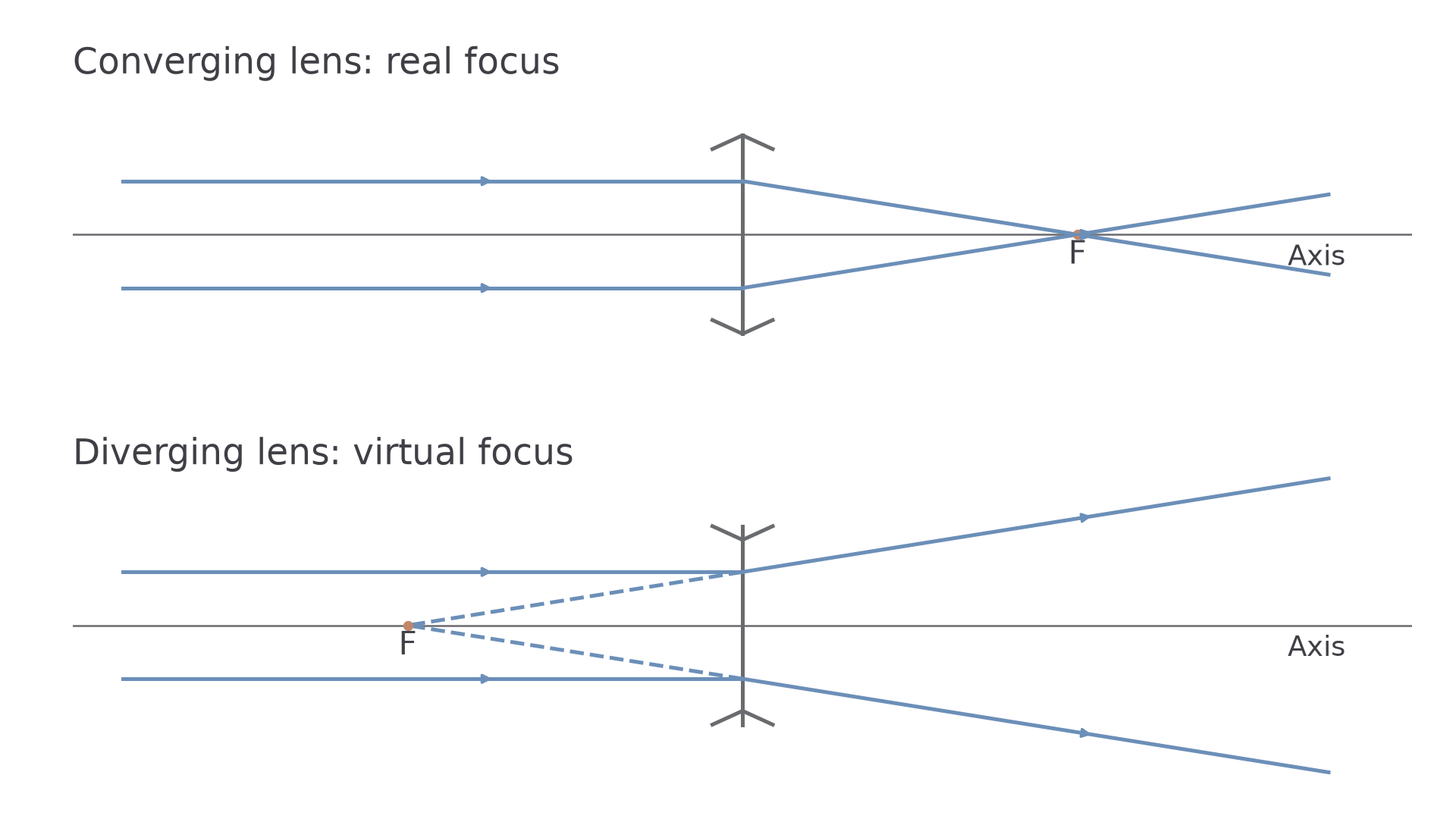
A typical converging lens is thicker at its centre than at its edges. When parallel rays of light strike it, the lens bends them inward so they meet at a single point on the far side. A converging lens can produce either a real image, formed where refracted rays actually cross, or a virtual image, formed where the refracted rays only appear to come from when traced backwards.
A typical diverging lens is thinner at its centre than at its edges. Parallel rays passing through it are spread apart so they appear to originate from a single point on the same side as the incoming light. A diverging lens always produces a virtual image for a real object because the refracted rays never actually meet.
The comparison diagram below shows the opposite behaviour of the two lens types, so notice where the rays genuinely meet for a converging lens and where they only appear to come from for a diverging lens.
[DIAGRAM: asset_name: B.1.2 - Defects of Vision and Their Correction Using Lenses - Diagram 1; asset_slug: B.1.2 - Defects of Vision and Their Correction Using Lenses - Diagram 1; caption: Principal foci of converging and diverging thin lenses; description: Principal foci of converging and diverging thin lenses]
To describe any thin lens precisely, you need three linked ideas: principal focus, focal length, and power.
Principal Focus (F)
For a converging lens, the principal focus is the point at which rays travelling parallel to the principal axis converge after passing through the lens. For a diverging lens, it is the point from which those rays appear to diverge.
The centre of the lens and the principal focus are separated by the focal length. This is a geometric property of the lens, so the sign tells you which type of lens you are dealing with.
Focal Length (f)
The distance measured along the principal axis from the centre of the lens to the principal focus. It is positive for converging lenses and negative for diverging lenses.
Opticians often describe how strongly a lens bends light by quoting its power rather than its focal length. A short focal length means a large power because the lens changes the direction of the rays more sharply.
Power of a Lens
A measure of a lens's ability to refract light, defined as the reciprocal of the focal length in metres. Converging lenses have positive power, diverging lenses have negative power, and the unit is the dioptre (D).
If the focal length is measured in metres, the power is given by:
Power of a Lens
Here is in dioptres and is in metres. Converting centimetres to metres before calculating is essential, otherwise the power will be wrong by a factor of 100.
The thin lens equation and magnification
A thin-lens model relates object position, image position and size using a stated sign convention.
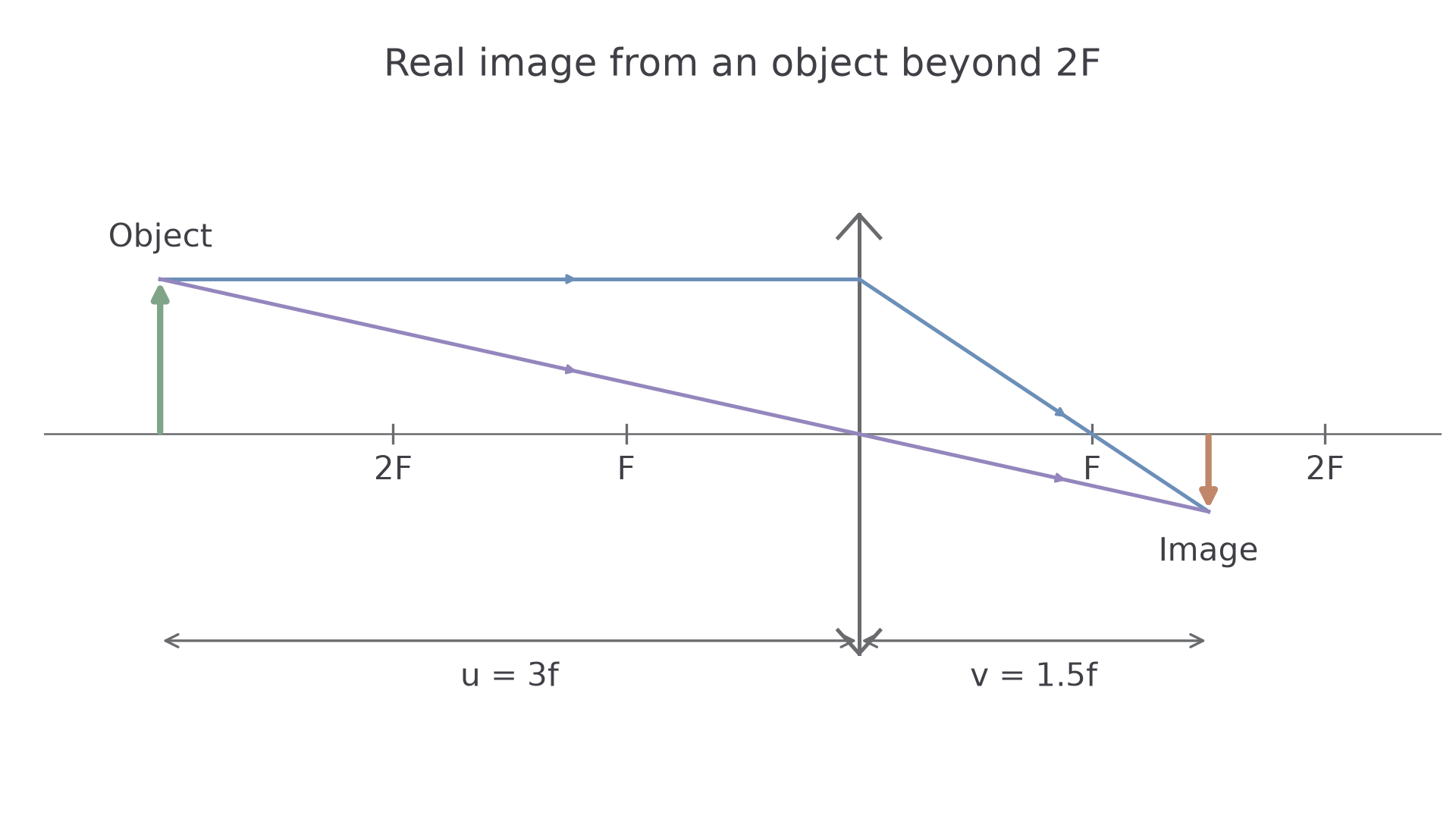
To locate the image formed by a thin lens, you can draw a ray diagram using two construction rays from the top of the object:
- A ray parallel to the principal axis, which refracts through the principal focus for a converging lens or appears to come from the principal focus for a diverging lens.
- A ray passing through the centre of the lens, which continues undeviated.
Where these rays meet, or appear to meet when traced back, is the top of the image. A ray diagram therefore tells you whether the image is real or virtual, upright or inverted, and magnified or diminished.
The ray diagram below puts those two construction rules into one example, so trace each standard ray and note why an object beyond 2F produces a real, inverted, diminished image.
[DIAGRAM: asset_name: B.1.2 - Defects of Vision and Their Correction Using Lenses - Diagram 2; asset_slug: B.1.2 - Defects of Vision and Their Correction Using Lenses - Diagram 2; caption: Scaled rays from an object beyond twice the focal length; description: Scaled rays from an object beyond twice the focal length]
The same information can be obtained quantitatively from the thin lens equation:
Thin Lens Equation
In this lesson, is treated as positive because the object is a real object placed in front of the lens. The image distance is positive for a real image and negative for a virtual image. The focal length is positive for a converging lens and negative for a diverging lens. All three distances must be written in the same unit.
The AQA data relation is . For image-size calculations use the magnitude of this ratio:
Magnification
Here is the magnitude of the linear magnification, or image height divided by object height. Under the distance convention used in this lesson, the sign of identifies a real or virtual image, while the magnitude gives the size ratio.
Let us work through a calculation to see these equations in action.
Worked example. A converging lens has a focal length of 5.0 cm. An image is formed 20 cm from the lens on the far side. Find the object distance.
Identify knowns: cm and cm.
The object must be placed 6.7 cm from the lens.
Myopia and its correction
Myopia gives the relaxed eye a finite far point: distant rays converge too soon.
Myopia
A defect of vision in which distant objects cannot be focused because the combined optical power of the eye is too great, or the eyeball is too long, so the image of a distant object forms in front of the retina rather than on it.
A person with myopia can focus on objects within their near-to-far-point range, but not on objects beyond that far point. The far point, which is the greatest distance at which the eye can focus clearly, is less than infinity for a myopic eye.
The paired diagrams below show both the defect and its correction, so compare the uncorrected focus in front of the retina with the corrected case after a diverging lens has shifted the final focus back onto the retina.
[DIAGRAM: asset_name: B.1.2 - Defects of Vision and Their Correction Using Lenses - Diagram 3; asset_slug: B.1.2 - Defects of Vision and Their Correction Using Lenses - Diagram 3; caption: Diverging spectacles shift the final focus onto the retina; description: Diverging spectacles shift the final focus onto the retina]
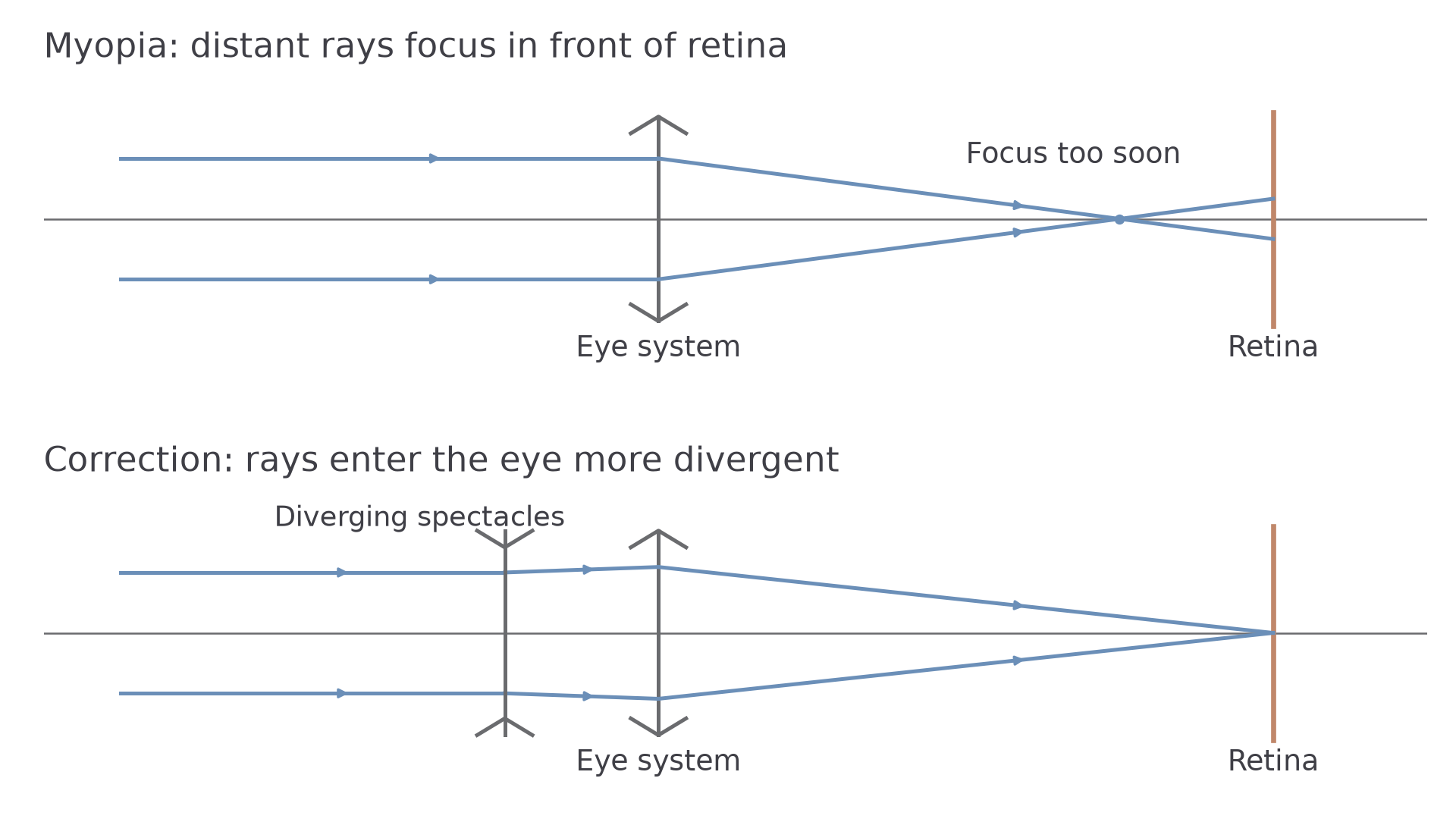
Correction is achieved using a diverging lens placed in front of the eye. The lens must take parallel rays from a distant object and produce a virtual image at the person's far point. The eye can then focus that virtual image onto the retina.
For a thin correcting lens effectively at the eye, with the far point measured from that lens,
where is the uncorrected far point written as a positive distance. The negative sign appears because the correcting lens is diverging. The power is therefore:
Worked example. A short-sighted person has a far point of 1.0 m. What power of correcting lens is needed?
The prescription is a lens of power D.
Continue this lesson.
You’re previewing NovaLearn without an account. Create a free account to read the rest.
Create free account