3.4.1.6 - Momentum
Momentum tracks direction as well as motion. Use signed changes and graph areas to analyse impacts, test when a system conserves momentum, and distinguish that conservation law from the changes in kinetic energy during collisions and explosions.
Momentum and direction
Momentum is the product of mass and velocity: . Its SI unit is , equivalent to . It is a vector, in the direction of velocity. A slow heavy body can have the same momentum magnitude as a fast light body.
In one dimension, choose a positive direction before substituting. If east is positive, a trolley travelling west at has . The minus sign specifies west, not a smaller mass or negative kinetic energy.
[DIAGRAM: asset_name: 4.1.6 - Momentum - Diagram 1; asset_slug: 4.1.6 - Momentum - Diagram 1; caption: Opposite signs for eastward and westward momentum; description: Opposite signs for eastward and westward momentum.]
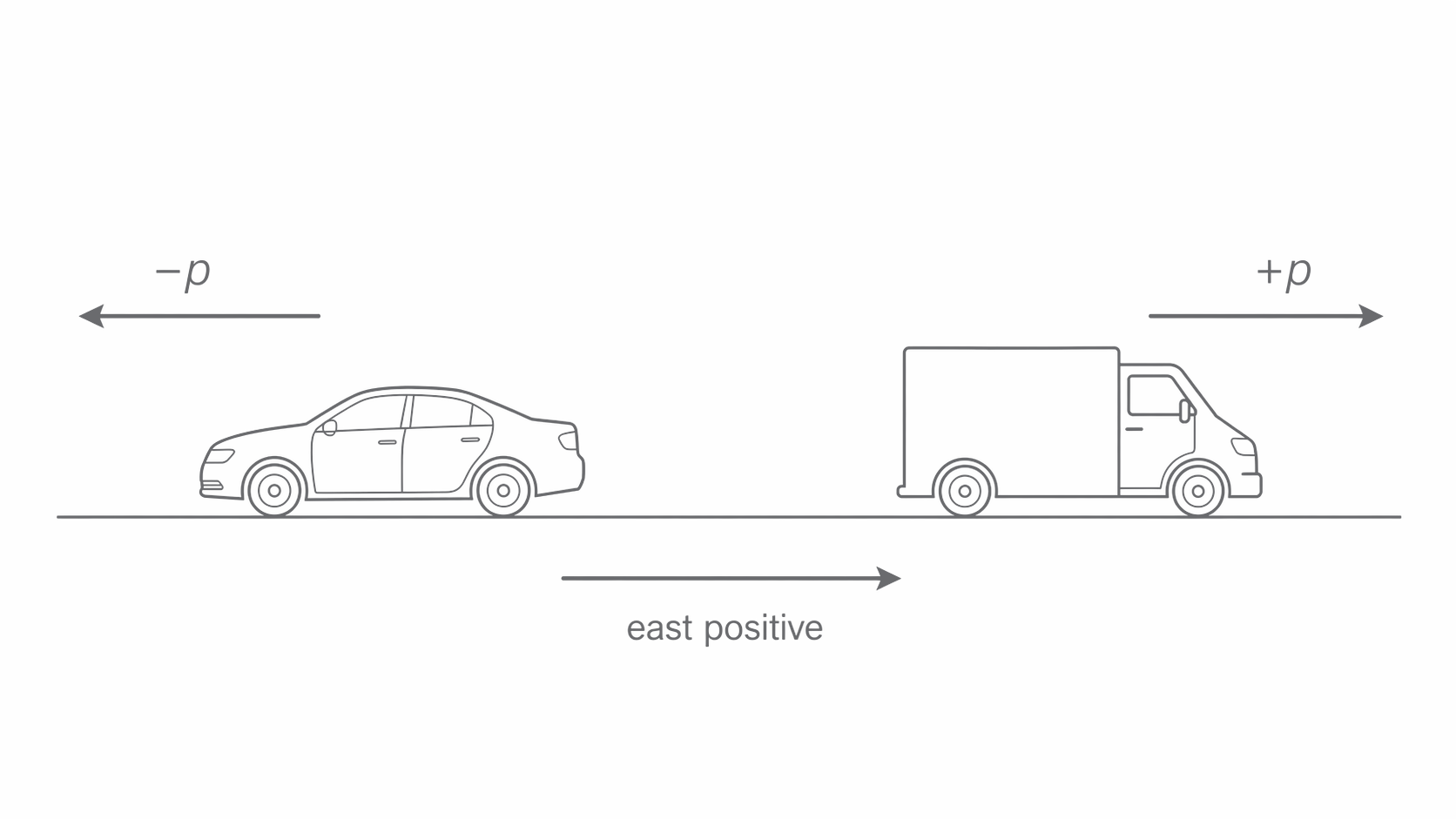
The equal arrow lengths illustrate equal momentum magnitudes for two different vehicles, not necessarily equal speeds or masses. The two momenta add to zero although both vehicles move. Their kinetic energies are positive. Total momentum is found by adding signed momenta, not by adding their magnitudes.
A change is final minus initial: . If the trolley changes from to , its change is . A reversal often gives a larger change than stopping; subtracting speeds would miss this.
Force and momentum change
The resultant external force controls the rate at which a body's momentum changes. Over a finite time interval,
For a constant force this is also its force at every instant. For a varying force it gives only the average; the instantaneous force corresponds to the gradient of the momentum–time graph at that instant. When mass is constant, , so . Do not apply the single-body formula blindly to a rocket with mass flowing across the boundary: all transferred momentum must be accounted for.
A ball initially moving at rebounds at . Then . Over , the average resultant force is . Its direction is opposite the incoming motion. If gravity is negligible during this short horizontal impact, this is approximately the racket's average force.
Using would calculate the difference in speed rather than the velocity change. Using milliseconds without conversion would make the answer a thousand times too small. For fixed , : the symbol denotes change and denotes proportionality, not equality.
Impulse from signed graph area
Impulse is the change in momentum caused by a force over an interval. For constant force, . For variable force, add the contributions over short intervals: the signed area between the force–time curve and the time axis is the impulse. The graph must show the resultant force, or a particular interaction force whose impulse is being calculated.
[DIAGRAM: asset_name: 4.1.6 - Momentum - Diagram 2; asset_slug: 4.1.6 - Momentum - Diagram 2; caption: A force pulse with triangular rise and fall and a constant middle section; description: A force pulse with triangular rise and fall and a constant middle section.]
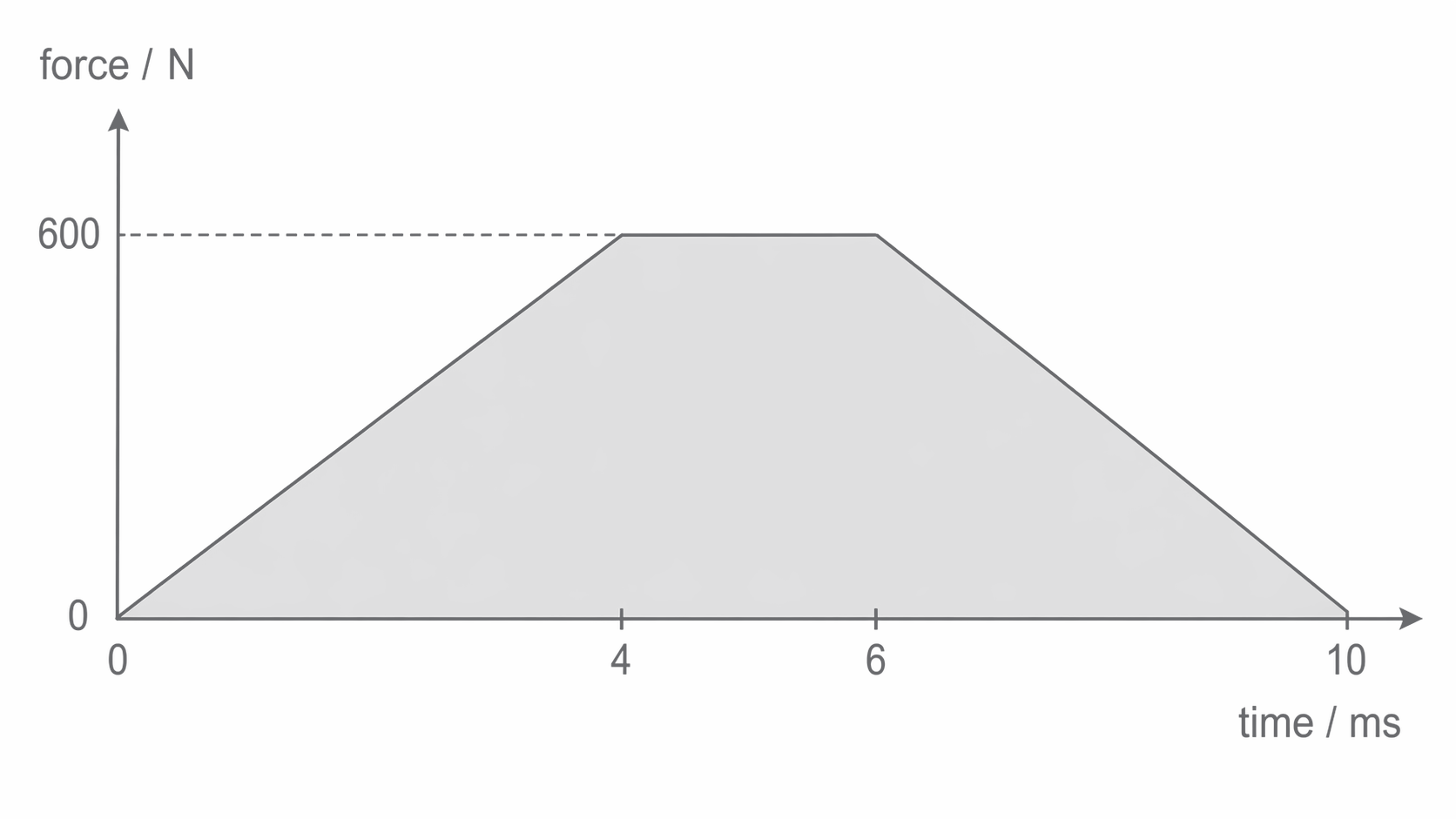
This positive pulse rises to at , stays there until , and falls to zero at . Its area is
The average force over the whole is , below the peak . Multiplying the peak by the whole contact time would overestimate impulse. A region below the axis contributes negative impulse. Split a line crossing the axis at its zero before finding signed areas.
For a curved graph, count squares or sum narrow trapezia using ; smaller intervals generally improve the estimate. State the time unit: . Once impulse is known, use , retaining any initial momentum. Force–time area is momentum change, whereas force–displacement area is work, measured in joules.
Collisions, recoil and energy
A system's total momentum remains constant if the resultant external force is zero. Over a brief collision, negligible external impulse is the useful approximation: small friction may act, but change the total momentum by much less than the collision transfers between the bodies. Internal interaction forces are equal and opposite and act for the same time, so their impulses cancel in the total.
For two bodies in one dimension,
A trolley at sticks to a stationary trolley. The shared velocity is . Initial kinetic energy is , but final kinetic energy is . The missing of kinetic energy becomes internal energy, sound and deformation; energy as a whole is conserved.
An elastic collision conserves total kinetic energy as well as momentum. An inelastic collision does not conserve kinetic energy; sticking is a completely inelastic example, not a requirement for all inelastic collisions. Momentum conservation has the external-impulse condition for either type. To classify a measured collision, compare the total kinetic energies before and after, allowing for measurement uncertainty; equal total momentum alone cannot distinguish the types.
In an explosion, stored internal energy becomes kinetic energy. Two fragments produced from rest must have equal and opposite momenta, but not equal speeds. For fragments and , if the first moves at , the second moves at . Their total momentum is zero; their total kinetic energy is . The increase is supplied by released internal energy, not created from nothing.
Contact time and safer transport
Impact protection changes how momentum is transferred. For the same passenger mass and change from the same velocity to rest, the impulse is fixed. A crumple zone and a correctly used restraint can increase the passenger's stopping time, reducing the magnitude of the average force, . The force-time pulse still needs the same signed area. A lower average does not by itself prove a lower peak: the shape of the pulse matters.
For a passenger stopping from , the impulse magnitude is . Increasing stopping time from to reduces average force magnitude from to . These are idealised whole-body averages, not injury thresholds. Spreading contact over a larger area reduces pressure for the same force; it is a separate benefit from increasing stopping time.
A rebound gives a larger momentum change than stopping at the same incoming speed. Packaging should absorb energy and avoid a sharp rebound as well as provide time/distance to stop. At a given impact, Newton's third law still gives equal and opposite contact forces between the colliding bodies; a “stronger” vehicle does not exempt its partner from this law.
Ethical transport design considers occupants and other road users. A rigid front may protect its own passenger space yet shorten the stopping time of a pedestrian. Deformable structures can reduce that harm; designers must balance passenger survival space, pedestrian protection and the risk to cyclists. A defensible comparison uses test evidence such as force-time curves and realistic crash speeds, acknowledges uncertainty, and does not claim any design eliminates all risk. Momentum conservation concerns the chosen system: vehicle momentum alone is not conserved when the road, barrier or another vehicle provides an external impulse.