3.7.4.3 - Energy Stored by a Capacitor
Derive stored energy from the charge–pd relationship, choose an appropriate energy equation, and account for energy transferred during charging or a partial discharge.
Work stored in the electric field
Separating charge requires work against the growing electric field between the plates. The capacitor stores electric potential energy in its electric field. Electrons are transferred through the external circuit, not through the dielectric. Equal and opposite plate charges give zero net charge, but do not cancel the field between the plates.
When the capacitor discharges through a load, its field energy is transferred to other forms: thermal energy in a resistor, or light and thermal energy in a flash tube. Peak power can be large when energy accumulated over a long time is delivered in a short pulse. The load and circuit resistance determine the discharge rate.
Distinguish energy stored by the capacitor from total energy supplied by the source. Some source energy can be dissipated in the charging circuit. Saying all the battery's work is stored would violate that energy balance.
Why the energy is a triangle
The capacitor pd starts at zero and rises as charge is added. Moving a small additional charge through the instantaneous pd stores . For constant capacitance, , so the pd rises linearly from zero to the final . The average pd with respect to transferred charge, rather than time, is therefore .
Adding the small work transfers gives . This is the triangular area under a -against- graph. The specification also uses the graph with charge vertically against pd horizontally:
[DIAGRAM: asset_name: 7.4.3 - Energy Stored by a Capacitor - Diagram 1; asset_slug: 7.4.3 - Energy Stored by a Capacitor - Diagram 1; caption: For constant capacitance the charge–pd graph is a straight line. Its triangular area is one half QV and represents stored energy, the gradient is capacitance.; description: For constant capacitance the charge–pd graph is a straight line. Its triangular area is one half QV and represents stored energy, the gradient is capacitance.]
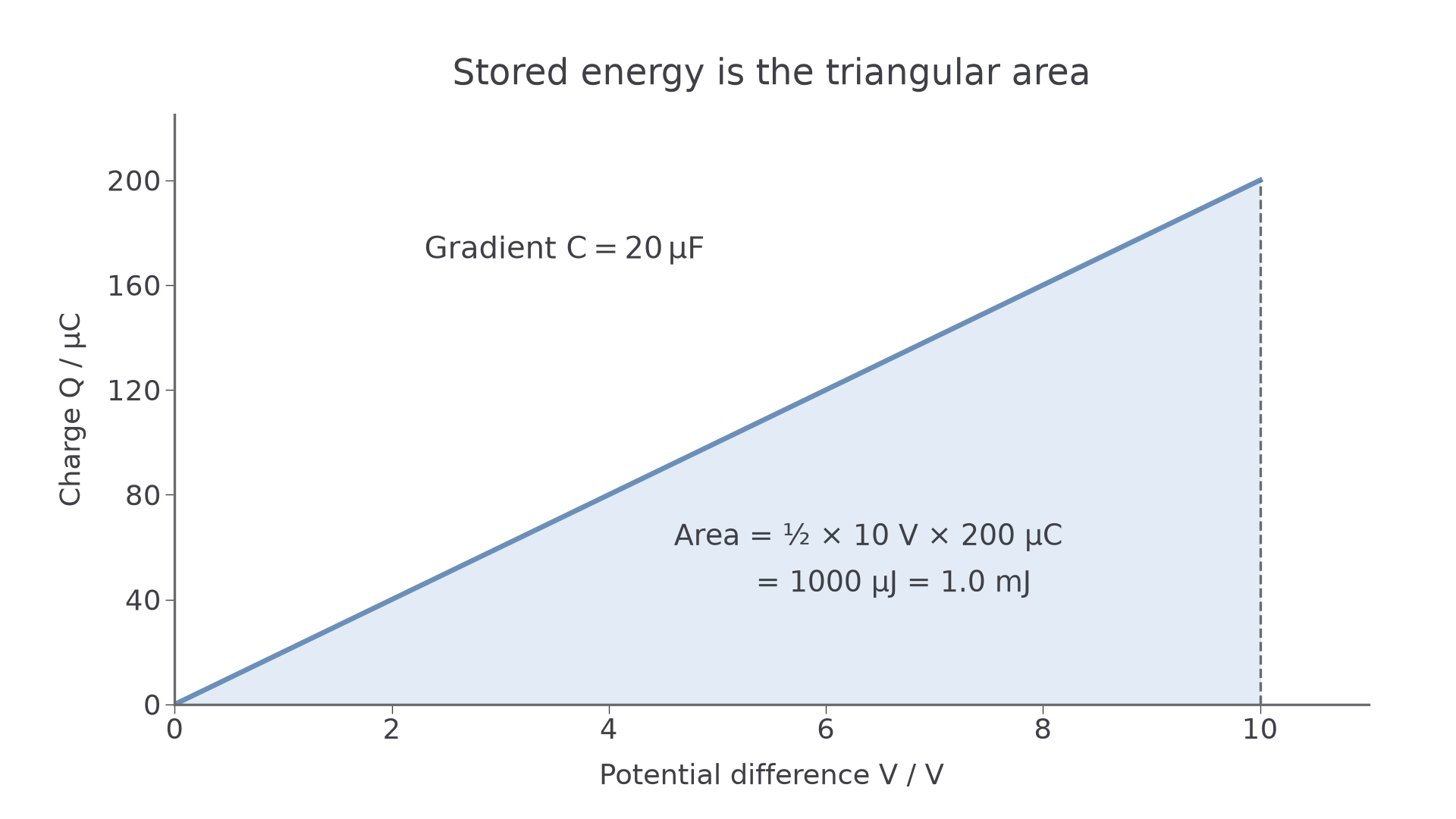
For constant , and , so . Thus the area under this -against- graph also equals the stored energy:
Its unit is . This area interpretation assumes a linear capacitor. Do not treat the rectangle as stored energy: that would apply the final capacitor pd to every increment of charge.
Choosing an energy equation and a fixed quantity
Substituting or into the triangle result gives three equivalent forms:
Stored energy
Use , , or , according to the data supplied. Convert prefixes before squaring a quantity. For and , and .
The fixed quantity matters in comparisons. For the same , doubling or quadruples . For different capacitors at fixed , energy is proportional to . At fixed , energy is inversely proportional to . These statements are consistent because they describe different constraints. On log–log axes a plot of against , with fixed and fixed reference units, has gradient 2; this tests the power law .
Continue this lesson.
You’re previewing NovaLearn without an account. Create a free account to read the rest.
Create free account