3.11.1.1 - Concept of Moment of Inertia
Moment of inertia measures how strongly an object resists angular acceleration about a chosen axis. Calculate it by weighting each mass by the square of its distance from that axis, then use the result to compare rotating designs.
Inertia about a chosen axis
An object with more mass is harder to accelerate in a straight line. Rotation also depends on where that mass lies: pushing the same mass farther from the rotation axis makes it harder to change the angular velocity.
Moment of inertia, , measures resistance to angular acceleration about a specified axis. Its SI unit is . For the same resultant torque, a larger gives a smaller angular acceleration. This does not mean a larger torque is needed merely to maintain steady rotation in the absence of resistance.
Always name the axis. A long rod rotates easily about its own length but is much harder to spin about an axis through its centre perpendicular to its length. The mass is unchanged, but its distances from the axis are different. For a rigid object about a fixed axis, changing angular speed alone does not change .
Point masses and the squared radius
A small object can be modelled as a point mass when its size is negligible compared with its distance from the rotation axis.
Point mass
Here is the shortest, perpendicular distance from the mass to the axis, in metres, and is in kilograms.
[DIAGRAM: asset_name: C.1.1 - Concept of Moment of Inertia - Diagram 1; asset_slug: C.1.1 - Concept of Moment of Inertia - Diagram 1; caption: A point mass at perpendicular distance r from an axis through the page; description: A point mass at perpendicular distance r from an axis through the page.]
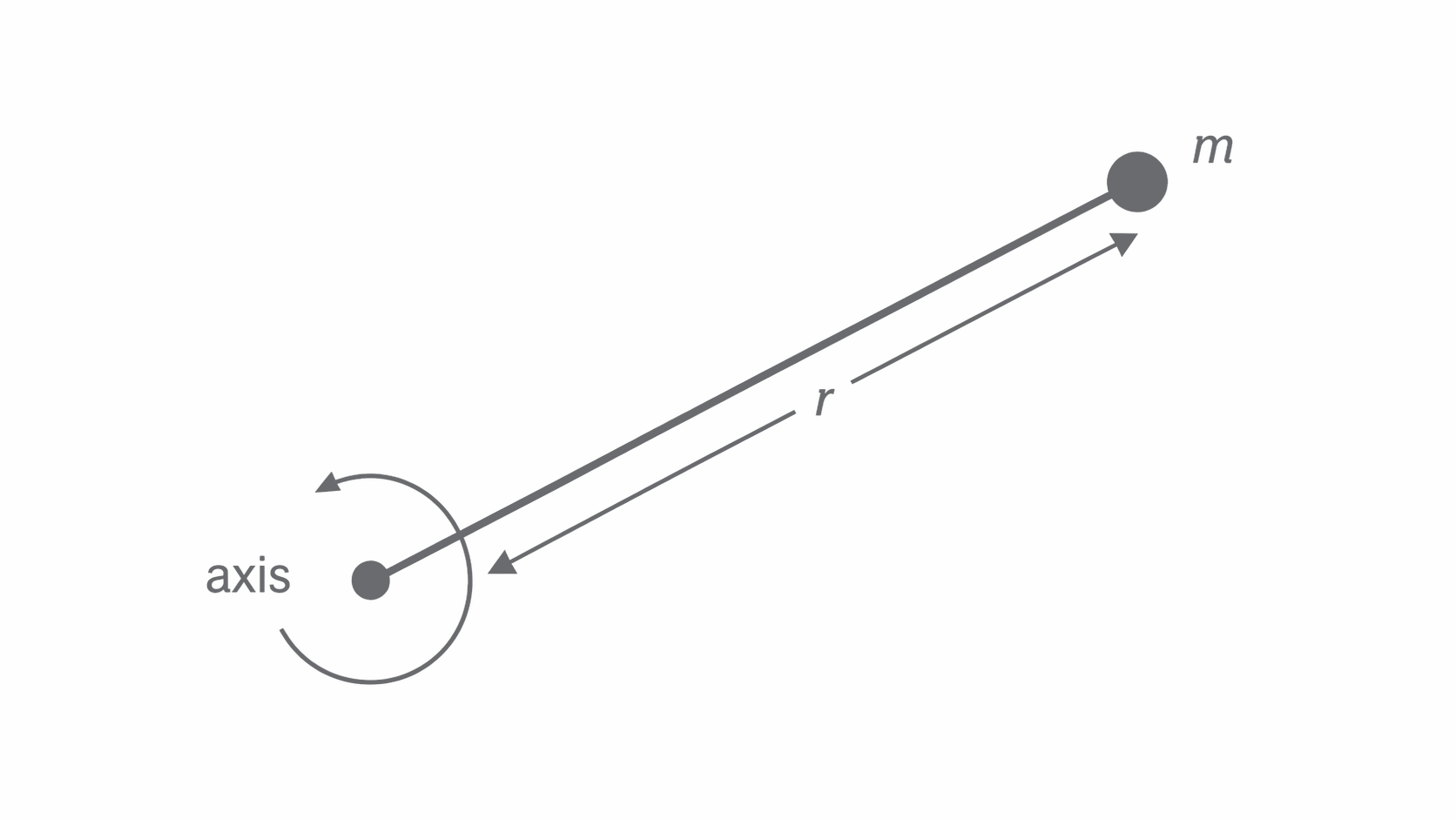
The rod in this model is light enough to neglect. A mass from the axis contributes . Doubling its radius multiplies this by four. Moving it to the axis makes its point-mass contribution zero; a real object of finite size still has some mass away from the axis.
To reduce the contribution to a fraction , the new radius must be . It is the radius squared, not the radius, that is proportional to .
Adding contributions across an object
An extended object is a collection of small mass elements at different perpendicular distances from the same axis.
Extended object
Square each distance before multiplying by its own mass, then add the contributions. Do not square an average radius.
For two small masses at and at , the total is
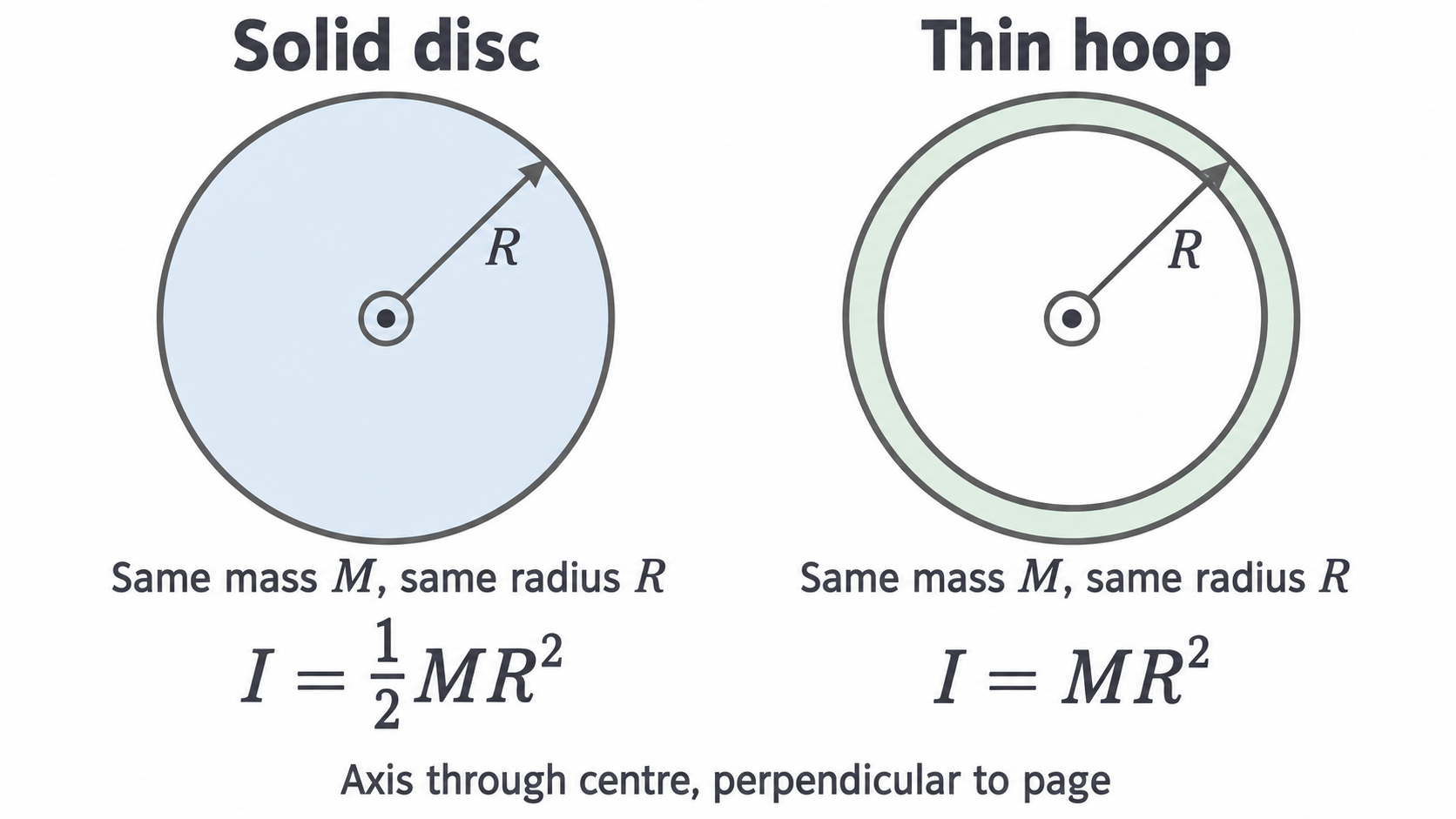
A continuous body requires the same summation over very small elements. Expressions for standard shapes will be supplied when needed; you must use the stated axis and dimensions, rather than memorise a table of results.
[DIAGRAM: asset_name: C.1.1 - Concept of Moment of Inertia - Diagram 2; asset_slug: C.1.1 - Concept of Moment of Inertia - Diagram 2; caption: Equal-mass disc and thin hoop about their central perpendicular axes; description: Equal-mass disc and thin hoop about their central perpendicular axes.]
Continue this lesson.
You’re previewing NovaLearn without an account. Create a free account to read the rest.
Create free account