3.9.2.4 - Stellar Spectral Classes
Absorption lines reveal the states of atoms in a stellar atmosphere. Use their patterns to classify stars by temperature, and explain why strong hydrogen Balmer lines identify an intermediate temperature rather than the hottest stars or the most hydrogen.
The OBAFGKM temperature sequence
A spectral class is a category determined from the absorption-line pattern in a star's spectrum. The main sequence of classes, from hottest to coolest, is O, B, A, F, G, K, M. This temperature sequence is distinct from the main-sequence region of an HR diagram.
The following values and line descriptions are the AQA specification table. The endpoints are approximate class boundaries rather than perfectly sharp physical divisions.
| Class | Intrinsic colour | Temperature / K | Prominent absorption lines |
|---|---|---|---|
| O | Blue | 25 000–50 000 | , He, H |
| B | Blue | 11 000–25 000 | He, H |
| A | Blue-white | 7 500–11 000 | H strongest; ionised metals |
| F | White | 6 000–7 500 | Ionised metals |
| G | Yellow-white | 5 000–6 000 | Ionised and neutral metals |
| K | Orange | 3 500–5 000 | Neutral metals |
| M | Red | Below 3 500 | Neutral atoms, TiO |
Here H and He denote neutral atoms; is singly ionised helium. In astronomical usage, “metals” means elements heavier than helium. TiO is titanium oxide, a molecule whose absorption features are prominent in cool M stars.
[DIAGRAM: asset_name: A.2.4 - Principles of the Use of Stellar Spectral Classes - Diagram 1; asset_slug: A.2.4 - Principles of the Use of Stellar Spectral Classes - Diagram 1; caption: The spectral sequence runs from hot O stars to cool M stars; description: Monochrome summary of OBAFGKM with written intrinsic colours and the Balmer maximum at A. Hatching does not encode a wavelength or numerical temperature.]
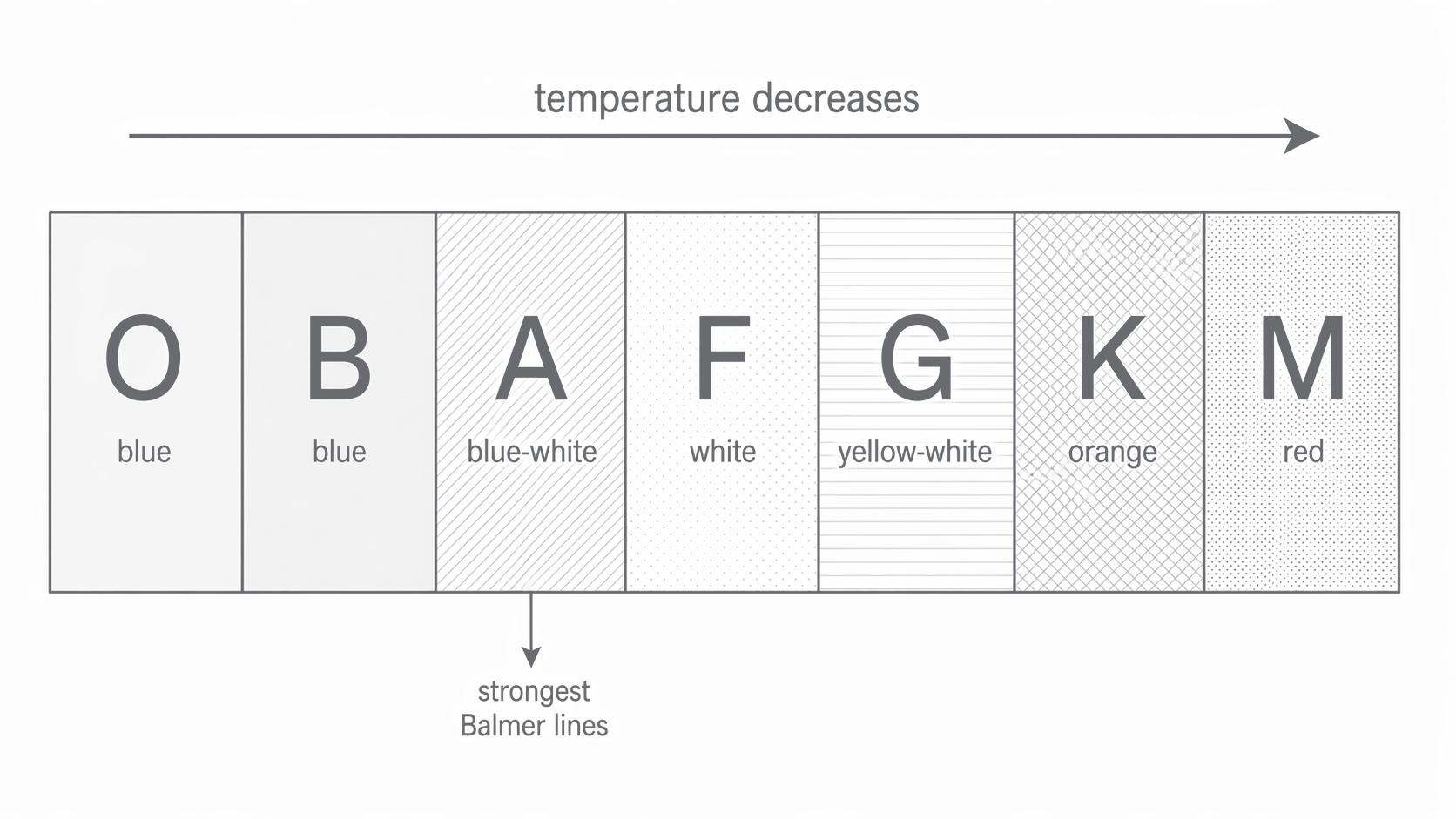
The listed colours are intrinsic, before effects such as reddening by dust. Colour helps estimate temperature, but the absorption-line pattern is the classification evidence. Weak lines do not necessarily mean that the element is absent.
How absorption lines form
Light from hotter, deeper layers of a star passes through cooler gas in its outer atmosphere. The underlying spectrum is approximately continuous. Atoms and ions in the cooler gas absorb photons only at energies matching allowed electron transitions, reducing intensity at particular wavelengths.
The photon energy must match the energy gap: . The absorbed radiation can subsequently be re-emitted in other directions. Along the original line of sight there is less light at that wavelength, so a dark absorption line appears against the continuum. Dark means reduced intensity, not necessarily zero intensity.
[DIAGRAM: asset_name: A.2.4 - Principles of the Use of Stellar Spectral Classes - Diagram 2; asset_slug: A.2.4 - Principles of the Use of Stellar Spectral Classes - Diagram 2; caption: Cooler stellar gas produces absorption lines in a continuous spectrum; description: Schematic sequence: a hot continuum source, cooler gas absorbing selected wavelengths, and the observed absorption spectrum. Positions of lines are illustrative, not a measured spectrum.]
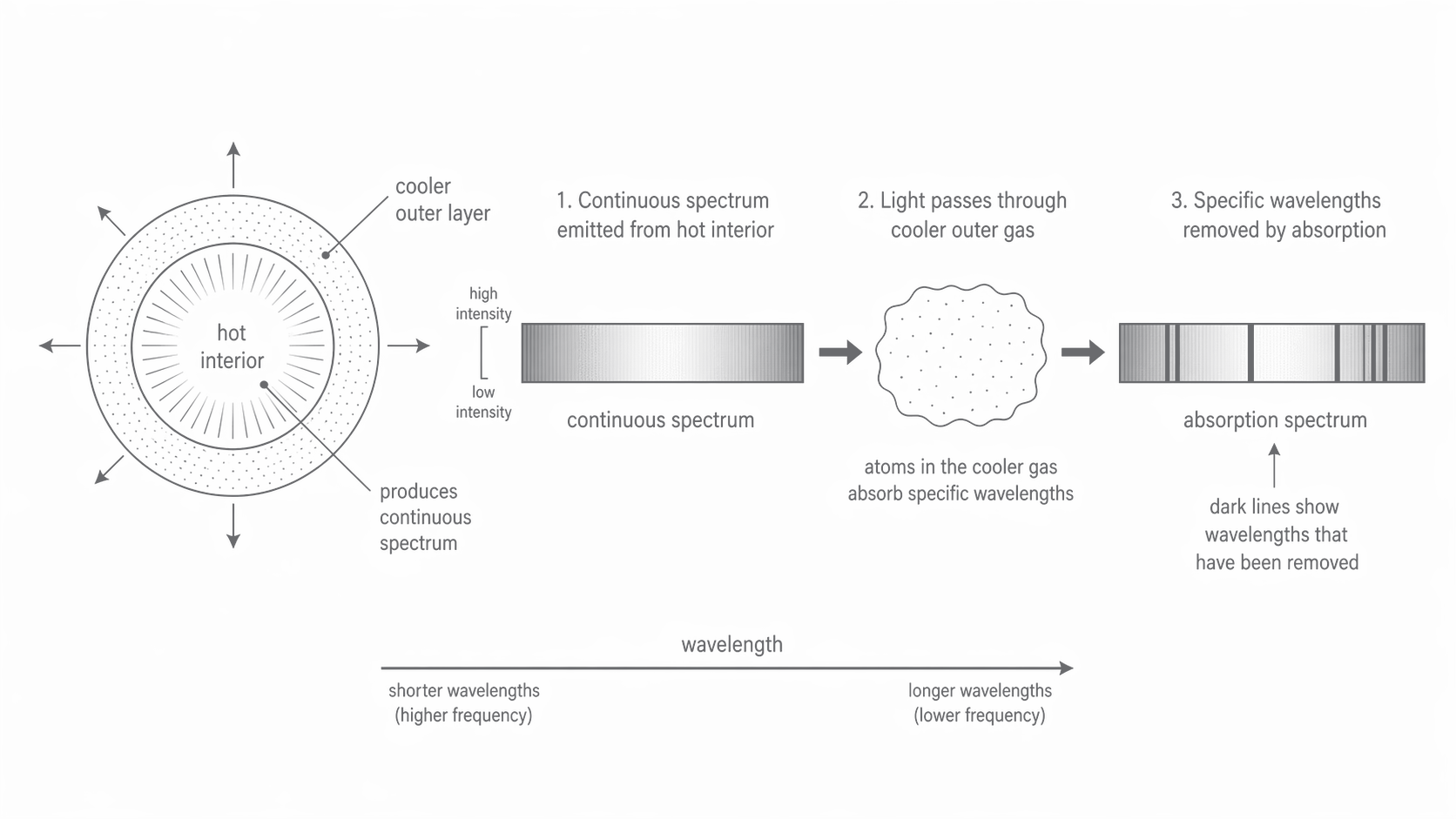
A transition also requires an atom in the correct initial state. Raising temperature changes the population of excited states and can ionise atoms by removing electrons completely. Consequently similar mixtures of elements can show different line strengths at different temperatures. Spectral classification uses this state dependence; it is not simply a catalogue of which elements a star contains.
Continue this lesson.
You’re previewing NovaLearn without an account. Create a free account to read the rest.
Create free account