3.12.1.2 - Thermionic Emission of Electrons
Heating a cathode releases electrons; an electric field then accelerates them. Separating these two jobs explains both the construction of an electron gun and the relation between its accelerating voltage and beam speed.
Thermionic emission
A metal contains mobile electrons, but attraction to the metal prevents most of them from escaping its surface. Thermionic emission is the release of electrons from a sufficiently hot metal. Heating changes their energy distribution so that a larger fraction can overcome the surface energy barrier, called the work function.
A current in a filament supplies energy by electrical heating. The filament may itself be the emitting cathode, or it may heat a separate cathode. Increasing its temperature increases the emission rate: it releases more electrons per second, rather than increasing the charge on each electron. Positive ions are not the emitted beam particles.
The electron gun
An electron gun combines a heated cathode, a positive anode with an aperture, and an evacuated or low-pressure enclosure. Two supplies have separate roles. A low-voltage heater supply, for example , drives current through the filament; both filament terminals must be connected. A larger accelerating supply, for example , makes the anode positive relative to the cathode.
The electric field between cathode and anode exerts a force on the electrons towards the anode. Some pass through its small hole and form a narrow beam. The aperture selects a narrow part of the beam; an aperture alone does not explain precise focusing, which real guns achieve with shaped electrodes. Low gas pressure reduces collisions that would scatter electrons or remove their kinetic energy.
[DIAGRAM: asset_name: D.1.2 - Thermionic Emission of Electrons - Diagram 1; asset_slug: D.1.2 - Thermionic Emission of Electrons - Diagram 1; caption: A heated cathode supplies electrons to a positive apertured anode; description: Simplified electron-gun geometry. The two filament leads connect to a low-voltage heating supply, omitted here. V labels a separate cathode-to-anode accelerating supply, not current arrows.]
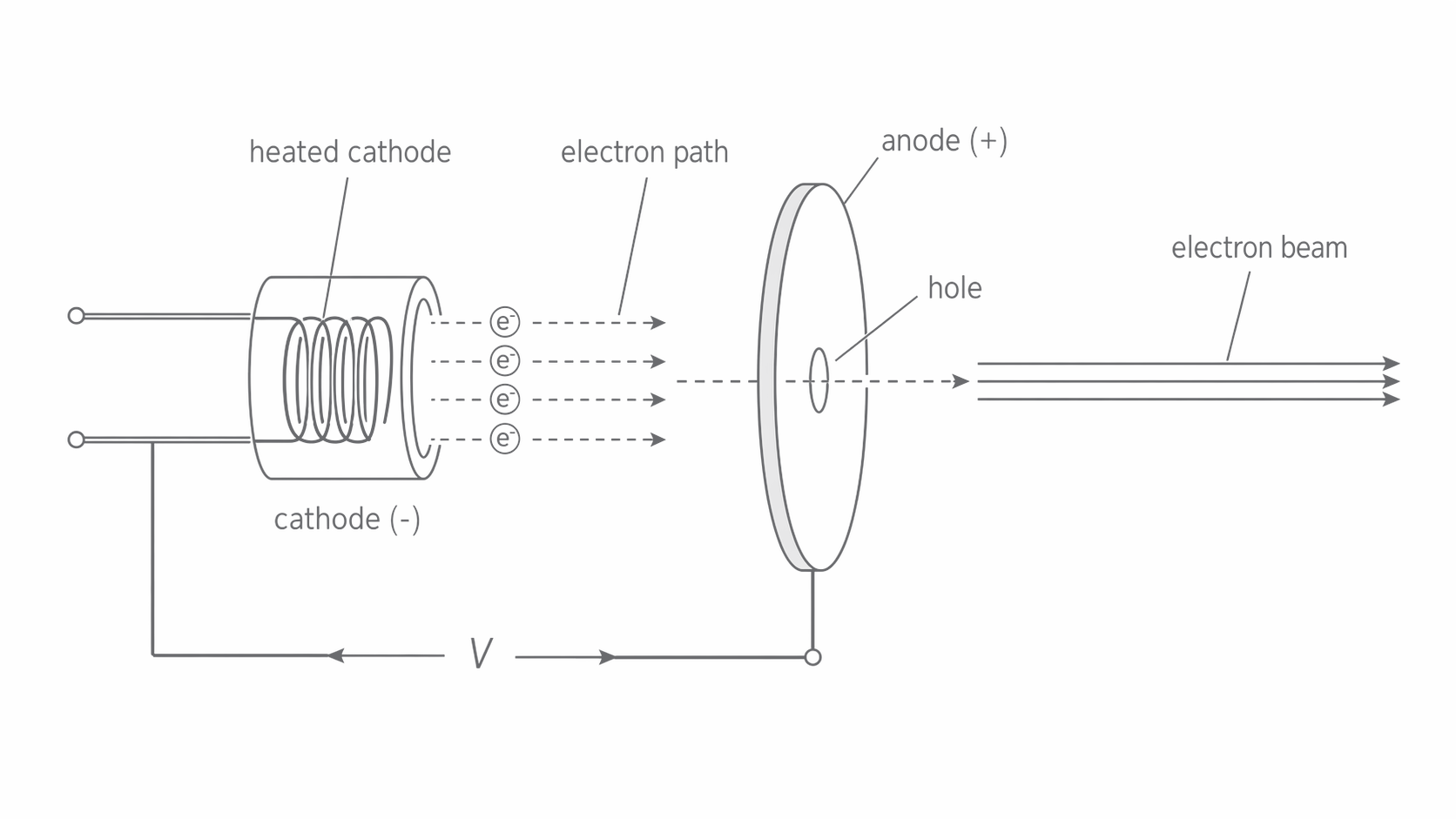
This sketch shows the gun geometry rather than the complete supply circuits. Both free filament leads connect to the heater supply, which is omitted; the lower label marks the separate accelerating potential difference. Its arrows are not electron-flow arrows.
After the anode, electrons travel at constant velocity only where the resultant force is negligible. An aperture does not automatically make every nearby electric field zero: this is an idealisation for the field-free region beyond it. Later electric or magnetic fields can change the beam's motion.
Work done by the accelerating field
Potential difference is energy transferred per unit charge. Write for the positive magnitude of an electron's charge; the electron itself has charge . When it moves to an anode at a potential higher than the cathode, its potential-energy change is . The electric field therefore does positive work on it.
Continue this lesson.
You’re previewing NovaLearn without an account. Create a free account to read the rest.
Create free account