3.11.2.1 - First Law of Thermodynamics
Track energy transferred by heating and by work, using the AQA sign convention to explain changes in a gas and energy transfers over a complete cycle.
Systems and internal energy
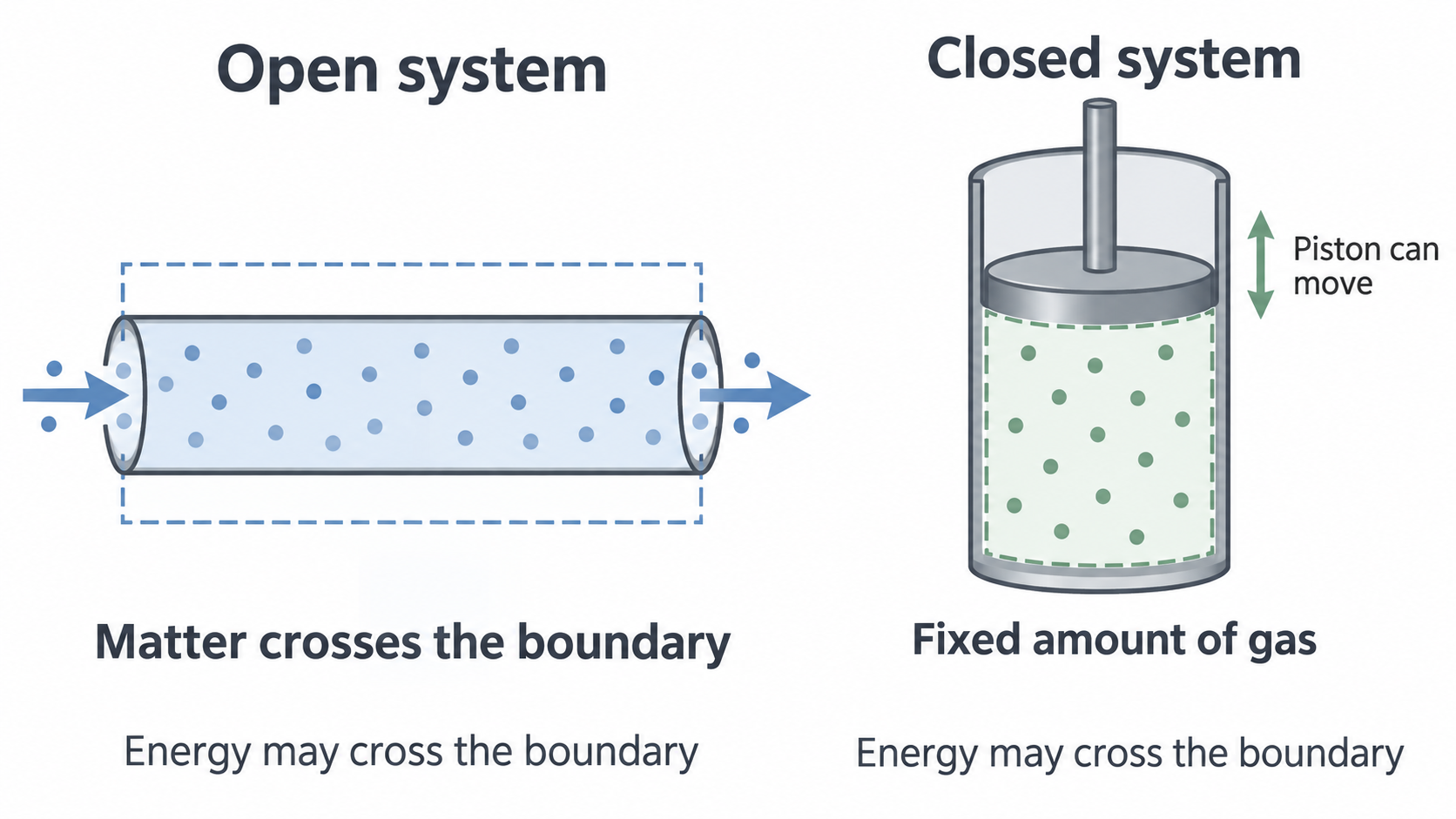
A system is the matter we choose to study. Its boundary separates it from its surroundings. A sealed gas cylinder is a closed system: no matter crosses the boundary, although a piston may move and energy may cross. A pipe carrying gas is an open system because matter enters and leaves.
[DIAGRAM: asset_name: C.2.1 - First Law of Thermodynamics - Diagram 1; asset_slug: C.2.1 - First Law of Thermodynamics - Diagram 1; caption: An open system exchanges matter, a closed system keeps the same particles even when its boundary moves.; description: An open system exchanges matter, a closed system keeps the same particles even when its boundary moves.]
Internal energy, , is the sum of the randomly distributed kinetic and potential energies of the particles. It excludes the kinetic energy of the whole cylinder moving through a room. Internal energy is a state function: returning to the same thermodynamic state returns the system to the same internal energy.
For a fixed amount of ideal gas, internal energy depends only on temperature. For substances in general, temperature alone does not determine internal energy: a change of phase can change potential energy at constant temperature.
The first-law energy balance
Heating and work are ways of transferring energy across the boundary; they are not separate stores of energy inside the gas. For a closed system with no relevant change in bulk kinetic or gravitational energy, conservation gives:
First law: work done by the system
is energy transferred to the system by heating, is its increase in internal energy and is work done by the system. All three are in joules. This lesson considers pressure–volume work; if electrical work or stirring is supplied, it must also be included consistently.
If a gas receives by heating and transfers to a piston, its internal energy increases by . Heating need not raise the temperature by itself: compare the heat input with the work output.
Assigning signs before calculating
Assign signs from the direction of each energy transfer before substituting numbers. The work convention must stay the same throughout a calculation.
| Quantity | Positive | Negative |
|---|---|---|
| Energy enters by heating | Energy leaves by heating | |
| Gas does work on surroundings | Surroundings do work on gas | |
| Internal energy increases | Internal energy decreases |
For expansion against a positive external pressure, . For compression, . Expansion into a vacuum is an important exception: there is no resisting force, so no work is transferred.
Worked compression: of work is done on a gas while leaves by cooling. Thus , and
The gas gains internal energy despite losing energy by heating. A book using work on the gas writes , with ; these are the same physics.
Continue this lesson.
You’re previewing NovaLearn without an account. Create a free account to read the rest.
Create free account