3.6.2.2 - Ideal Gases
Use measured gas-law relationships to connect pressure, volume, temperature and amount of gas. Convert between molecular and molar descriptions, recognise the limits of the ideal model, and calculate work during expansion.
Experimental gas laws and their controls
The gas laws are empirical: they summarise experiments. Each simple relationship keeps both the amount of gas and one other variable constant. A sealed sample fixes the amount; it does not necessarily fix the volume if its boundary can move.
| Law | Constant quantities | Relationship |
|---|---|---|
| Boyle's law | Amount and temperature | |
| Charles's law | Amount and pressure | |
| Pressure law | Amount and volume |
Here is absolute temperature in kelvins and is absolute pressure, measured from vacuum. A gauge often reads pressure above atmospheric pressure: then . Using the gauge reading alone changes the proportionality.
For Boyle's law, doubling pressure halves volume. A plot of against is an inverse curve; a plot of against is a straight line through the origin. Its gradient is the constant . A straight line with a nonzero intercept is linear, but does not show direct proportionality.
[DIAGRAM: asset_slug: 6.2.2 - Ideal Gases - Diagram 1; caption: Two equivalent plots of Boyle’s law; description: Equivalent inverse-volume and reciprocal-volume plots for a fixed amount of gas at constant temperature.]
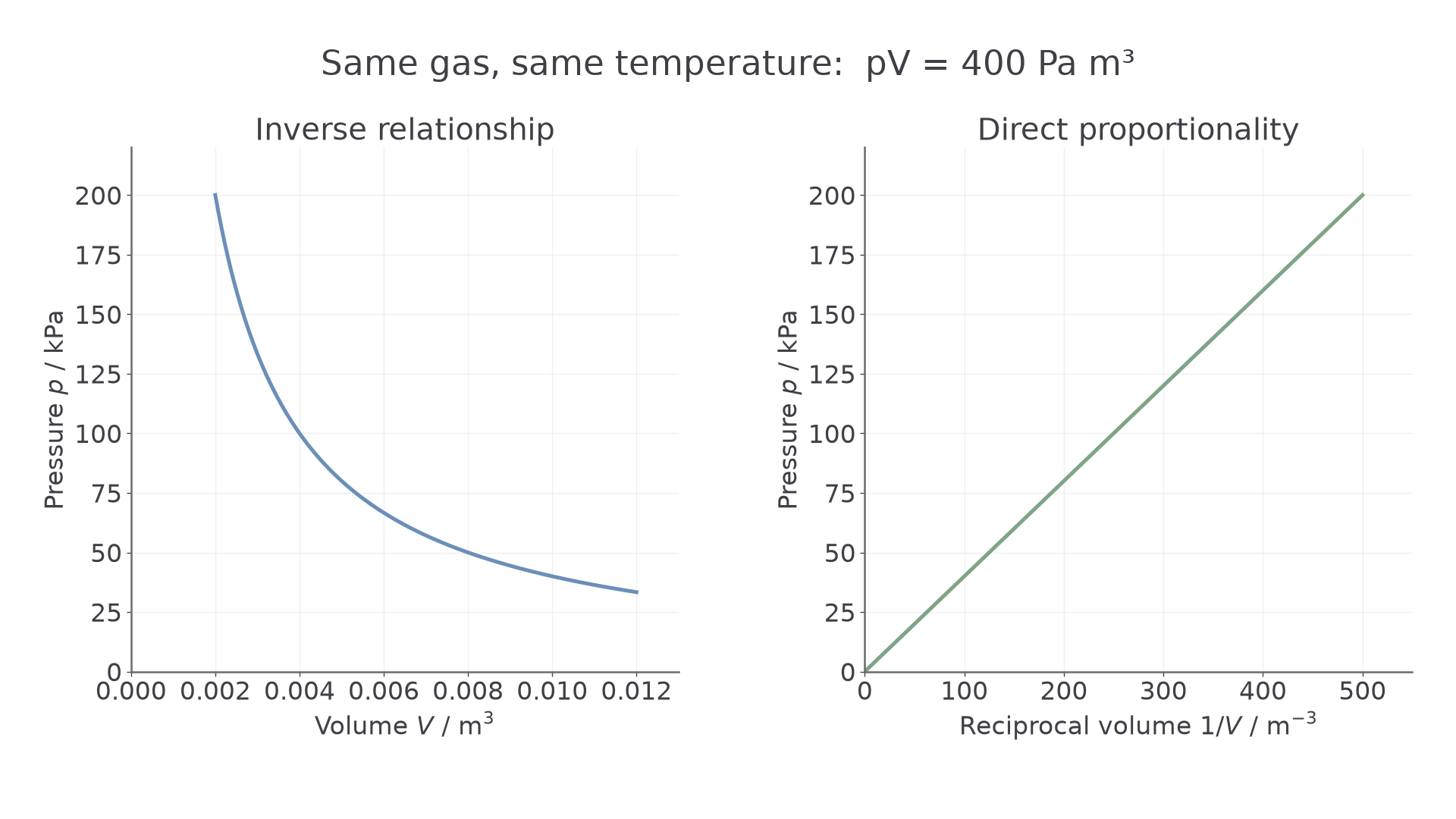
These exact illustrative curves both represent . The reciprocal-volume axis has unit .
These relationships describe equilibrium states. Rapid compression heats a gas, so its immediate pressure is not a Boyle's-law measurement at the original temperature. Compress slowly and wait for thermal equilibrium. For Charles's law a movable boundary allows expansion while pressure stays constant; a rigid sealed flask instead follows the pressure law when heated. Required practical 8 investigates Boyle's and Charles's laws with these controls.
Absolute temperature and extrapolation
The Celsius zero is a chosen reference, so doubling a Celsius temperature does not double the thermal state that controls gas behaviour. Absolute zero is , equivalent to . For the ordinary gases and thermal processes in this course, absolute temperature cannot be negative.
Temperature conversion
A Celsius interval and a kelvin interval have the same size. Heating from to changes from about to : the ratio is , not 2. The temperature difference is , not . Use 273 instead of 273.15 when appropriate to the data precision.
For a dilute gas at fixed volume, pressure plotted against Celsius temperature is approximately linear. Extending the fitted trend to zero pressure estimates an intercept near . At fixed pressure, a volume-versus-Celsius plot gives the same ideal extrapolated intercept. Plotting either quantity against kelvin temperature instead gives direct proportionality.
This is an extrapolation, not a way of experimentally shrinking a real gas to zero volume. Real gases condense or depart from ideal behaviour before reaching the extrapolated point. In the classical ideal-gas model the random translational kinetic energy tends to zero as tends to zero; do not infer that all microscopic motion in all matter literally ceases. A line continued into negative kelvin temperatures is outside the ordinary gas model's physical domain.
Moles, molecules and the ideal gas equation
For a fixed amount of gas, the three experimental laws combine to make constant. Increasing the amount at fixed and raises pressure in proportion. An ideal gas obeys
Two ways to count the gas
Use in , in and in . Here is the amount in moles and the number of particles. Helium particles are atoms; nitrogen particles are molecules. One mole contains particles, so
Substitution gives , where . With , this gives . The two forms are the same model, expressed per mole or per particle.
Continue this lesson.
You’re previewing NovaLearn without an account. Create a free account to read the rest.
Create free account