FS1 7.3 - Generating functions of sums
Independent observations combine by multiplying their PGFs. You will extract sum probabilities, recognise distributions after simplifying products, and handle shifted or weighted totals with the correct independence assumptions (FS1 7.3).
Two fresh observations are different from twice one observation
Is tossing two fair coins equivalent to tossing one fair coin and recording its result twice?
Let a head score and a tail score . Both procedures have expected total , but two fresh tosses can score , whereas doubling one score gives only or . Their different PGFs will expose the distinction immediately.
You already know
For a PGF, probabilities are coefficients and . From value transformations, . From the moment lesson, derivatives at one give the mean and variance. Equal means do not imply identical distributions.
Independence supplies a new operation: multiplication. It is a condition on the observations, not a consequence of giving them different names.
PGF of an independent sum
If and are independent, then for ,
Use the product where both expectations exist. No derivation of this rule is required.
In the formula booklet.
Repeat the rule for mutually independent : the sum's PGF is . If they also have the same distribution, it is . These repeated-product forms are consequences of the supplied two-variable rule, rather than separate printed formulae.
For the opening fair scores, . Independence gives
By contrast, doubling one score gives
The coefficient at is in the first expression and zero in the second. The same average hides a completely different possibility of an odd score.
Key idea
Independent copies produce powers of the PGF. Multiplying one random value changes the PGF's argument. In general, .
The following check asks about one observation, so no independence assumption can turn it into two fresh observations.
Multiplication collects every way to make a total
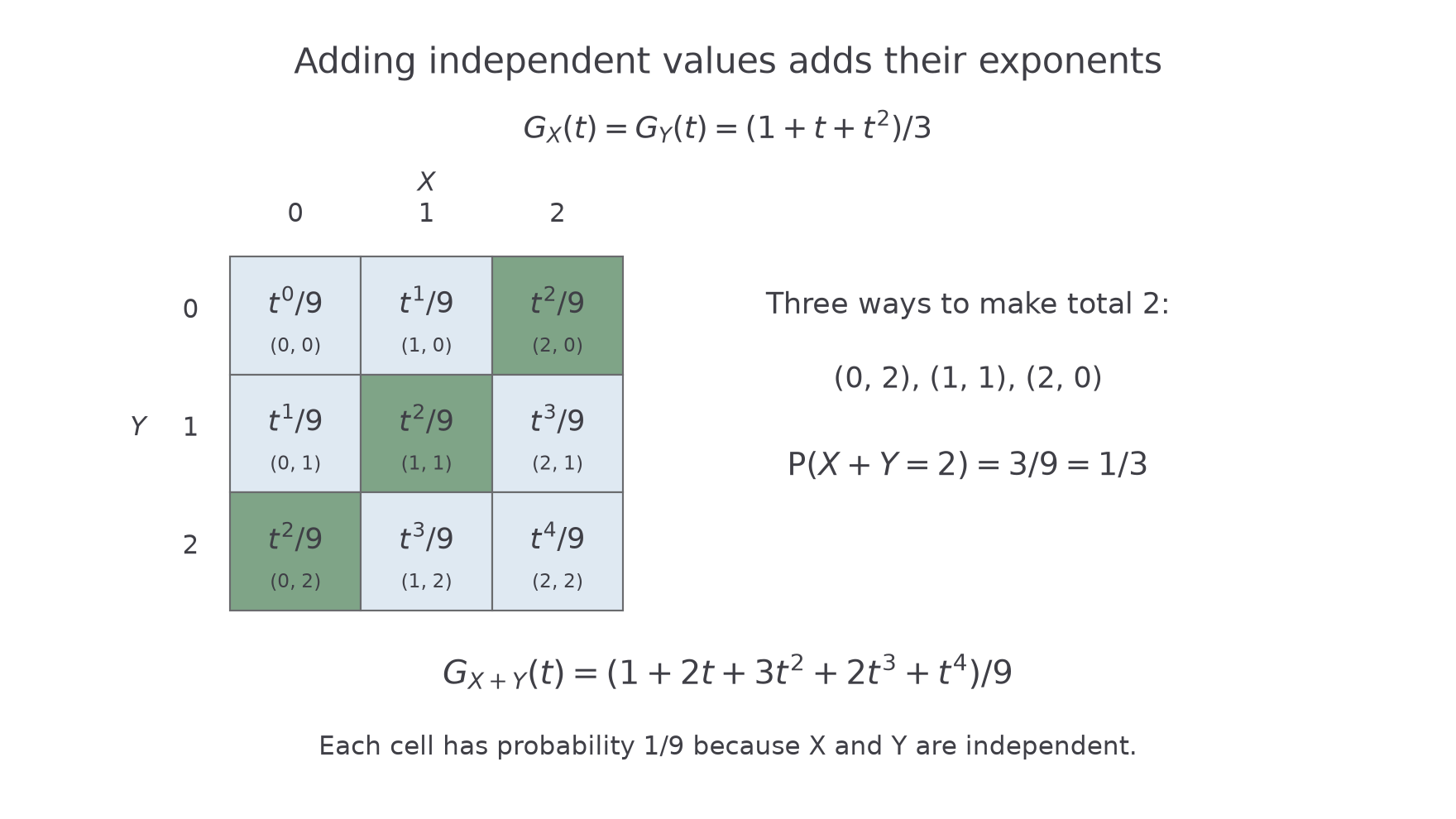
The coefficient of a total's power collects all pairs of exponents that add to it.
In the product , a term with power times a term with power contributes to power . Under independence its coefficient is , the probability of that pair. Add all contributions to the required total.
[DIAGRAM: asset_name: Coefficients collect pairs with the same total; asset_slug: 9fm0-fs115-sum-coefficients; caption: Three independent outcome pairs contribute to the coefficient for total two; description: A three-by-three grid has X and Y values zero, one and two along its headers. Each cell shows its pair and the term t to the power of the pair sum divided by nine. The three cells for pairs zero comma two, one comma one and two comma zero are sage; the other cells are pale blue. A side panel gives probability of total two as three ninths, and the expanded sum PGF below is one plus two t plus three t squared plus two t cubed plus t to the fourth, all divided by nine.]
Worked example 1: adding two equal discrete distributions
Question. Independent variables each take with equal probabilities. Find the PGF of , and hence find .
Plan. Square the individual PGF and read its quadratic coefficient.
Why this step? The quadratic term comes from , and . Reading only the middle pair would lose two valid possibilities.
Answer. , with .
Check. There are nine equally likely pairs and three have total ; the expanded coefficients add to .
Worked example 2 changes only the number of independent observations, from to . The individual distribution and target total remain unchanged.
Worked example 2: adding a third observation
Question. For three independent variables with the same distribution, find the PGF of , and hence .
Plan. Cube the PGF, counting only products contributing to power .
Why this step? You can obtain total with one value , in three positions, or two values , in three pairs of positions. A full cubic expansion is unnecessary.
Answer. , and .
Check. The six permitted ordered triples each have probability . Also .
For unequal distributions, multiply their different PGFs instead. The powers still collect totals; identical distributions are needed only to replace a product by a power of one common function.
Watch out
Wrong: add the PGFs to obtain a sum distribution, or multiply coefficients at the same power only. Right: multiply the functions and collect every exponent pair making the required total. Adding PGFs gives value , rather than , at .
Increase the number of copies once more.
Recognising the distribution after multiplying
Simplify the product, then match it to a supplied standard PGF, accounting for any shift in the variable.
The following are consequences of the independent-product rule and the supplied standard PGFs; they are not separately printed sum-distribution rules.
| Independent variables | Product PGF | Distribution of the sum |
|---|---|---|
The binomial and negative binomial rows require the same . In particular, a sum of independent geometric trial counts with common is . Different probabilities do not generally combine into one of these standard forms.
For example, independent Bernoulli probabilities and give product , not the of . Their mean alone does not identify the sum distribution.
Worked example 3: a nonstandard pair produces a standard wait
Question. Independent each have PGF . Let . Find , identify the distribution of , and find exactly.
Plan. Multiply the two PGFs, include the shift factor, then match the geometric trial-count form.
Why this step? Both operations are needed: multiplication combines the independent values, while the outside adds . Omitting either changes the variable.
Answer. , , and .
Check. The PGF's first non-zero power is , with coefficient ; that matches a first-success trial count starting at .
Continue this lesson.
You’re previewing NovaLearn without an account. Create a free account to read the rest.
Create free account