CP 3.3 - Matrices for 2-D transformations
A transformation matrix turns a geometric instruction into a calculation on coordinates. You will build and recognise matrices for reflections, rotations, stretches and enlargements in two dimensions, and use the images of two simple vectors to explain their entries.
Building a matrix from two images
A point is reflected in the line . Can you write one matrix that reflects every point in that line? Finding where and go will do the whole job.
You already know
A point has position vector . Matrix multiplication uses rows from the left factor and columns from the right. From coordinate geometry, reflection in swaps the coordinates.
Take . Applying it to the two unit vectors gives
These images are the first and second columns. Since , their images determine every other image by the same linear combination.
Linear transformation
A linear transformation preserves addition and scalar multiplication: and . A matrix acting on column vectors gives such a transformation. In particular, the origin stays at the origin. A non-zero translation is not represented by a matrix acting on , because it moves the origin.
For the four required reflections, track what happens to each coordinate. The images of the unit vectors then give these matrices:
| Mirror line | Coordinate rule | Matrix |
|---|---|---|
| , the -axis | ||
| , the -axis | ||
The columns-as-images rule is not in the formula booklet: learn it. The booklet does give a reflection matrix from which the non-vertical mirror cases can be obtained.
Reflection in a line through the origin
For a mirror line ,
The line makes angle with the positive -axis. Use the direct coordinate rule for the vertical mirror line. In the formula booklet.
A full description names the transformation and the mirror line. “Reflection” by itself leaves the geometry incomplete.
Worked example 1: reflection in a coordinate axis
Question. Find the matrix for reflection in the -axis, and use it to find the image of .
Plan. Find the images of the two unit vectors, place them in columns, then multiply by the point's column vector.
Why this step? Reflection in the -axis reverses horizontal displacement, so it changes the -coordinate, despite the axis being named after .
Answer. The matrix is , and the image is .
Check. The midpoint of the point and image is , on the mirror line, and their joining segment is perpendicular to it.
The next example changes the mirror line to a diagonal. Both unit-vector images now move, so the non-zero entries sit off the main diagonal.
Worked example 2: reflection in a diagonal line
Question. Determine the matrix for reflection in , and find the image of .
Plan. Use to obtain the two matrix columns, then apply the matrix to .
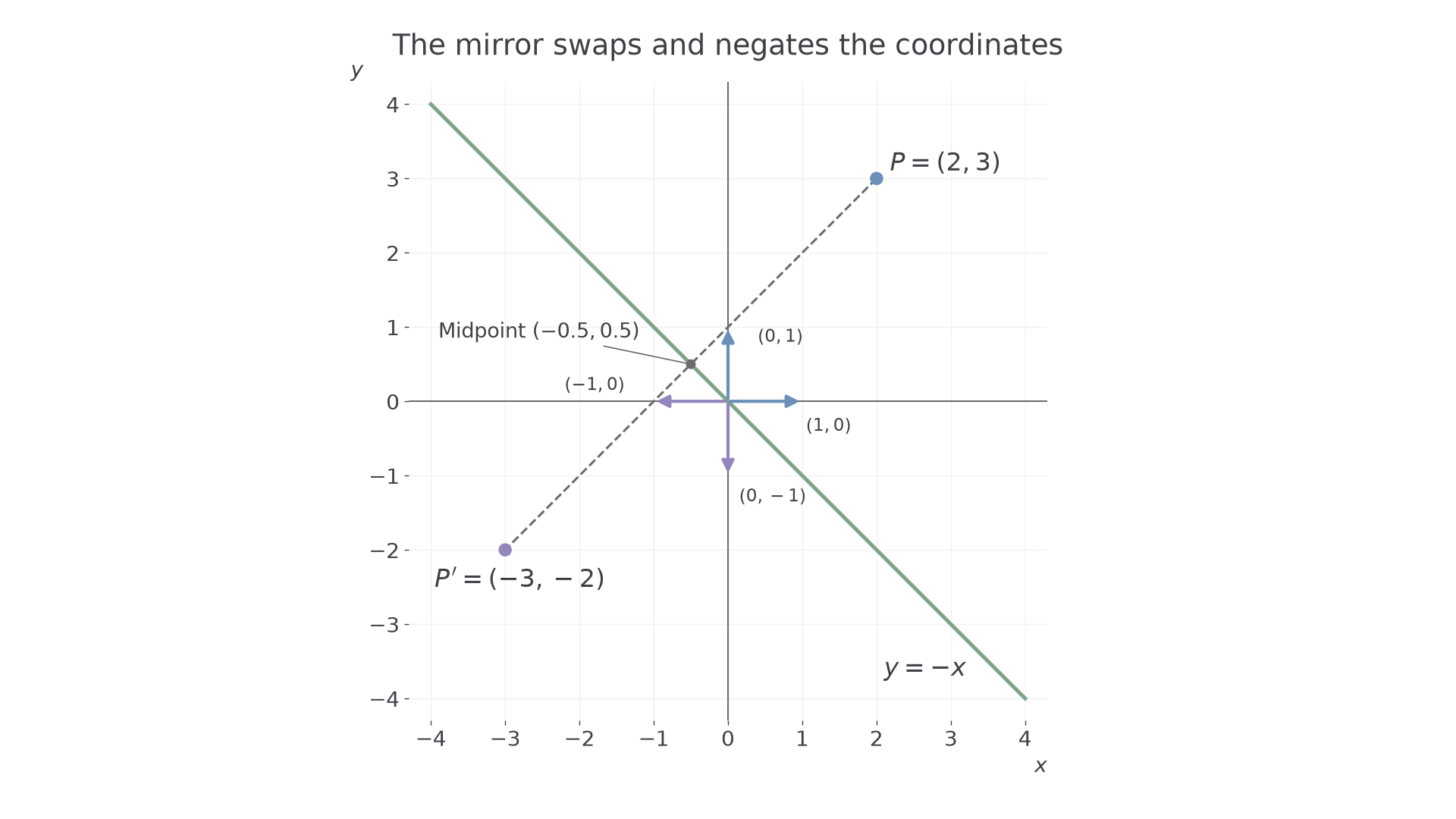
Why this step? Swapping alone reflects in . Reflection in swaps and negates both coordinates.
Answer. , and .
Check. The midpoint is , on . The joining segment has gradient , perpendicular to the mirror's gradient .
The two points sit the same perpendicular distance from the mirror. This geometric check catches a wrong sign immediately.
[DIAGRAM: asset_name: Reflection of a point in y equals minus x; asset_slug: 9fm0-cp16-reflection; caption: Reflection in y equals minus x swaps and negates the two coordinates; description: Equal-scale coordinate axes show P at (2, 3) and P prime at (-3, -2), joined by a dashed segment perpendicular to the mirror line y equals minus x. Their midpoint (-0.5, 0.5) lies on the mirror. Unit vectors and their reflected images show the two columns of the matrix.]
Watch out
Wrong: “ reflects in the -axis because its first entry is negative.” Right: it changes and keeps , so its mirror is the -axis. Test if you are unsure.
Try a different diagonal, keeping the column method.
Rotations through any angle
A rotation about the origin moves both unit vectors through the same angle, preserving their lengths and the right angle between them.
You already know
On the unit circle, the point at angle has coordinates . Positive angles are anticlockwise. Exact trigonometric values and the identities , let you handle clockwise angles.
After an anticlockwise turn through , the first unit vector becomes . The second starts a quarter-turn further round, so its image is . Put these vectors in columns:
Rotation about the origin
An anticlockwise rotation through angle about has matrix
A clockwise rotation through uses . In the formula booklet.
Read the first column as a quick orientation check. For , must go to , not .
Worked example 3: an exact anticlockwise rotation
Question. Find the matrix for rotation through anticlockwise about the origin, and the image of .
Plan. Substitute the exact sine and cosine values, then multiply by the point's position vector.
Why this step? Exact surds preserve the exact rotation; rounded entries would only approximate it.
Answer. The matrix is , and the image is .
Check. The distance from the origin is still , and the image lies above the positive -axis.
The second example changes the angle to a clockwise one. Only the angle input changes; there is no separate rule to memorise.
Worked example 4: a clockwise rotation
Question. Find the matrix for rotation through clockwise about the origin, and use it to transform .
Plan. Use , keeping the two sine entries' signs distinct.
Why this step? The upper-right entry is , so a negative sine makes that entry positive.
Answer. The matrix is , and the image is .
Check. The image has length and lies below the positive -axis, as a clockwise turn requires.
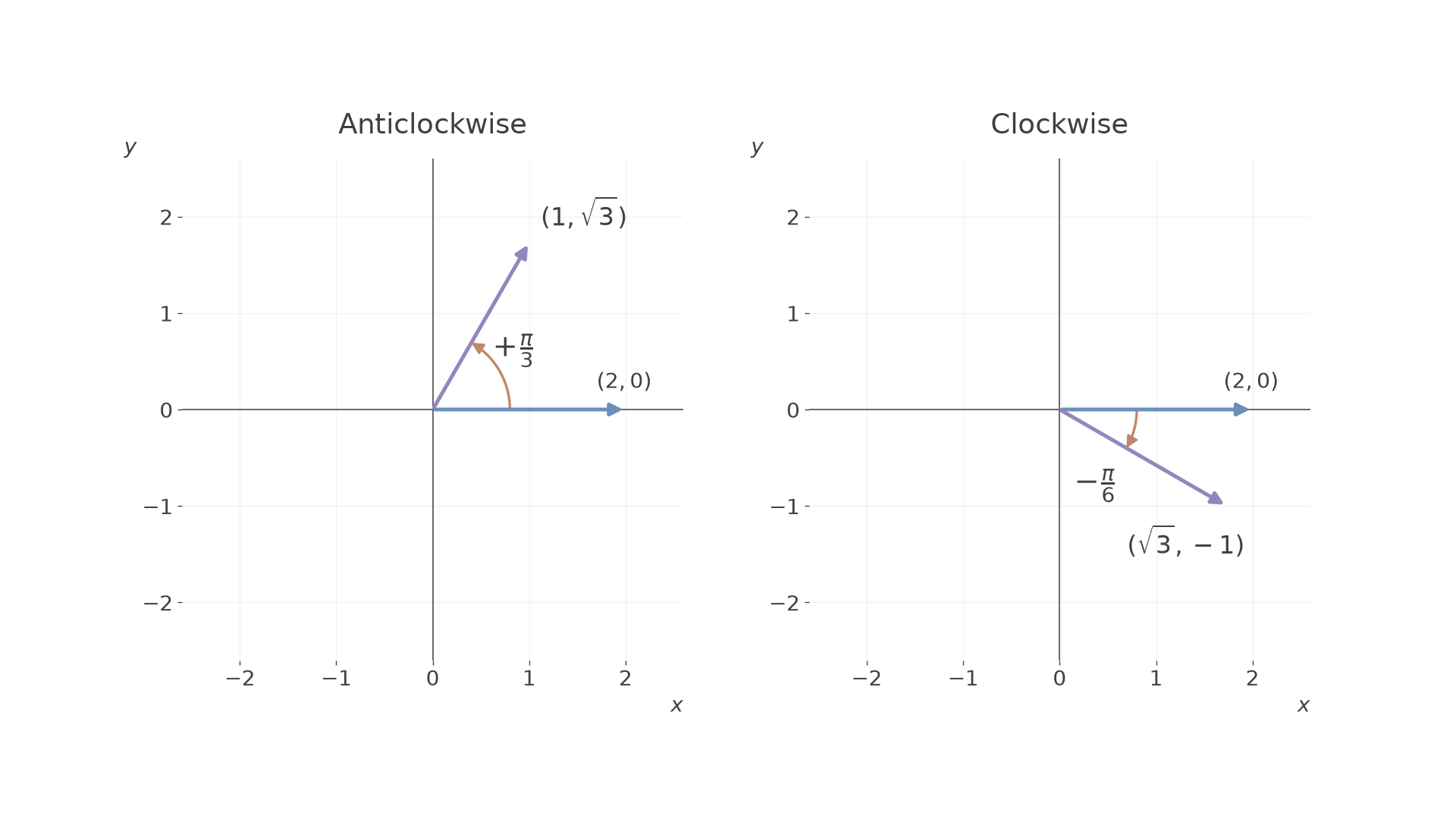
Both pictures use the same radius, so the effect of the sign is visible.
[DIAGRAM: asset_name: Positive and negative rotation angles; asset_slug: 9fm0-cp16-rotations; caption: Positive angles turn anticlockwise; negative angles turn clockwise; description: Two equal-scale coordinate panels show the vector (2, 0). The left panel rotates it anticlockwise by pi over 3 to (1, root 3); the right rotates it clockwise by pi over 6 to (root 3, -1). Arcs have arrowheads and endpoints are labelled.]
Watch out
Wrong: use a positive in the anticlockwise formula for a clockwise turn. Right: substitute . Checking the image of tells you which way the matrix turns.
A complete description gives the centre, angle and direction; a matrix alone does not supply those words for you.
Stretches and enlargements
A stretch changes one coordinate scale; an enlargement changes both by the same factor.
If horizontal distances are tripled while vertical distances stay the same, then . The unit vectors go to and , giving . A vertical stretch with factor instead sends to , giving .
Stretches and enlargement
A stretch of scale factor parallel to the -axis or -axis has matrix, respectively,
An enlargement of centre and real scale factor has matrix
A negative scale factor reverses the affected coordinate direction. Not in the formula booklet: learn it.
A scale factor between and reduces distances in the relevant direction. The word “stretch” describes the transformation family, not a promise that the picture gets bigger. An enlargement with is exactly a half-turn: both send every to . Two quite different descriptions can name the same transformation.
Worked example 5: stretching in one direction
Question. Describe fully the transformation represented by , and find the image of .
Plan. Read the coordinate rule from the product with , then substitute the point.
Why this step? Only is multiplied by , so this is a stretch parallel to the -axis, rather than an enlargement.
Answer. A stretch of scale factor parallel to the -axis; the image is .
Check. The horizontal displacement from the -axis triples, while the vertical coordinate remains .
The next example changes one feature: the same scale factor now acts on both coordinates. The image keeps its direction from the origin.
Worked example 6: scaling both coordinates
Question. Describe fully the transformation represented by , and find the image of .
Plan. Read the common diagonal factor, state the centre and scale factor, then transform the point.
Why this step? A common multiplier of the position vector scales every distance from the origin, so the origin is the enlargement's centre.
Answer. An enlargement of centre and scale factor ; the image is .
Check. The original distance is , and the image distance is . Both points lie on .
Check whether the scale factor acts on one coordinate or both.
Watch out
Wrong: is an enlargement of scale factor . It leaves the vertical coordinate unchanged. The correct description is a stretch of scale factor parallel to the -axis; enlargement by uses .
If , use the signed factor for coordinates and for the multiplier of distance. For example, sends to , on the opposite side of the origin at twice the distance.
Exam tip
For an enlargement, state the centre and signed scale factor. For a stretch, state the direction and scale factor. For a reflection, give the mirror line. Pearson asks you to “describe fully”: the missing geometric detail can cost a mark.
The opening reflection is now settled: its columns are and , and it sends to .
Quick Recap
- The images of and form the first and second columns of the transformation matrix.
- Reflections in the axes change one sign; reflection in swaps coordinates, and reflection in swaps and negates them.
- The rotation matrix uses positive angles anticlockwise and negative angles clockwise, about the origin.
- A stretch scales one coordinate; an enlargement about the origin scales both, with negative factors reversing direction.
The opening question needs : it reflects every point in , including .