FM2 3.3 - Toppling and sliding
A supported rigid body can lose equilibrium because the available friction is too small or because the required contact force reaches the edge of its base. You will calculate both boundaries, decide which occurs first, and check that the proposed event is physically possible. You will work with inclined planes and with horizontal or oblique applied forces.
At impending toppling the contact reaches an edge
Can making a floor rougher make a block topple rather than slide? Yes. Extra friction can prevent sliding long enough for the supporting pressure to reach an edge. We will compare the two boundaries rather than assuming that “rougher” means every kind of failure is delayed. A second useful surprise is that, for a body on an incline under weight alone, multiplying every mass by the same factor changes neither critical angle.
You already know
For coplanar equilibrium, resolve forces and take moments. Weight acts vertically through the actual mass centre G. From A-level Mathematics, friction satisfies , with equality at impending sliding. The normal reaction acts within the contact region; its position is found from moments, not fixed at the base centre.
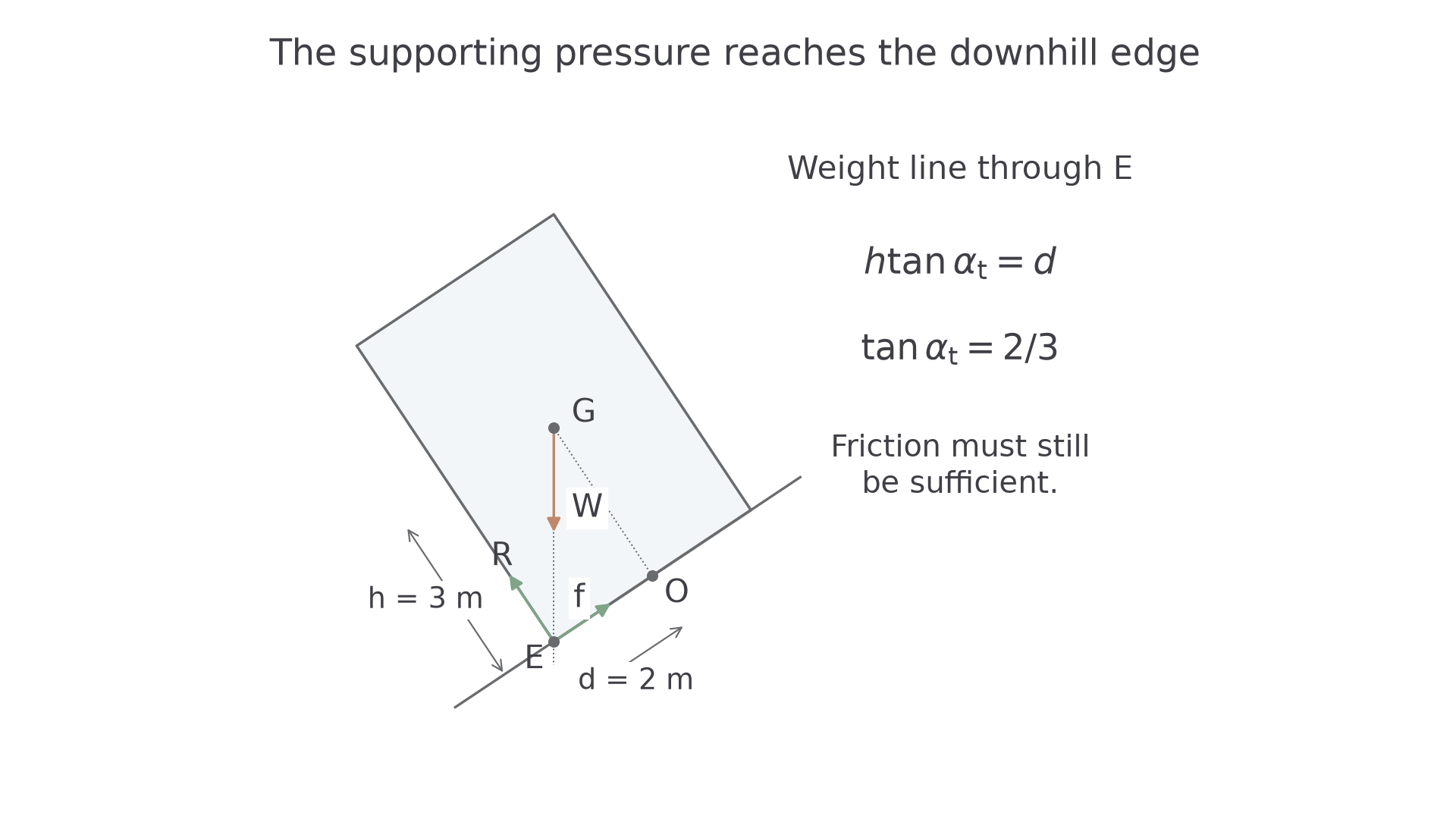
Imagine increasing an incline slowly while the body remains at rest. The normal resultant moves towards the downhill edge. At impending toppling it acts at that edge, leaving no supporting pressure on the uphill side. With only weight and contact forces, the vertical through G then passes through the downhill edge. Beyond this position, whole-base equilibrium is impossible.
Weight-only toppling on an incline
Let G be a perpendicular height h above the base plane. Let d be the distance, along the base, from its perpendicular projection to the downhill supporting edge. For , , and sufficient friction to prevent earlier sliding,
For a centred body with base width , . For a circular base tilted in an axial section, d is the appropriate radius when G is on its axis. Use the actual centre height, not the full body height.
Not in the formula booklet: learn it.
The same result follows by taking moments about the downhill edge E. The weight's downhill component has arm h, while its normal component has arm d: . The common W cancels. If G is off-centre, measure d from its projection to the particular edge about which the body would turn.
[DIAGRAM: asset_name: The critical weight line at a downhill edge; asset_slug: 9fm0-fm156-toppling-incline; caption: At the weight-only toppling boundary the vertical through G passes through the downhill supporting edge; description: An exact rectangular section of width four and height six is inclined at arctan two thirds. Its mass centre is three metres normal to the base centre. The vertical weight line passes through the downhill edge E. At E the normal and friction forces act, with base half-width two and centre height three identified in the right-triangle geometry.]
Worked example 1: a uniform block on a sufficiently rough plane
Question. A uniform cuboid has a rectangular section of base width and height . Its base rests on a plane that is slowly tilted. Friction is sufficient to prevent sliding. Find the inclination at which the cuboid is on the point of toppling.
Plan. Use centre height and downhill distance , then place the weight line through the downhill edge.
Why this step? Toppling depends on the height of G, halfway up a uniform cuboid. The full height is not the weight's moment arm.
Answer. The critical inclination is , to three significant figures.
Check. At that angle, , exactly the distance to the downhill edge. The friction assumption must allow .
Change only the mass distribution so that G lies on the same central perpendicular at height , while the outer dimensions stay fixed.
Worked example 2: raise the centre without changing the base
Question. The same cuboid-shaped body now has its centre above the base centre. Sliding is still prevented. Find its critical toppling angle.
Plan. Keep the downhill base distance , replacing only the centre height.
Why this step? Raising G makes the weight line move farther downhill for the same small tilt, so the supporting edge is reached earlier.
Answer. The body reaches impending toppling at .
Check. This is smaller than . The required friction ratio at the boundary is now ; a larger total mass would cancel from the moment equation again.
For a composite body, first calculate G from mass moments. Convert its coordinate to a height above the supporting base before applying the geometry. A distance measured from a top face is not automatically that height.
Watch out
Wrong: using a base diameter instead of its radius, a full body height instead of G's height, or a centre distance from the wrong end. Right: draw the section containing G and the downhill supporting edge, and label d and h directly on it.
Change only the centre height again.
Compare the sliding and toppling angles
“Sufficiently rough” removes one possible event from consideration. If the coefficient of friction is given instead, calculate both candidate boundaries. The smaller angle is reached first as a horizontal plane is slowly tilted from zero.
For a weight-only body before motion,
Impending sliding requires , so . Weight cancels here as well as in the toppling condition.
Which event occurs first?
For a body with centre height h, downhill base distance d, no other applied force, and a slowly increasing inclination ,
Compare the angles, or equivalently compare and :
| Condition | First boundary |
|---|---|
| Sliding | |
| Toppling | |
| Simultaneous impending sliding and toppling |
The later candidate assumes equilibrium could continue that far. Once an earlier boundary is reached, it is not a prediction of the body's subsequent motion.
Not in the formula booklet: learn it.
At a predicted sliding boundary, check that the normal resultant remains within the base. At a predicted toppling boundary, check that the required friction is no greater than the available limit. These checks confirm that the selected event can actually be reached first.
Worked example 3: a block slides before its pressure reaches the edge
Question. The uniform width-, height- cuboid rests on a plane slowly tilted from horizontal. The coefficient of friction is . Determine which event occurs first and its angle.
Plan. Use for toppling and for sliding, then compare.
Why this step? Reaching the toppling geometry is irrelevant if the plane cannot supply enough friction to hold the body until then.
Answer. Sliding occurs first, at .
Check. At this angle, the normal resultant is downhill of the base centre. Since , the supporting edge has not been reached.
Change only the coefficient of friction from to .
Worked example 4: the rougher plane changes the first event
Question. The same cuboid is on a plane with coefficient of friction , slowly tilted from horizontal. Find the first event and its angle.
Plan. Retain the toppling angle, recalculate the sliding candidate, and test the contact condition at the earlier one.
Why this step? Friction has changed, so the sliding boundary moves. The mass distribution and supporting width have not changed, so the toppling boundary stays fixed.
Answer. Toppling occurs first, at .
Check. At impending toppling, . Friction is below its limiting value; writing at this event would be incorrect.
The opening question now has a concrete answer. The rougher plane prevents the earlier sliding event, allowing the block to reach its unchanged toppling boundary. It does not increase that geometric boundary.
Watch out
Wrong: imposing limiting friction and impending toppling in every problem. Right: calculate the two candidates separately. Both equalities hold together only when the model gives simultaneous limiting events.
Change only the coefficient once more, to the boundary between the two cases.
Compare force thresholds on a horizontal plane
The parameter being increased may be an applied force rather than an incline angle. Consider a body of weight W whose centre lies directly above the centre of a base of width . A horizontal force F acts to the right at height H. On a horizontal plane, and the required friction has magnitude F.
At impending toppling about the right edge, the contact force has no moment about that edge. The push's clockwise moment balances weight's anticlockwise moment: . At impending sliding, .
Continue this lesson.
You’re previewing NovaLearn without an account. Create a free account to read the rest.
Create free account