CP 3.3 - Successive and 3-D transformations
Two transformations combine by matrix multiplication, with the first action written on the right. You will explain that order, calculate matrices for successive transformations, and extend the column-image method to reflections in coordinate planes and rotations about coordinate axes in three dimensions.
The first transformation acts on the right
Start with . Stretch horizontally by scale factor , then rotate anticlockwise through about the origin. Will reversing those two instructions give the same point? Your hands can perform the instructions in either order; matrix multiplication records precisely which order you chose.
You already know
The columns of a transformation matrix are the images of the unit vectors. Matrix products act on column vectors from the left. In two dimensions, is a quarter-turn anticlockwise, and is a horizontal stretch of scale factor .
Following the point gives . Its algebra is : the stretch has to reach first. Associativity lets you write this as .
Successive transformations
If represents the first transformation and the second, the combined matrix is
For three transformations, first , then , then , the product is . The orders must be conformable. Not in the formula booklet: learn it.
Writing the point at the far right is a useful way to decide the order. You can then calculate the combined matrix once and reuse it for every point.
Worked example 1: stretch then rotate
Question. A transformation is a stretch of scale factor parallel to the -axis followed by a rotation through anticlockwise about the origin. Find its matrix and the image of .
Plan. Write the rotation matrix to the left of the stretch matrix, multiply, then apply the product.
Why this step? The right-hand factor acts directly on the point, so the chronological first transformation must stand on the right.
Answer. , and the image is .
Check. Separately, , matching the combined product.
The second example changes one feature: the order of the same two transformations. This isolates exactly what the multiplication order controls.
Worked example 2: rotate then stretch
Question. Find the matrix for the rotation in Worked example 1 followed by its stretch, and find the image of .
Plan. Reverse the factor order, putting the stretch on the left, then transform the point.
Why this step? The stretch always changes the current horizontal coordinate. After the rotation, that coordinate came from the original vertical coordinate.
Answer. , and the image is .
Check. Separately, . This differs from , answering the opening question.
Order matters, but it does not always change the result. There is a useful exception: any enlargement about the origin, , commutes with every linear transformation of the same dimension, because . Scaling the whole picture before or after transforming it gives the same image. A one-direction stretch has no such general guarantee.
Watch out
Wrong: “ followed by gives .” Right: it gives . Put a point vector at the right and read which factor touches it first.
The next question changes the first transformation to a reflection; keep the same order reasoning.
Reflections in coordinate planes
In three dimensions, reflection in a coordinate plane changes the sign of the coordinate perpendicular to that plane and leaves the other two unchanged.
You already know
A three-dimensional point has position vector . The plane contains the - and -axes; the plane is the -plane.
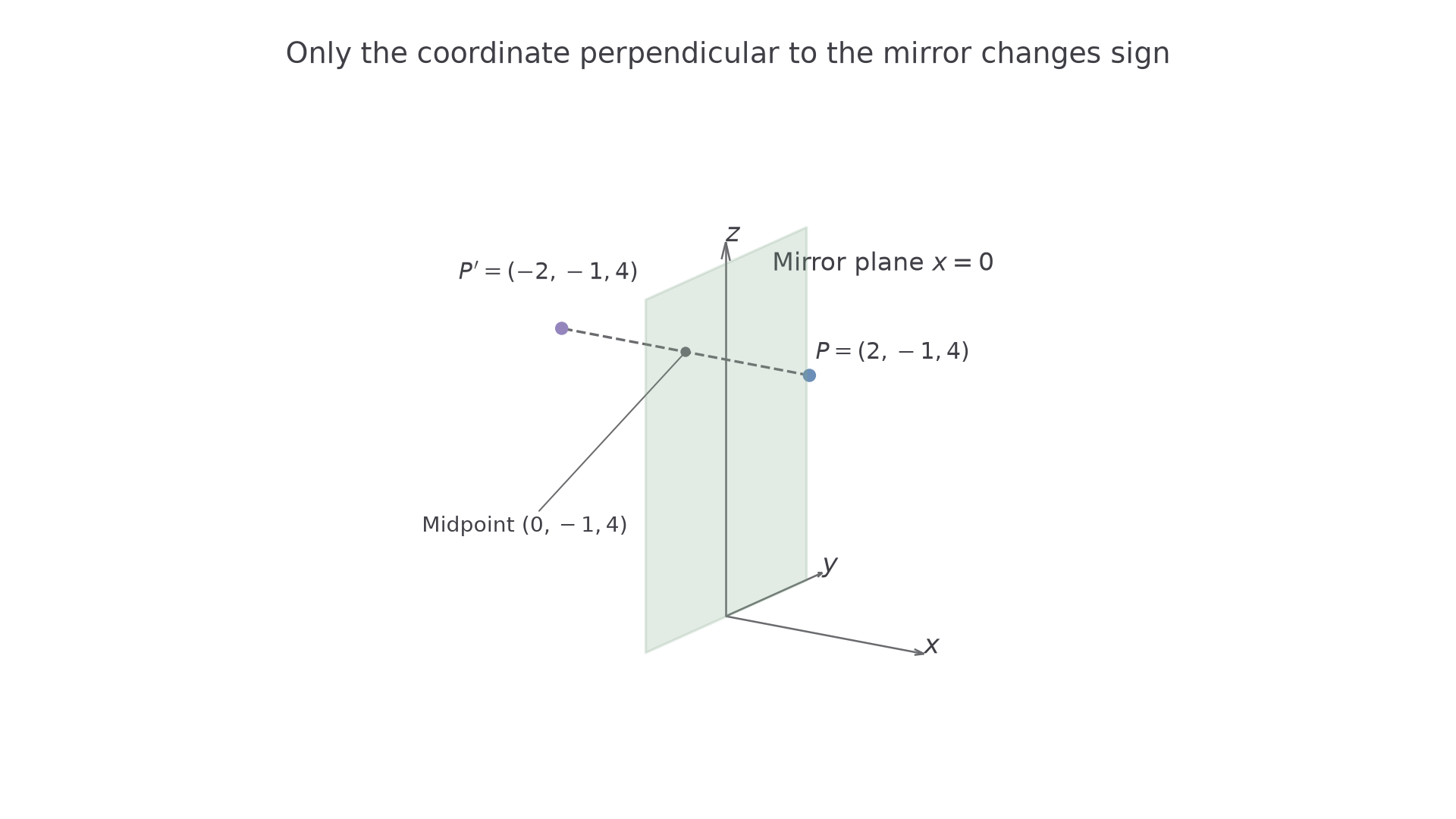
For example, lies two units from ; its reflection is . Their midpoint is in the mirror plane. Nothing has happened to the coordinates parallel to that plane.
The unit-vector idea now uses three columns: the images of , and , in that order.
Coordinate-plane reflections
Reflections in , and have matrices, respectively,
Not in the formula booklet: learn it.
Identify the plane by the coordinate that changes sign, rather than guessing from a drawing in perspective.
Worked example 3: reflection in x equals zero
Question. Find the matrix for reflection in , and the image of .
Plan. Negate the first coordinate and retain the other two, then write and use the three unit-vector columns.
Why this step? The -direction is perpendicular to , so only that displacement reverses.
Answer. , and .
Check. The midpoint is , and is parallel to the -axis, perpendicular to the mirror plane.
The second example changes only the mirror plane. The last coordinate now reverses instead of the first.
Worked example 4: reflection in z equals zero
Question. Find the matrix for reflection in , and the image of .
Plan. Keep the first two unit vectors fixed and reverse the third, then multiply.
Why this step? Reflection in a plane keeps both directions within the plane; negating all three coordinates would be a different transformation.
Answer. , and the image is .
Check. The midpoint belongs to , and both points are four units from it.
The picture separates the perpendicular displacement from the two coordinates that stay fixed.
[DIAGRAM: asset_name: Reflection in a three-dimensional coordinate plane; asset_slug: 9fm0-cp17-plane-reflection; caption: Reflection in x equals zero reverses the perpendicular coordinate only; description: A three-dimensional coordinate diagram shows the translucent plane x equals zero and the points (2, -1, 4) and (-2, -1, 4), joined through their midpoint (0, -1, 4). The x, y and z directions are labelled.]
Watch out
Wrong: call “the -axis”. It is a plane containing the other two axes. Right: describe this transformation as reflection in the plane , or the -plane.
For a different coordinate plane, locate the perpendicular direction first.
Rotations about coordinate axes
A rotation about a coordinate axis leaves that coordinate unchanged and rotates the other two in their perpendicular plane.
Direction needs a viewpoint. Here a positive rotation is anticlockwise when viewed from the positive end of the rotation axis towards the origin. This gives the right-hand convention: a positive turn takes towards about , towards about , and towards about . If a question specifies a different viewing direction, translate its instruction before selecting the angle's sign.
For a rotation about , the -coordinates follow the familiar two-dimensional rotation, while stays fixed. The same reasoning works cyclically in the - and -planes.
Coordinate-axis rotations
Write , , using the positive viewing convention above. Rotations about the -, - and -axes are
The two-dimensional rotation matrix is supplied, but these three-dimensional forms are not. Not in the formula booklet: learn it.
The signs in the -axis matrix deserve attention: the rotating pair is in cyclic order, rather than . For a positive quarter-turn it sends to and to , while keeping .
Worked example 5: rotation about the z-axis
Question. Rotate through anticlockwise about the -axis, viewed from positive towards the origin. Find the matrix and image.
Plan. Use the two-dimensional quarter-turn on , leaving unchanged.
Why this step? A point moves around the -axis in a plane of constant , so the last row must leave that coordinate unchanged.
Answer. The matrix is , and the image is .
Check. The -coordinate is still , and the squared distance from the axis is still .
The second example changes only the rotation axis, retaining the same angle, viewing convention and point. The fixed coordinate therefore changes.
Worked example 6: rotation about the x-axis
Question. Rotate through anticlockwise about the -axis, viewed from positive towards the origin. Find the matrix and image.
Plan. Fix and apply a positive quarter-turn to the ordered pair .
Why this step? The -coordinate belongs to the rotation axis, so it is the first coordinate that stays fixed this time.
Answer. The matrix is , and the image is .
Check. The squared distance from the -axis remains , and the first coordinate remains .
The coordinate along the rotation axis supplies a quick check on the answer.
Watch out
Wrong: the stated positive quarter-turn about the -axis sends to . Rotation about that axis must keep unchanged. The correct image is , from .
For other angles, the same matrices give, for example, . You can check the unchanged coordinate and the perpendicular distance without needing a complicated perspective sketch.
Problem-solving
For a three-dimensional rotation, first identify the fixed coordinate, then the direction of the turn from the stated viewpoint. Test one unit vector before transforming the whole point.
The opening two operations do give different answers: and . The geometric reason is that the horizontal stretch acts on a different direction after a quarter-turn. The product order captures that difference automatically.
Quick Recap
- means first, then ; reversing the order may change the result.
- In three dimensions, the images of , , form the three columns.
- Reflection in a coordinate plane reverses the perpendicular coordinate only.
- Rotation about a coordinate axis leaves that coordinate fixed. State the viewing direction when describing the turn.
Stretch then rotate sends to ; rotate then stretch sends it to . The two instructions do not commute.