FM1 5.1 - Oblique impact of two spheres
Resolve an oblique sphere collision along and perpendicular to the line of centres (FM1 5.1). You will combine momentum and restitution, retain each sphere's tangential component, calculate kinetic-energy loss and use a prescribed deflection to constrain the coefficient.
The impulse acts along the line of centres
Can a collision exchange the forward components of two velocities while leaving their sideways components with their original spheres? In the smooth-sphere model, the contact impulse acts along the line joining the centres. Components perpendicular to that line remain unchanged for each sphere.
The spheres in this lesson are smooth uniform spheres of equal radius moving on a smooth horizontal plane. Their masses may differ. We use a plan view; the impulse is horizontal, and no rotational model is needed.
You already know
For a direct collision, total signed momentum is conserved when external impulse is negligible, and when is initially behind in the chosen positive direction. Smooth contact preserves velocity components perpendicular to its impulse.
Choose the unit vector from the centre of towards the centre of at impact, and a perpendicular unit tangent . The approaching condition is . It concerns relative motion along the line of centres, rather than either sphere's full speed.
Oblique collision equations
For masses , with negligible external horizontal impulse,
Separately,
Use the same signed normal components in both equations, then rebuild each velocity vector.
Not in the formula booklet: learn it.
Total momentum is conserved in the plane, but the two normal equations are enough once the individual tangential components are known. Do not apply restitution to the full velocity magnitudes.
Worked example 1: equal masses with two tangential motions
Question. Two smooth spheres of equal radius and mass collide with their line of centres parallel to positive from to . Their initial velocities are
If , find both velocities after impact.
Plan. Preserve the two components, then solve momentum and restitution for the components .
Why this step? The tangential components stay with their own spheres; conserving only their combined tangential momentum would leave unnecessary unknowns.
Answer. , .
Check. Total momentum is before and after, and normal separation speed is half the approach speed .
Change only from to .
Worked example 2: exchange normal components, not whole velocities
Question. Repeat the collision for .
Plan. Keep both tangential components and update only the restitution equation.
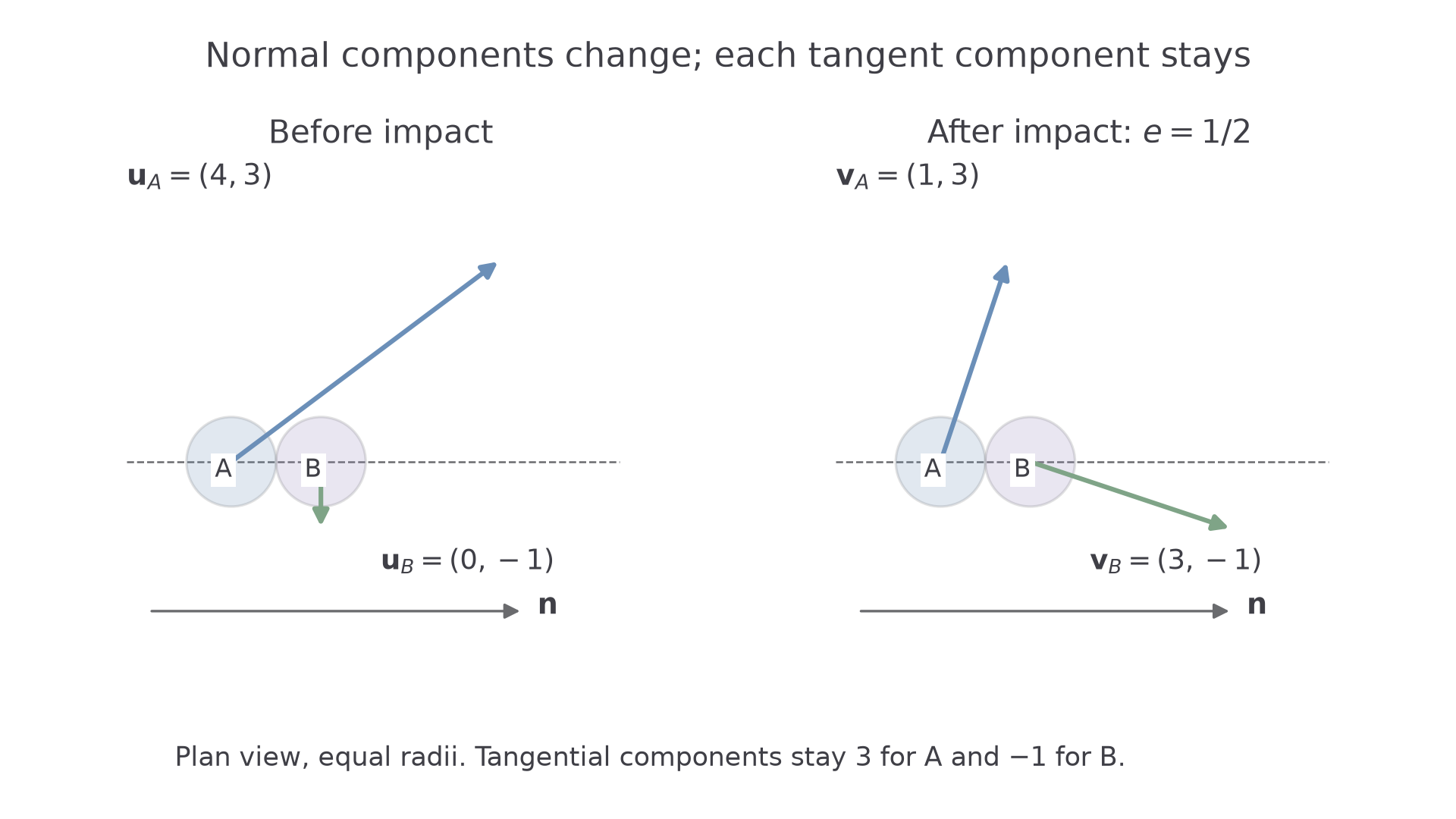
Why this step? Equal masses with exchange their normal components, but smooth contact does not transfer either tangential component to the other sphere.
Answer. , .
Check. still moves at speed ; a zero normal component does not mean it is at rest.
[DIAGRAM: asset_name: Normal exchange and separate tangential components; asset_slug: 9fm0-fm145-line-centres; caption: Smooth sphere contact changes the normal components but preserves each tangential component; description: A before-and-after plan view shows two spheres of equal radius, A left of B, with their horizontal line of centres labelled positive normal. Before impact A has velocity (4,3) and B has velocity (0,minus 1). After impact for coefficient one half, A has velocity (1,3) and B has velocity (3,minus 1). Velocity arrows are anchored at their sphere centres and a side panel identifies the unchanged tangential values 3 and minus 1.]
Watch out
Wrong: assume a sphere's final velocity follows the line of centres. Right: only its velocity change follows that line. A sphere with a non-zero initial tangential component retains it after impact.
Change only the coefficient again.
A sloping line of centres and unequal masses
The line of centres may be sloping in the given axes. Resolve both incoming velocities into one common normal-tangent frame, solve the normal problem, then return both answers to the original axes.
Here take
The labels refer to the collision geometry, rather than the floor's orientation.
Resolve and reconstruct in a common frame
For perpendicular unit vectors ,
Use the corresponding expressions for . The same line-of-centres momentum and restitution equations apply in this frame.
Not in the formula booklet: learn it.
A non-unit direction vector gives scaled scalar products; normalise before treating them as physical velocity components.
Worked example 3: unequal masses in a rotated frame
Question. Equal-radius spheres have masses , , and incoming velocities
The line of centres from to is parallel to , and . Find both final velocities.
Plan. Project into the stated frame, conserve mass-weighted normal momentum, then reconstruct.
Why this step? The unequal masses weight momentum, but do not enter the relative-speed restitution equation.
Answer. The final velocities are and .
Check. Their mass-weighted sum is , equal to the initial total momentum. Their normal components separate at speed .
Change only 's mass from to , keeping its radius, incoming velocity and the other data unchanged.
Worked example 4: change the mass weighting
Question. Repeat the preceding collision with .
Plan. Retain the component projections and restitution equation, but replace the momentum equation.
Why this step? Reusing the old momentum equation would retain the old mass even though every incoming velocity component is unchanged.
Answer. The final velocities are and .
Check. The two vectors sum to , the initial total for the new equal masses.
The common frame prevents two different angles from obscuring a simple one-dimensional normal collision. The tangential parts are carried through separately.
Watch out
Wrong in Worked example 3: . Sphere has mass , so its normal momentum needs that weighting. Right: ; restitution still gives .
If a figure gives before-and-after directions, annotate its components with signs. Use the given geometry rather than introducing extra unknown angles, and return to notation when requested.
Change only 's mass once more.
Continue this lesson.
You’re previewing NovaLearn without an account. Create a free account to read the rest.
Create free account