FP2 4.1 - Further loci and regions
Find complete complex loci and regions involving distance ratios, argument quotients and intersecting restrictions (FP2 4.1). You will select the correct circle or arc, identify boundary intersections and retain every domain exclusion.
A fixed distance ratio can give a circle or a line
What does really draw: a whole circle, or only part of one? First we will extend familiar distance loci; then we will see why an argument equation needs more than its Cartesian circle equation.
You already know
For , is the distance from the point . Equal distances from two distinct fixed points give a perpendicular bisector. A modulus inequality selects a side of its boundary; simultaneous conditions mean intersection. Principal arguments lie in , and is undefined.
For , points are twice as far from as from . The unequal weights prevent the quadratic terms cancelling as they do for equal distances.
A distance-ratio equation
For fixed distinct and , write . Then
is equivalent to
For , this is a circle; for , the perpendicular bisector. For , it is the single point . Squaring is valid because both sides are nonnegative.
Not in the formula booklet: learn it.
If and the fixed points are distinct, the equality has no solutions. If the fixed points coincide, simplify the original equality first: gives the whole plane for , and just for .
Worked example 1: unequal distances give a circle
Question. Find the locus , giving its centre and radius.
Plan. Square both distances, collect terms and complete the square.
Why this step? The completed-square form locates the centre directly and makes the radius unambiguous.
Answer. The circle has centre , or coordinates , and radius .
Check. At , the distances are and , so the equality holds. This is the circle's leftmost point.
Change only the ratio factor from to .
Worked example 2: the circle case becomes a line
Question. Find the locus .
Plan. Use the same expansion and observe the cancellation of the quadratic terms.
Why this step? Equal coefficients make the quadratic terms cancel, giving the perpendicular bisector rather than a circle with a finite radius.
Answer. The complete vertical line .
Check. It passes through the midpoint of and , and is perpendicular to their horizontal joining line.
Keep the coefficient outside the modulus until you square the whole equality.
Watch out
The wrong squared right-hand side is . The factor must also be squared, giving . Otherwise the resulting circle is wrong.
Change the ratio factor again; the same Cartesian method still works.
Intersect a ratio region with a vertical strip
The boundary circle does not choose the shaded side. Retain the original inequality while simplifying, or use a test point after finding the boundary.
Region and strip conditions
For nonnegative distance expressions and , squaring preserves an inequality:
A real-part restriction
is the closed vertical strip , when . Strict comparisons exclude the corresponding boundaries. Combine conditions by intersection.
Not in the formula booklet: learn it.
For our distance pair, subtracting the squared right side gives
The negative coefficient is what controls the inequality reversal.
Worked example 3: the exterior within a strip
Question. Describe the region
Find where its circular and vertical boundaries meet.
Plan. Simplify the ratio comparison, intersect with the strip, then substitute the active vertical edge into the circle.
Why this step? The exterior, rather than the interior, satisfies the original ratio comparison.
Answer. Keep the exterior of the circle centred at , radius , within . All admissible edges are included. The boundary meetings are . The line does not meet the circle.
Check. At , , so the left edge belongs. At , the circle would require , which has no real solution.
Reverse only the distance comparison; leave the strip unchanged.
Worked example 4: the circular cap within the same strip
Question. Describe
including all active boundaries.
Plan. Reverse the previous circle inequality, then identify which strip edges actually meet the surviving set.
Why this step? The circle starts at , so is not an edge of this intersection.
Answer. The closed left cap of the disc cut by , bounded by the relevant circular arc and the chord from to . Its leftmost point is .
Check. satisfies the original inequality , so the chord's midpoint is included.
That last point matters: these conditions compare raw distances. Replacing the inequality by a quotient without checking would wrongly delete .
[DIAGRAM: asset_name: Opposite ratio regions inside the same strip; asset_slug: ratio-strip-intersections; caption: Reversing the ratio inequality exchanges the shaded overlap; only active portions form the region boundary.; description: Two equal-scale Argand panels show the circle centred at(3,0) with radius2 and strip0 at most x at most2. The left shades the circle exterior inside the strip and includes point0. The right shades the closed circular cap with1 at most x at most2 and includes point2. Active circular arcs and vertical edges are solid; unused boundary portions are faint guides. The meeting points are labelled(2,plus or minus root3).]
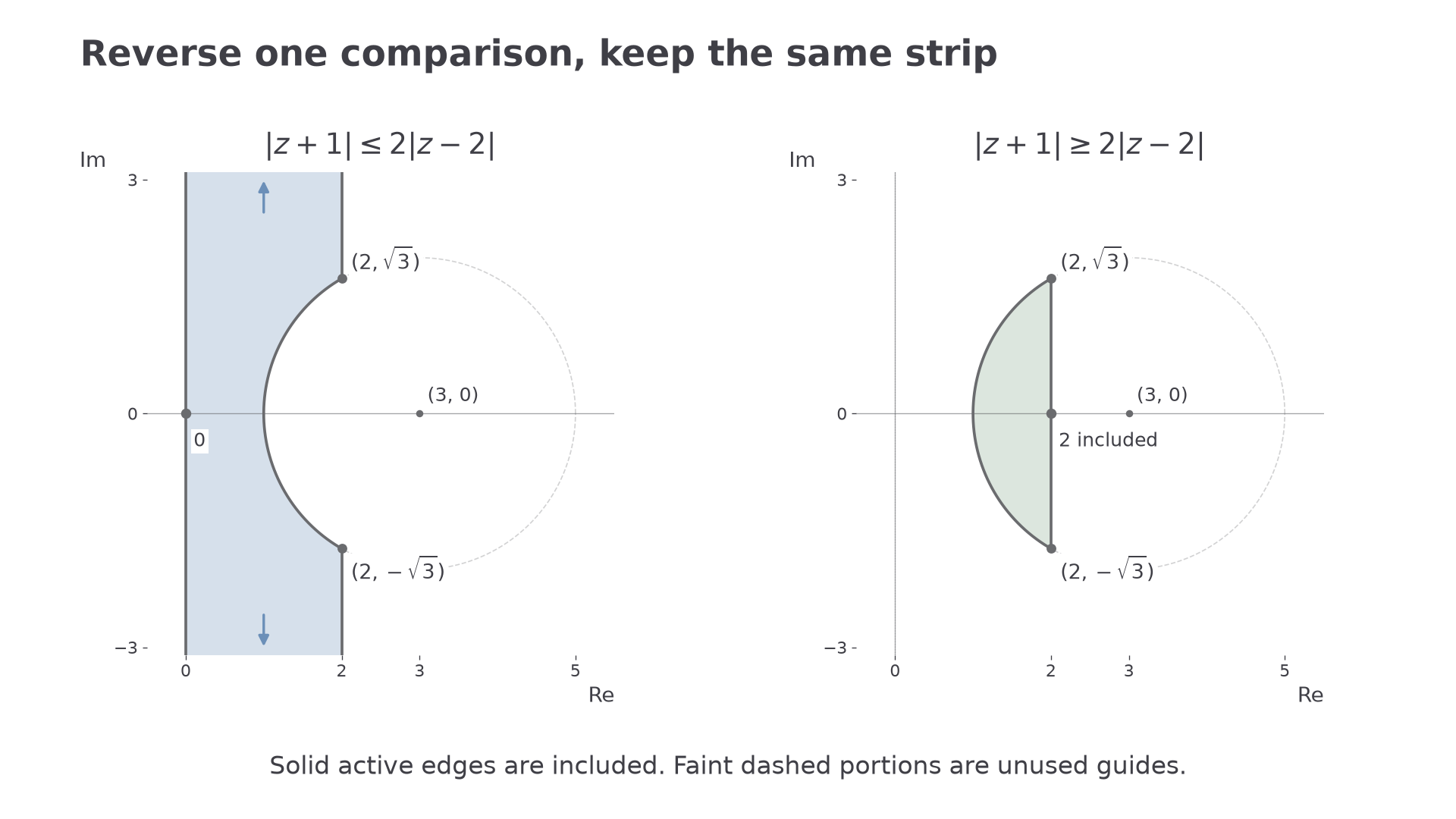
Choose the side from the original comparison, not from the appearance of its circle equation.
Watch out
The line is the wrong conclusion for . Dividing the simplified inequality by reverses it, so the correct side is .
Change the inside-cap comparison to a strict one and track the endpoints separately.
An argument quotient selects an oriented arc
The quotient must exist and be nonzero before its argument is defined. Thus both and are excluded when .
Geometrically, the argument fixes an oriented angle between the directions to the two fixed points. The supporting locus is a circle through them for a non-straight angle, but only the appropriate arc has the required principal argument.
Continue this lesson.
You’re previewing NovaLearn without an account. Create a free account to read the rest.
Create free account