FM2 5.1 - Variable acceleration in a straight line
Acceleration need not stay constant. The useful equation depends on whether it is given in terms of time, velocity or position. You will choose that equation, use initial conditions, and interpret the resulting motion, including changes of direction and speeds approached without ever being reached.
Choose the variable before integrating
A particle starts at , moving in the positive direction at . Its acceleration is always negative but becomes smaller in magnitude as it travels further. If its speed tends to zero, must it eventually stop at a finite position? Keep that question in mind: the last model will give a surprisingly definite answer.
You already know
In straight-line motion, signed velocity is , acceleration is , and speed is . Integrating velocity gives displacement; distance adds the magnitudes of the displacement changes between reversals. You can solve separable and first-order linear differential equations and use an initial condition to select a solution.
Choose an origin and positive direction, then let denote displacement from that origin. Negative means the particle is on the negative side; negative means it is moving in the negative direction. Negative acceleration does not always mean slowing down: if and , speed is increasing.
If acceleration is expressed using , introducing time first can make the algebra harder. The chain rule gives a direct route:
Use this on a branch where velocity can be treated as a differentiable function of position. At a turning point, need not be finite: use the motion on either side to interpret the point, rather than dividing by zero.
Straight-line rate equations
For signed displacement , velocity and acceleration ,
Choose the form that matches the given function and the quantity required. The last identity is used on an appropriate position branch as explained above.
Not in the formula booklet: learn it.
Here are the routes you will use. The same function letter stands for the particular function given in a problem, not one universal acceleration law.
| Given or already found | Useful equation | What it finds directly |
|---|---|---|
| Velocity as a function of time. | ||
| Position as a function of time. | ||
| Time and velocity, usually by separation. | ||
| Displacement and velocity without first finding time. | ||
| Velocity squared as a function of position. | ||
| Time and position, usually by separation. |
These are uses of the rate identities, not additional supplied formulae. For example, integrating gives . The initial velocity fixes ; its sign also helps select the physically appropriate branch when taking a square root.
The booklet's equations and are explicitly for constant acceleration. Substituting a changing value of into them does not extend their validity.
Key idea
Choose the derivative from the variable in the acceleration law and the quantity you want. Carry signed velocity throughout; check its sign before interpreting speed, distance or a square root.
You do not need a force equation when acceleration itself is given. First choose the direct kinematic route.
Integrate a time law and track reversals
When is given in terms of , integrate once for velocity and again for position. There are two initial conditions to use: an initial velocity does not determine the position constant.
For the following pair, is in seconds, is in metres and the signed acceleration is
in , for . Initially . The acceleration changes sign at ; whether the particle reverses there depends on its velocity, not just its acceleration.
Worked example 1: one reversal after starting from rest
Question. The initial velocity is zero. Find , , the displacement after seconds and the total distance travelled during those seconds.
Plan. Integrate twice with the separate initial conditions. Find the velocity zeros, then add the magnitudes of the position changes.
The velocity is positive for and negative for . Hence the particle reverses at .
Why split at , rather than ? Direction changes when velocity changes sign. At , velocity is , so the particle is still moving forwards.
Answer. , . The displacement is ; the total distance is .
Check. Differentiating gives , differentiating gives , and both initial conditions hold. Distance exceeds the magnitude of displacement because the particle returns for the last seconds.
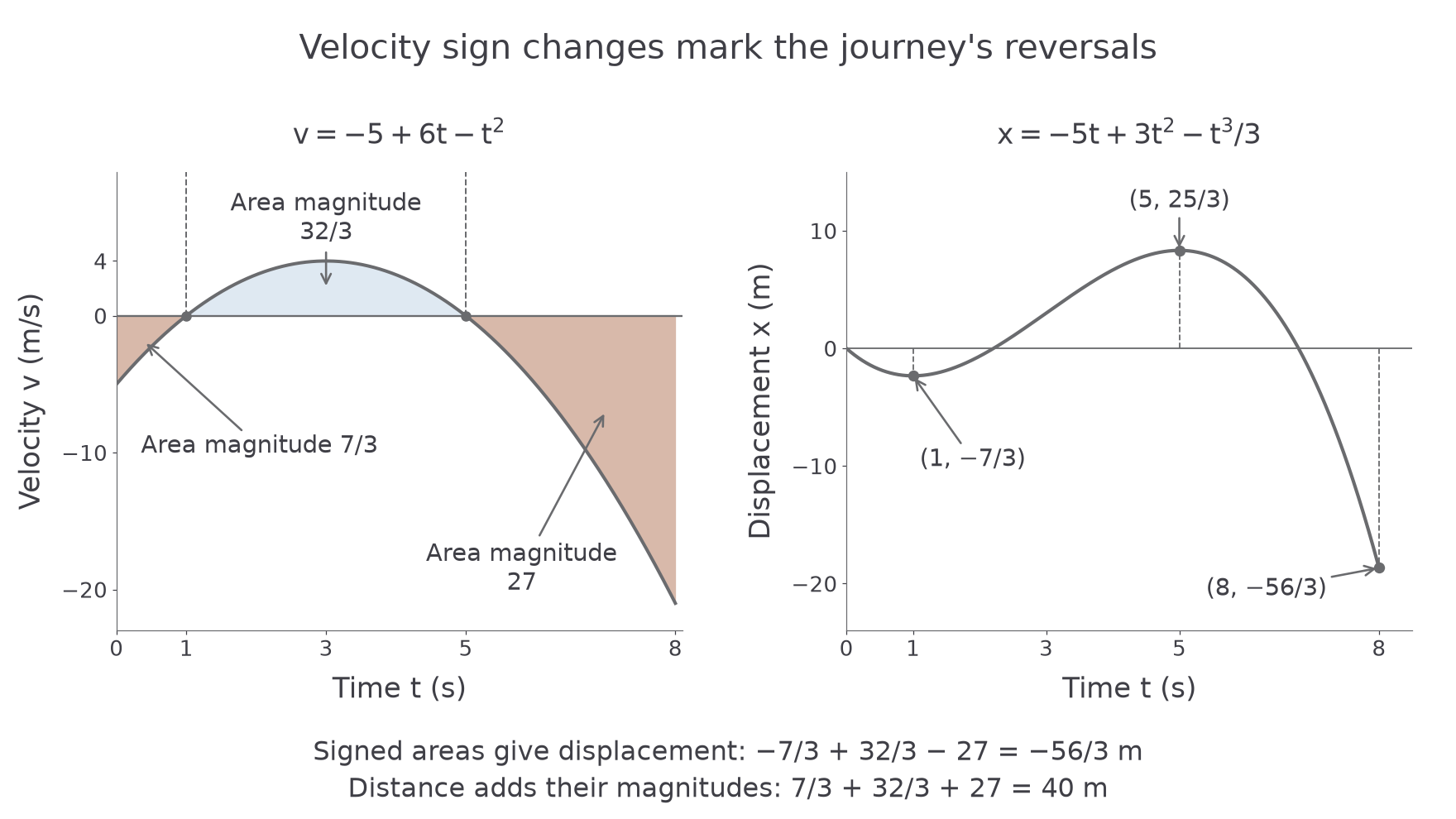
Worked example 2 changes only the initial velocity, from to . The acceleration, initial position and observation interval remain unchanged. There are now two reversals.
Worked example 2: a negative start and two reversals
Question. For the same acceleration and , take . Find , , the displacement after seconds and the total distance travelled.
Plan. Change the velocity constant, integrate with the same initial position, then split the journey at every velocity sign change.
The signs of are negative on , positive on , and negative on .
Why find both zeros? Using only the last reversal would cancel some earlier travel instead of counting it.
Answer. , . The displacement is , while the total distance is .
Check. The signed segment displacements add to . Adding their magnitudes instead gives , agreeing with the journey described.
The velocity graph makes the distinction visible: areas below the time axis contribute negative displacement but positive distance.
[DIAGRAM: asset_name: Velocity signs and distance through two reversals; asset_slug: 9fm0-fm2-157-reversals; caption: Split distance at velocity sign changes, not at zero acceleration; description: Aligned panels show velocity minus five plus six t minus t squared and position minus five t plus three t squared minus t cubed over three from zero to eight seconds. Velocity is below zero before time one, above zero between one and five, and below zero after five. Clay fills negative areas and blue fills positive areas, with area magnitudes seven thirds, thirty-two thirds and twenty-seven. Grey guides identify the two position turning points. The position values are minus seven thirds, twenty-five thirds and minus fifty-six thirds at times one, five and eight.]
Watch out
Wrong: assume makes every integration constant zero, or use to locate a reversal. Right: substitute each initial condition into its own expression, and use a change of sign of to identify a reversal.
Change only the initial velocity once more, keeping the same acceleration and interval.
Separate a velocity law for time or displacement
If acceleration is given in terms of velocity, integrating it as though velocity were time is invalid. Separate the variables first. Use for elapsed time, or for displacement.
Consider the acceleration law
with in seconds and in metres. The numerical law uses SI units. For the accelerating branch , both and are positive, so the logarithms below have positive arguments.
For time, separate and use partial fractions:
At , the logarithm is zero, so . Rearranging the time relation gives
This has for all finite , justifying the branch used. The speed tends to , but never reaches it at a finite time.
Continue this lesson.
You’re previewing NovaLearn without an account. Create a free account to read the rest.
Create free account