FM1 5.2 - Successive oblique impacts
Apply the smooth-wall component laws one collision at a time (FM1 5.2). You will check the order of impacts, change tangent-normal frames when surfaces are not perpendicular, and calculate the final motion and combined energy loss.
Track each velocity through perpendicular walls
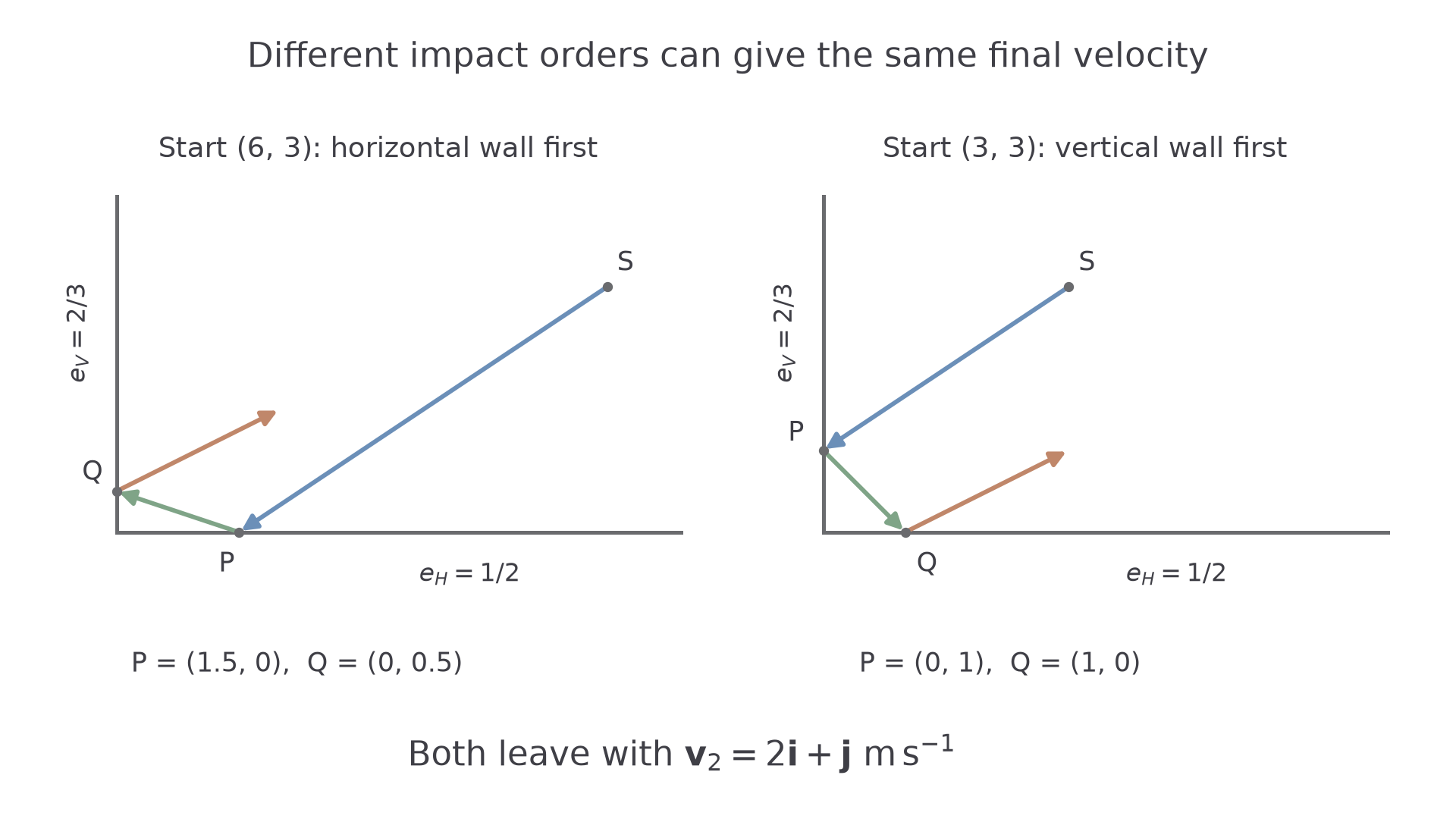
Can changing which wall a ball hits first leave its final velocity unchanged? For two perpendicular smooth walls, each collision changes a different component. The final velocity can agree even though the paths and impact points differ.
Model a small sphere as a particle moving on a smooth horizontal floor, with no horizontal force between impacts. The walls have plan-view equations and , and the accessible region has . The unit directions are horizontal.
You already know
At a smooth fixed wall, the parallel velocity component is unchanged and the normal component is multiplied by . Between impacts, straight-line motion has displacement equal to velocity multiplied by time. A collision's outgoing velocity becomes the next collision's incoming velocity.
Use separate coefficients for and for . The direction normal to one wall is parallel to the other.
Two perpendicular wall impacts
For incoming velocity , with , after one distinct impact with each wall,
provided the trajectory actually meets both walls and the stated smooth fixed-wall model applies. Reversing the order gives the same component calculation. The collision order and positions still have to be checked from the starting point.
Not in the formula booklet: learn it.
Compare the positive times to reach each wall before choosing the first impact. A zero or negative candidate time does not describe the next future encounter.
Worked example 1: the horizontal wall is reached first
Question. A particle starts at with velocity . The coefficients are , . Find the first two impact points and the velocity after each.
Plan. Compare the initial wall times, apply the first rebound, then calculate the second wall time using the new velocity.
Why this step? The original time was measured from launch; after the first bounce, calculate the remaining motion from the new point and velocity.
Answer. The points are , ; the velocities are , then , in .
Check. The total time to the second impact is . Each final component has been reversed and scaled by its own wall's coefficient.
Change only the initial -coordinate from to , retaining the height, incoming velocity and coefficients.
Worked example 2: the vertical wall is reached first
Question. Repeat the calculation from .
Plan. Compare the new initial times and follow the reversed wall order.
Why this step? The changed starting point alters the collision order, but neither wall's normal direction nor coefficient has changed.
Answer. The points are , then ; the final velocity is again .
Check. The first path lasts , then the second lasts . Substituting these into each straight-line segment gives both listed impact points.
This is the opening surprise: the two perpendicular impact rules act on separate components, so their final effects commute. It does not mean that arbitrary walls or arbitrary collision sequences can be reordered.
[DIAGRAM: asset_name: Different impact orders with the same final velocity; asset_slug: 9fm0-fm146-perpendicular-order; caption: Perpendicular walls can change the path order without changing the final velocity; description: Two plan-view panels show walls x equals zero and y equals zero. The first path starts at (6,3), hits (1.5,0), then (0,0.5), and leaves in direction (2,1). The second starts at (3,3), hits (0,1), then (1,0), and leaves in the same direction (2,1). The coefficients one half at the horizontal wall and two thirds at the vertical wall are labelled, with distinct colours for successive path segments.]
Watch out
Wrong: apply restitution to the same coordinate component at every collision. Right: identify the normal to the current wall. Also check whether the next surface is reached; a grazing path or a simultaneous corner encounter needs its own treatment.
Move only the starting point again.
Use a new frame for a non-perpendicular wall
After the first rebound, a sloping second wall requires a new tangent-normal decomposition. The original coordinate components need not be its parallel and perpendicular components.
Consider the wedge , bounded by the smooth walls and . For the diagonal wall choose
where points into the accessible wedge. Both vectors are unit vectors.
Apply the second wall to the intermediate velocity
If is the first rebound velocity, the next rebound is
Use the second wall's frame and coefficient. Check for approach to this accessible face before applying its rebound rule.
Not in the formula booklet: learn it.
A straight-line segment between the walls determines the second impact position. Resolve only after identifying the velocity arriving at that wall.
Worked example 3: a horizontal wall then a diagonal wall
Question. A particle starts at with velocity , in the wedge. The coefficients at and are and , respectively. Find the first two impact points and the velocity after the second impact.
Plan. Rebound at the horizontal wall, locate the diagonal encounter, then resolve the intermediate velocity in the diagonal frame.
Why this step? The diagonal wall preserves the projection along , rather than either original coordinate component separately.
Answer. The impact points are , , and .
Check. The outgoing normal component is , one third of the approach speed ; the tangent projection is unchanged.
Continue this lesson.
You’re previewing NovaLearn without an account. Create a free account to read the rest.
Create free account