FP1 4.4 - Loci problems with conics
Find the path of a point built from a moving conic point or its tangents. You will eliminate parameters, prove which points are attainable and keep the restrictions that an equation alone can hide.
A locus needs an equation and its restrictions
Two distinct tangents to have real parameters satisfying . Their intersection stays on , yet it can never enter the segment between and . Why can a moving point lie on a line but miss its middle? The real-parameter conditions decide the actual locus.
You already know
Use the conic parametrisations, focus-directrix properties, tangent equations and line-tangency conditions from FP1 4.1–4.3. The midpoint of and is . Two finite perpendicular gradients have product .
A locus is the set of all points satisfying a geometric rule. Use for the moving point whose path is required, leaving or a parameter for the original conic point.
There are two directions to check. First show that the construction forces the claimed equation. Then show that each claimed point can actually arise, or state the restrictions that remove unattainable points. Squaring, cancelling factors and eliminating a parameter can all hide those restrictions.
For example, , for real , gives , but also . The negative- half of that parabola is not traced. The polynomial equation alone is too large a set.
Key idea
Write coordinates for the constructed point, eliminate the original parameter or line gradients, then check reality, distinctness, excluded values and the converse. State the final equation together with every restriction.
Check an especially simple domain restriction.
A midpoint transforms a conic
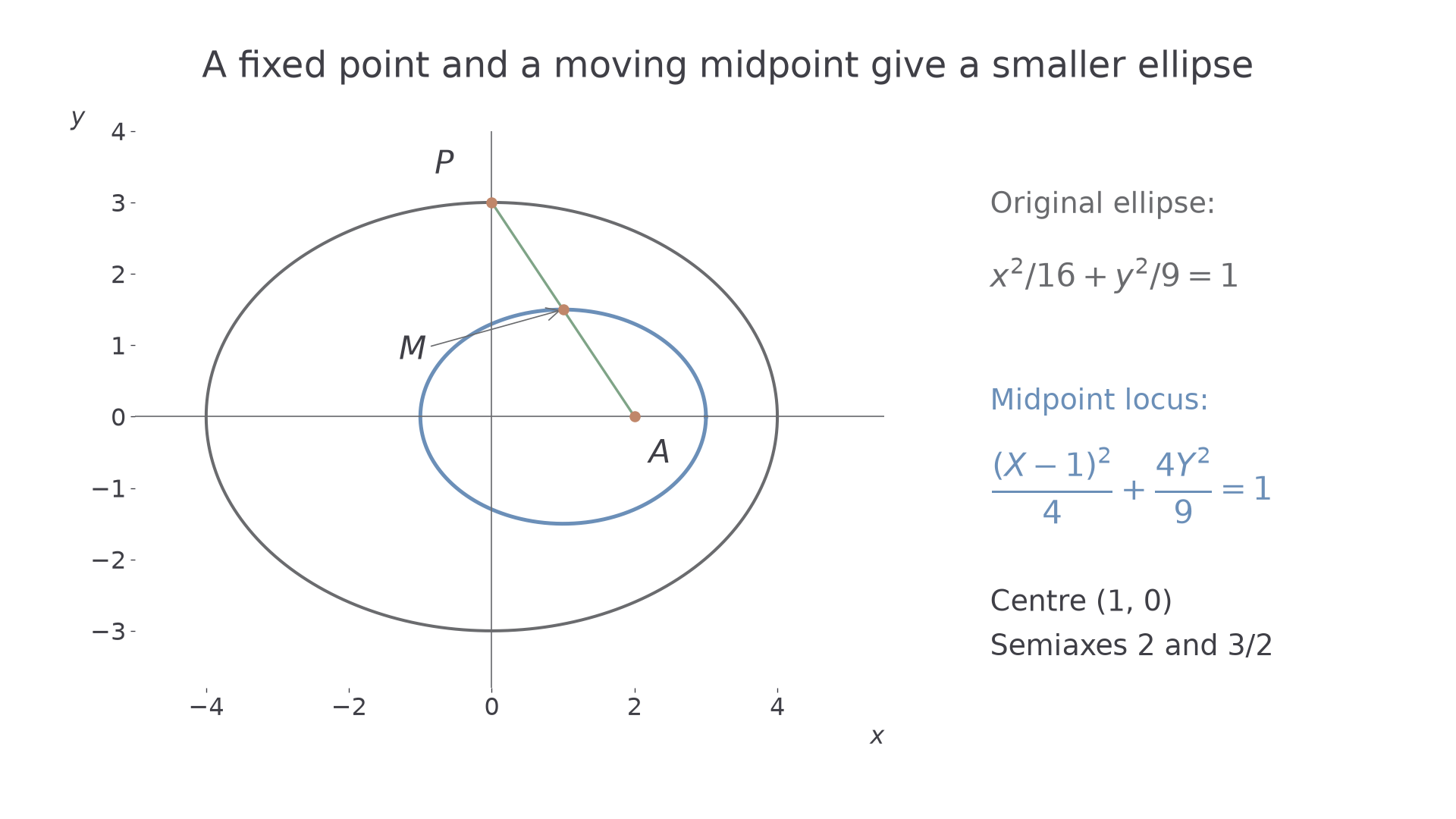
Start with a moving point on an ellipse and a fixed point . The midpoint has
The cosine-sine identity eliminates . A complete parameter period is still important: it ensures that every point of the resulting ellipse is attained.
These transformed locus equations are derived results, not formulas supplied in the booklet.
[DIAGRAM: asset_name: The ellipse traced by a moving midpoint; asset_slug: 9fm0-fp173-midpoint-locus; caption: Taking a midpoint halves the semiaxes and moves the centre halfway towards the fixed point; description: Equal-scale coordinates show the original ellipse x squared over 16 plus y squared over 9 equals 1 in grey, the fixed point A at (2,0), and the midpoint locus centred at (1,0) with semiaxes 2 and 3 over 2 in blue. The original point P at (0,3) is joined to A, with midpoint M at (1,3 over 2) marked on the smaller ellipse. A separate note states the locus equation (X minus 1) squared over 4 plus 4Y squared over 9 equals 1.]
Worked example 1: a fixed point to the right
Question. moves over . Find the locus of the midpoint of and .
Plan. Parametrise , write the midpoint coordinates and eliminate the parameter.
Why this step? Subtract the new centre before squaring; replacing by would not describe a translated ellipse.
Answer. The complete ellipse .
Check. Conversely, from any point satisfying this equation, lies on the original ellipse and has the required midpoint. No point of the new ellipse is missing.
Change only the fixed point's horizontal coordinate from to .
Worked example 2: the fixed point to the left
Question. Find the midpoint locus when , with the same moving .
Plan. Change the midpoint's centre while retaining the semiaxis scales.
Why this step? The fixed point moves by units, but the midpoint centre moves by only ; the semiaxes remain half the original ones.
Answer. The complete ellipse .
Check. Recovering from any locus point proves the converse.
This is an enlargement of scale factor about the fixed point, described through midpoint coordinates. The geometric construction explains both the new size and the new centre.
Watch out
Wrong: translate the centre but keep the original semiaxes. Right: the midpoint halves each coordinate's moving part, so it halves both semiaxes.
Move the fixed point vertically instead.
Tangent intersections and missing line segments
The tangents to at distinct parameters are and . If their intersection is , subtracting gives
Since , cancellation is valid. Therefore
These intersection coordinates are not printed in the booklet; they follow from the tangent equations. The sum and product of also let us check whether real distinct contact parameters exist.
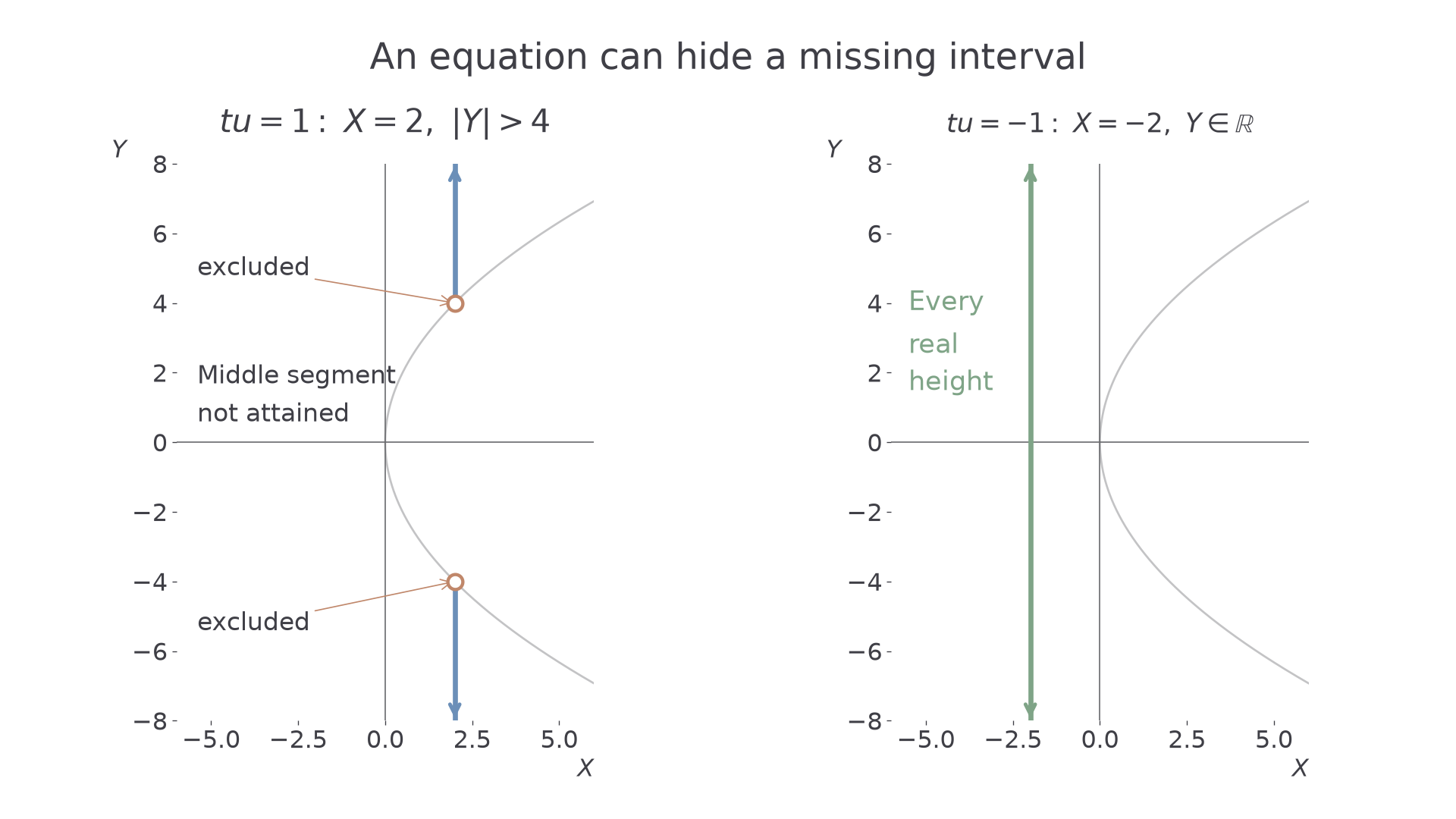
[DIAGRAM: asset_name: Complete and incomplete vertical loci of tangent intersections; asset_slug: 9fm0-fp173-tangent-loci; caption: Distinct real tangent parameters can remove a whole segment from a line; description: Two equal-scale coordinate panels use the parabola y squared equals 8x as light context. In the left panel the blue locus is x equals 2 with Y greater than 4 or less than minus 4; open circles at (2,4) and (2,minus 4) mark excluded endpoints and the middle segment is absent. In the right panel the sage locus is the whole line x equals minus 2, with no missing endpoint. Panel labels give tu equals 1 and tu equals minus 1. Arrowheads show that each locus extends beyond the plotting window.]
Worked example 3: the opening missing segment
Question. Distinct real tangent parameters on satisfy . Find the exact locus of their intersection.
Plan. Use , then determine which real sums are possible with product .
Why this step? The endpoints come from repeated parameters . They would describe a single tangent, rather than the intersection of two distinct tangents.
Answer. , with or .
Check. Conversely, the required parameters are the roots of . Its discriminant is exactly for the stated ranges, giving distinct real roots with product . Thus every stated point is attained.
Change only the product condition from to . The parameters now have opposite signs.
Worked example 4: the whole line is attained
Question. Find the exact locus for distinct real tangent parameters satisfying on the same parabola.
Plan. Find the new fixed horizontal coordinate and test whether every real vertical coordinate is possible.
Why this step? A negative product guarantees opposite-sign, non-zero roots. They are automatically distinct, so no endpoint must be removed.
Answer. The complete line , with .
Check. gives the midpoint of this line, ; the positive discriminant proves that every other height is also possible.
The opening puzzle is resolved: elimination locates a line, while real distinct roots decide how much of that line belongs to the locus.
Watch out
Wrong: stop at in the positive-product case. Right: preserve the distinctness condition; it removes both endpoints as well as the entire middle segment.
Increase the positive product.
Continue this lesson.
You’re previewing NovaLearn without an account. Create a free account to read the rest.
Create free account