FM2 2.2 - Equilibrium of laminas and frameworks
Knowing a body's centre of mass lets you replace its distributed weight by one force at one point. You will combine force balance with moments to find support reactions, hanging angles and forces that hold a lamina or framework in a prescribed position. You will distinguish what a smooth support, a cable and a freely turning hinge can actually supply.
Balance the forces and their turning effects
If you double a hanging plate's mass without changing its relative mass distribution, does its resting angle change? The support force doubles, but the angle need not change at all. Its centre of mass, rather than its total weight, determines that angle. First build the equilibrium equations that explain both effects.
You already know
A lamina or framework has weight acting vertically down through its centre of mass . Use the actual piece masses to find . A force's moment uses perpendicular distance to its line of action, with one declared positive turning sense.
A rigid body can translate or rotate. Forces can cancel while still turning the body. For equilibrium, both resultant force and resultant moment must vanish.
Equilibrium under coplanar forces
For a rigid body in equilibrium under forces in one plane,
Take moments about a convenient point , often a support through which unknown forces act. Once force balance holds, moment balance about one point also gives moment balance about every other point.
Not in the formula booklet: learn it.
A smooth contact support supplies a normal reaction that pushes the body. A cable pulls along its length. A freely turning hinge supplies force components but no resisting couple. Draw only the forces the stated model allows.
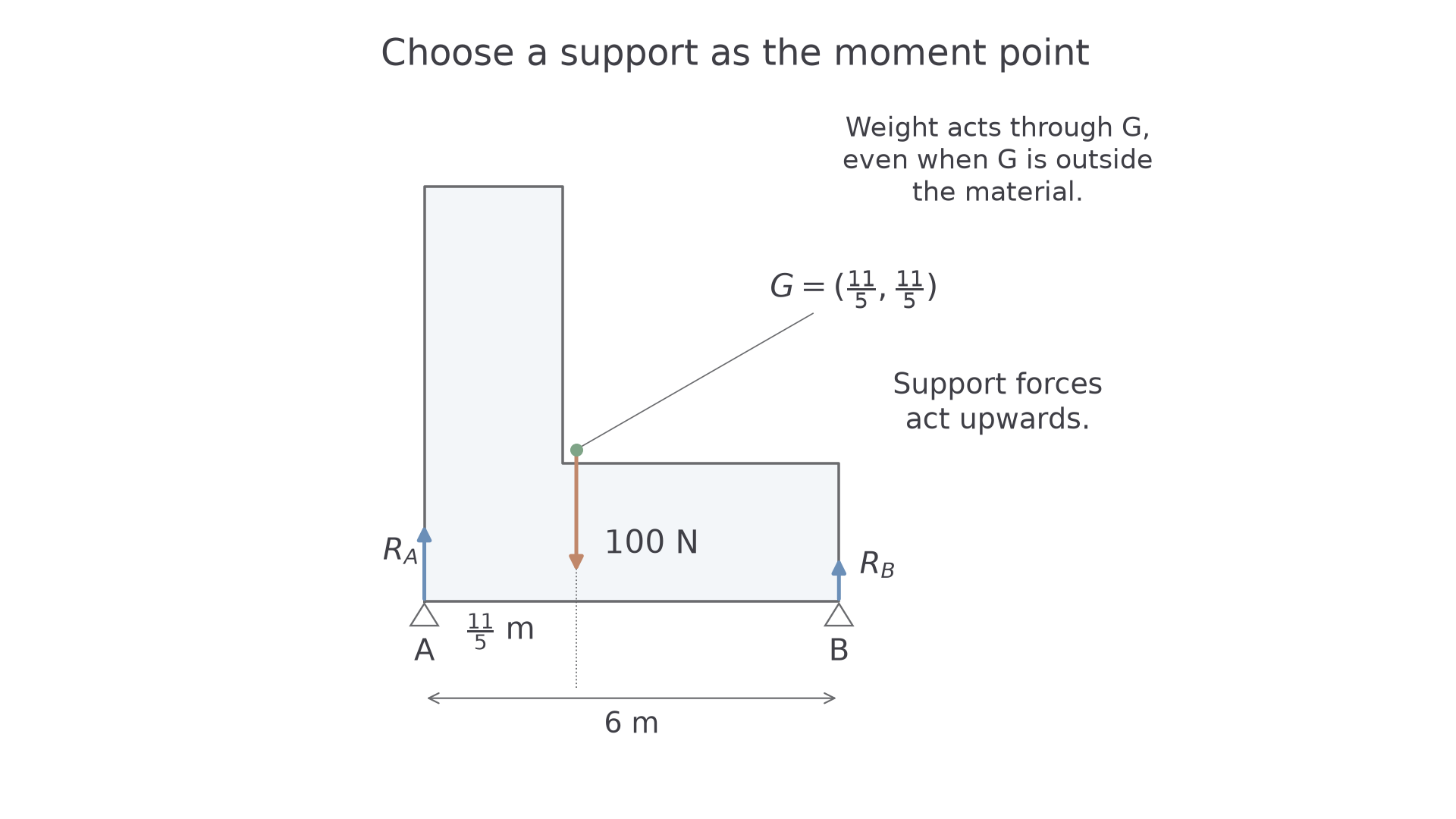
[DIAGRAM: asset_name: Support reactions and weight of an L-shaped lamina; asset_slug: 9fm0-fm152-support-reactions; caption: Use the horizontal distance from a support to the weight's vertical line of action; description: The L-shaped lamina from the preceding lesson has centre eleven fifths eleven fifths and weight one hundred newtons acting vertically down through it. Smooth supports under its lower edge at x zero and x six give upward reactions. Horizontal distances from the left support to the weight line and right support are eleven fifths metres and six metres.]
Worked example 1: two upward reactions
Question. A lamina has weight and centre , in metres. Its lower edge is horizontal. Smooth supports at and exert vertical reactions. Find both reactions.
Plan. Take moments about to remove its reaction, then use vertical force balance.
Why this step? Weight is vertical, so its moment arm about is 's horizontal coordinate, not the sloping distance .
Answer. and , both upwards.
Check. Both reactions are positive and total . Moments about give .
Change only the right support's position, moving it from to .
Worked example 2: move a support
Question. The same lamina, weight and centre are supported at and . Find the vertical reactions.
Plan. Use the new support spacing in the moment equation, then balance vertical forces.
Why this step? The weight's moment about the left support is unchanged. A shorter right-support lever arm needs a larger right reaction.
Answer. , , upwards.
Check. Moments about the right support give .
With only downward weights and two upward contact reactions, the weight line must lie between the supports, including a zero-reaction limiting case. A negative calculated upward reaction cannot be supplied by an ordinary support underneath; it means the assumed two-contact equilibrium is not possible.
Watch out
Wrong: using for the weight's moment about . Right: use , the horizontal distance to the weight's vertical line of action. The y-coordinate is not the moment arm, even though here its numerical value happens to match the x-coordinate.
Change only the right support position again.
A freely suspended body hangs with G below the support
A body freely suspended from a single point, with only its weight and support force acting, has two forces. They must be equal, opposite and on the same line. Otherwise they would leave a resultant force or a moment.
Free suspension under gravity
For a freely suspended rigid lamina or framework in its stable resting position, with centre distinct from suspension point ,
Use the body's geometry before rotation to find the angle between and a named edge; this angle is unchanged when the whole body rotates. If , this argument does not select a unique orientation.
Not in the formula booklet: learn it.
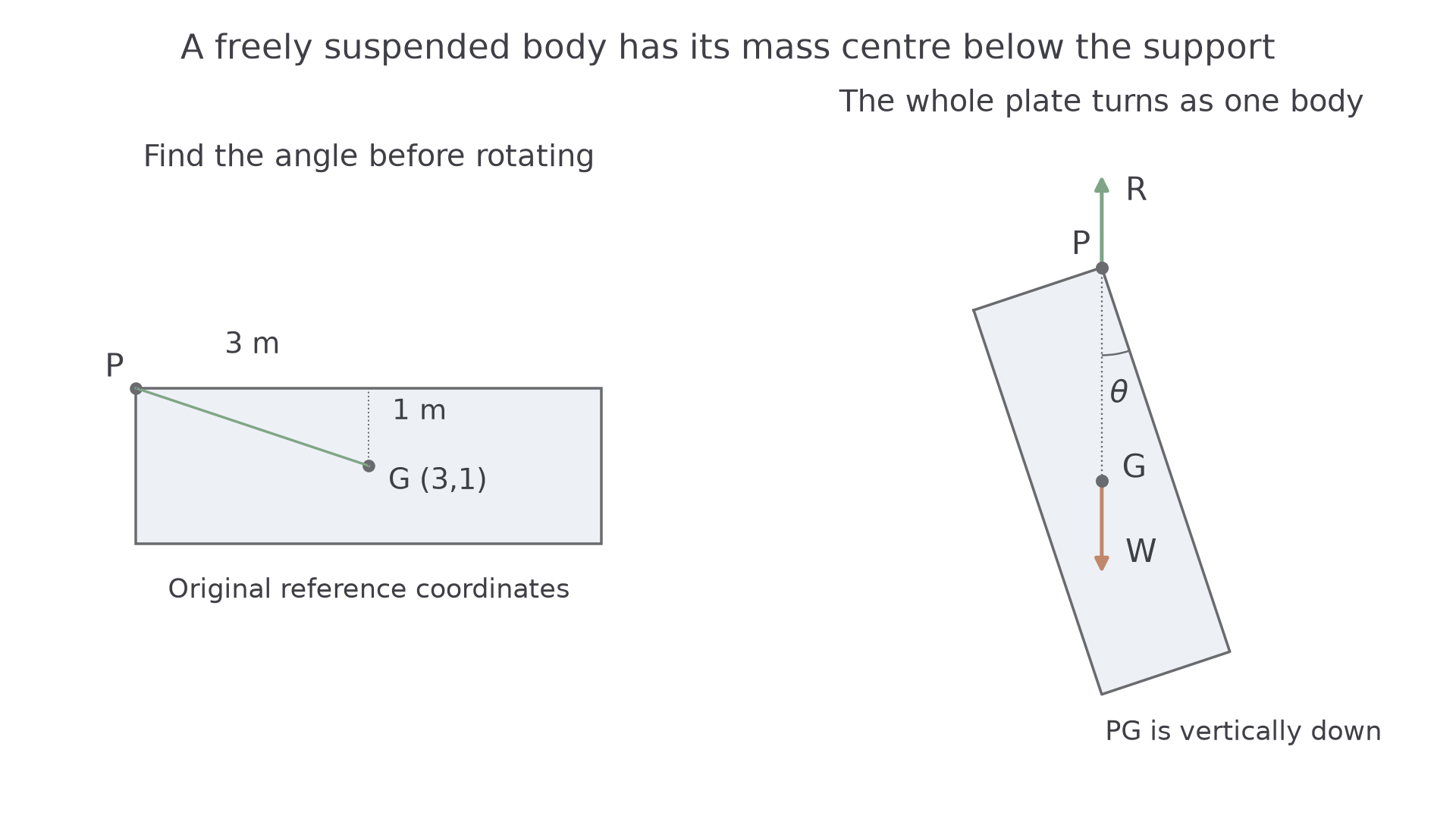
Find the displacement from the suspension point to , not from an unrelated corner. The desired angle may be with a horizontal edge in the original diagram; that edge generally will not be horizontal after hanging.
[DIAGRAM: asset_name: Geometry of a freely hanging rectangular lamina; asset_slug: 9fm0-fm152-suspension; caption: PG becomes vertical while the angle between PG and an edge stays fixed; description: Left panel shows the original six-by-two-metre rectangle with suspension point P at its top-left corner and centre G at three one. Their horizontal and downward offsets are three and one metres. Right panel rotates the rectangle so PG is vertically down, with weight down through G, support force up at P, and the acute angle between the long upper edge and downward vertical labelled theta.]
Worked example 3: hang a rectangular plate from a corner
Question. A uniform rectangular lamina occupies , in metres, and has mass . It hangs freely from its corner . Find the acute angle between its long upper edge and the downward vertical, and the support force.
Plan. Locate , form the right triangle from to , then set the support force equal to weight.
Why this step? After suspension is vertical. Its angle with the material edge can be calculated in the original, simpler rectangle diagram.
Answer. The acute angle is , and the support force is vertically upwards.
Check. Doubling all masses without changing their relative distribution would leave and this angle unchanged, while doubling the support force to . This answers the opening question.
Change only the suspension point to , on the same upper edge.
Worked example 4: move the suspension point
Question. The same rectangular lamina of mass now hangs from . Find the acute angle between its long upper edge and downward vertical, and the support force.
Plan. Retain and use its new displacement from .
Why this step? Changing the attachment point changes the line that must become vertical, even though the body and its centre are unchanged.
Answer. , and the support force is upwards.
Check. The smaller horizontal offset makes steeper relative to the upper edge, so the angle with that edge increases.
The equilibrium geometry does not depend on weight magnitude when the mass distribution is scaled uniformly. Attaching an extra particle is different: it can move and therefore change the angle.
Watch out
Wrong: making the geometric centre of the outline vertically below the support for a non-uniform composite. Right: locate its actual mass centre first. Also, measure both offsets from the suspension point and check which named edge the angle uses.
Change only the suspension point once more.
Continue this lesson.
You’re previewing NovaLearn without an account. Create a free account to read the rest.
Create free account