CP 4.5 - Maclaurin series and the general term
A function's derivatives at zero can reveal an entire power series. You will build Maclaurin expansions from those derivative values, distinguish a truncated approximation from the full series and describe the general term, including when many coefficients vanish.
How derivatives determine the coefficients
How could four polynomial terms give correctly to five decimal places? The answer starts with information about a function at just one point: zero.
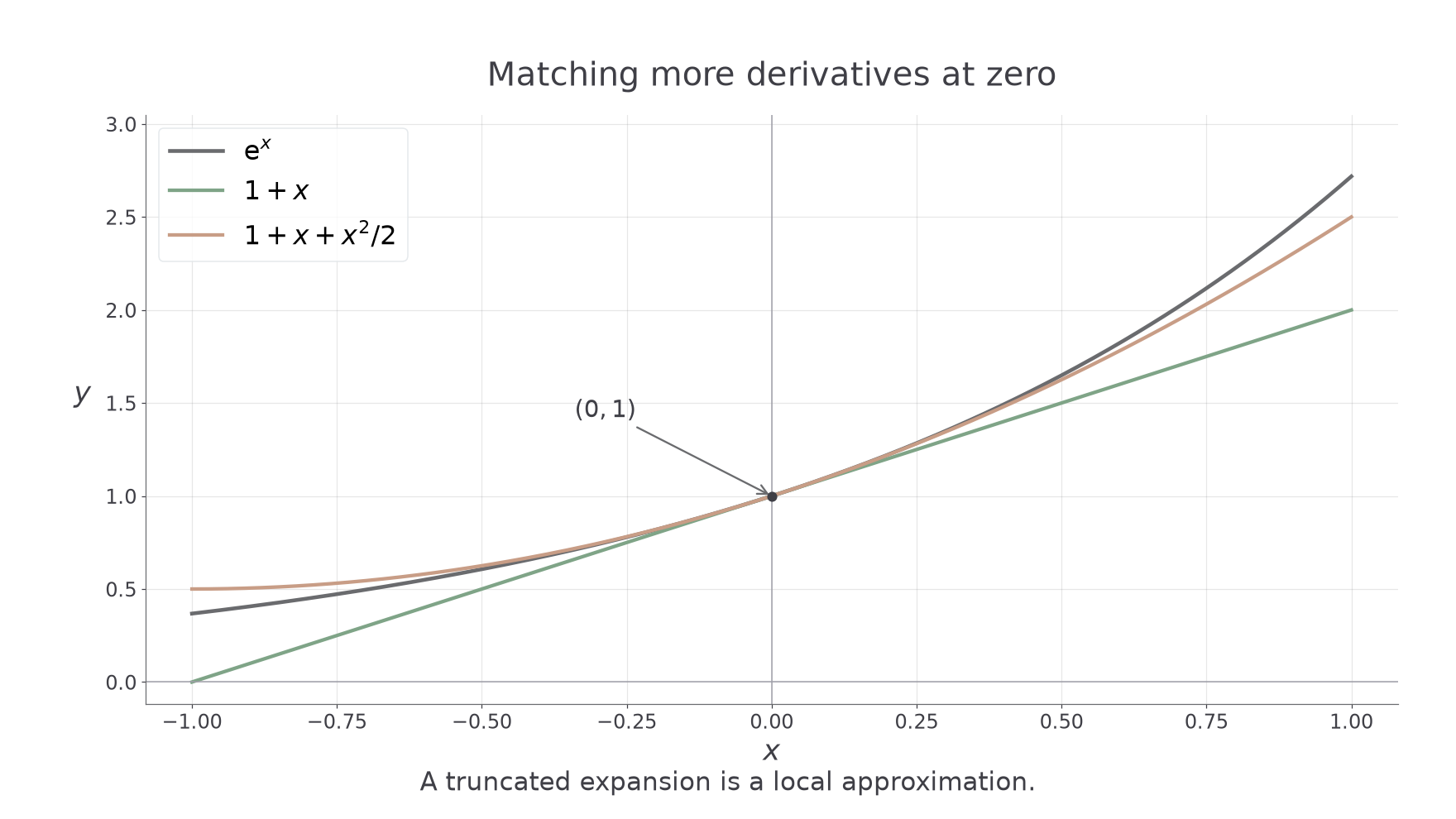
For , the value and every derivative at zero equal . The line matches the value and slope there. Adding matches the second derivative too. The extra term adjusts the curve's bending while preserving its value and slope at zero.
You already know
From A-level Mathematics, differentiate powers, exponentials, logarithms and trigonometric functions, using product and chain rules where needed. Trigonometric arguments are in radians. The notation means the derivative of order , not the power .
Suppose a power series starts . At zero its value is ; its first derivative is ; its second derivative is . In general, differentiating times and setting isolates . This explains the factorial divisor.
[DIAGRAM: asset_name: Matching derivatives near zero; asset_slug: 9fm0-cp30-maclaurin-local; caption: The line matches the value and slope at zero; the quadratic also matches the second derivative; description: A coordinate plot from minus 1 to 1 shows e to the x in grey, 1 plus x in sage and 1 plus x plus x squared over 2 in clay. All pass through (0,1), which is labelled. The quadratic follows the exponential more closely near zero. A legend identifies all three curves and a note states that a truncated expansion is a local approximation.]
Maclaurin series
A Maclaurin series is a power-series expansion about , with coefficients obtained from derivatives at zero. A truncated expansion keeps only finitely many terms; it generally approximates the function near zero rather than equalling it exactly.
Set and . Those conventions let the constant term fit the same general rule as every other term.
Maclaurin expansion
Where the series represents ,
The general term indexed from is
In the formula booklet.
The coefficient of is ; the term includes as well. Some coefficients can be zero, so “the first three non-zero terms” need not end at . A function must also be defined and have the required derivatives at zero before this procedure can start. For example, has no Maclaurin expansion at zero because is undefined.
Key idea
Evaluate the derivatives at zero, then divide by the appropriate factorials. A derivative value is not yet the coefficient, and a coefficient is not yet the full term.
The following check isolates the factorial step.
Constructing an expansion from derivatives
Keep derivative functions and derivative values separate: differentiate first, substitute zero second and insert the resulting numbers into the Maclaurin formula last.
A short table can prevent the common mistake of leaving inside a supposed coefficient. If the question specifies a highest power, calculate every derivative up to that order, including those whose values might be zero.
Worked example 1: a logarithm with a non-zero constant
Question. Find the Maclaurin expansion of up to and including the term in .
Plan. Find the first three derivatives, evaluate them at zero and divide by , and .
Thus
and
Why this step? The quadratic coefficient is , not , because the second derivative must be divided by .
Answer. The requested expansion is , with higher powers omitted.
Check. At the polynomial gives . Its first three derivatives at zero are , agreeing with the original function.
Worked example 2 changes only the coefficient of inside the logarithm, from to . Each differentiation now brings another factor of .
Worked example 2: tracking chain-rule factors
Question. Find the Maclaurin expansion of through the term in .
Plan. Apply the chain rule at each derivative, then use the values at zero in the same formula.
Therefore
and
Why this step? Chain-rule factors accumulate. Multiplying only the first derivative by would leave all the later coefficients too small.
Answer. , with higher powers omitted.
Check. Differentiating the cubic polynomial three times gives , exactly the third derivative value required at zero.
These particular logarithm expansions are not printed in the formula booklet: derive them from the supplied general formula. They provide local approximations near zero; the next lesson explains how standard series give their precise intervals of validity.
Watch out
Wrong: . Those derivative functions still vary with . Right: the coefficients use , which are numbers.
Pearson's schemes reward correct application of the Maclaurin formula separately from finding the derivative values. Show both stages, even when the final polynomial looks familiar.
General terms and missing powers
To find a general term, identify the pattern in derivative values and the powers that actually occur; then state where your index begins.
For a series with every power present, the coefficient index and the power can match. If alternate coefficients vanish, the first, second and third non-zero terms correspond to a different sequence of powers.
Worked example 3: every derivative follows one rule
Question. Find the Maclaurin series for , including its general term. Use the first four terms to estimate .
Plan. Express the derivative of order , evaluate at zero and use for the requested exponential.
Thus
Why this step? The function is , so requires . Substituting would estimate .
Answer. The general term is , for . The estimate is to five decimal places.
Check. A calculator gives , which also rounds to . This confirms the opening surprise for this particular input; a truncated polynomial does not have the same accuracy far from zero.
Worked example 4 changes the function to , keeping the same inner scale . The derivative values now alternate in sign and vanish at every even order.
Worked example 4: indexing the non-zero terms
Question. Find the first three non-zero terms of the Maclaurin series for , and its general non-zero term , with for the first.
Plan. Follow the sine/cosine derivative cycle, retain the odd derivative orders and translate the term index into the power .
Consequently,
At derivative order , the value is . Thus the required term is
Why this step? The non-zero term with index has power , not . Its factorial must use that same power, and starts the signs with a plus.
Answer. The first three terms are , with general non-zero term above.
Check. Substituting into gives exactly those three terms, including the negative second term.
The booklet supplies the underlying exponential and sine series, as well as the general Maclaurin formula. The scaled expressions here follow by the displayed derivative arguments; their precise ranges will be collected in the next lesson.
Watch out
Wrong: use while declaring that is the first sine term. That starts with a minus sign. Right: test your general expression at its first two indices before submitting it.
The following function has even powers, including its non-zero constant. Its third non-zero term therefore has power , not .
Quick Recap
- The coefficient of is ; the full term also includes .
- Differentiate, evaluate at zero, then substitute into the supplied formula.
- Zero derivative values remove powers, so count non-zero terms separately from derivative orders.
- Check a general term at its first two indices, and treat a finite truncation as a local approximation.
Four terms give , correctly rounding to .