Use de Moivre's theorem to turn the sine, cosine or tangent of a multiple angle into powers of trigonometric functions of the original angle. You will choose real or imaginary parts, simplify the resulting polynomial and keep the restrictions that matter when dividing.
Real parts give multiple cosines
Why does x=cos9π satisfy the cubic equation 8x3−6x−1=0? A link between a triple angle and a cube will explain it. The link is an identity, not an instruction to confuse the two.
You already know
De Moivre gives (cosθ+isinθ)n=cosnθ+isinnθ for integer n. From A-level Mathematics, use the binomial expansion and sin2θ+cos2θ=1.
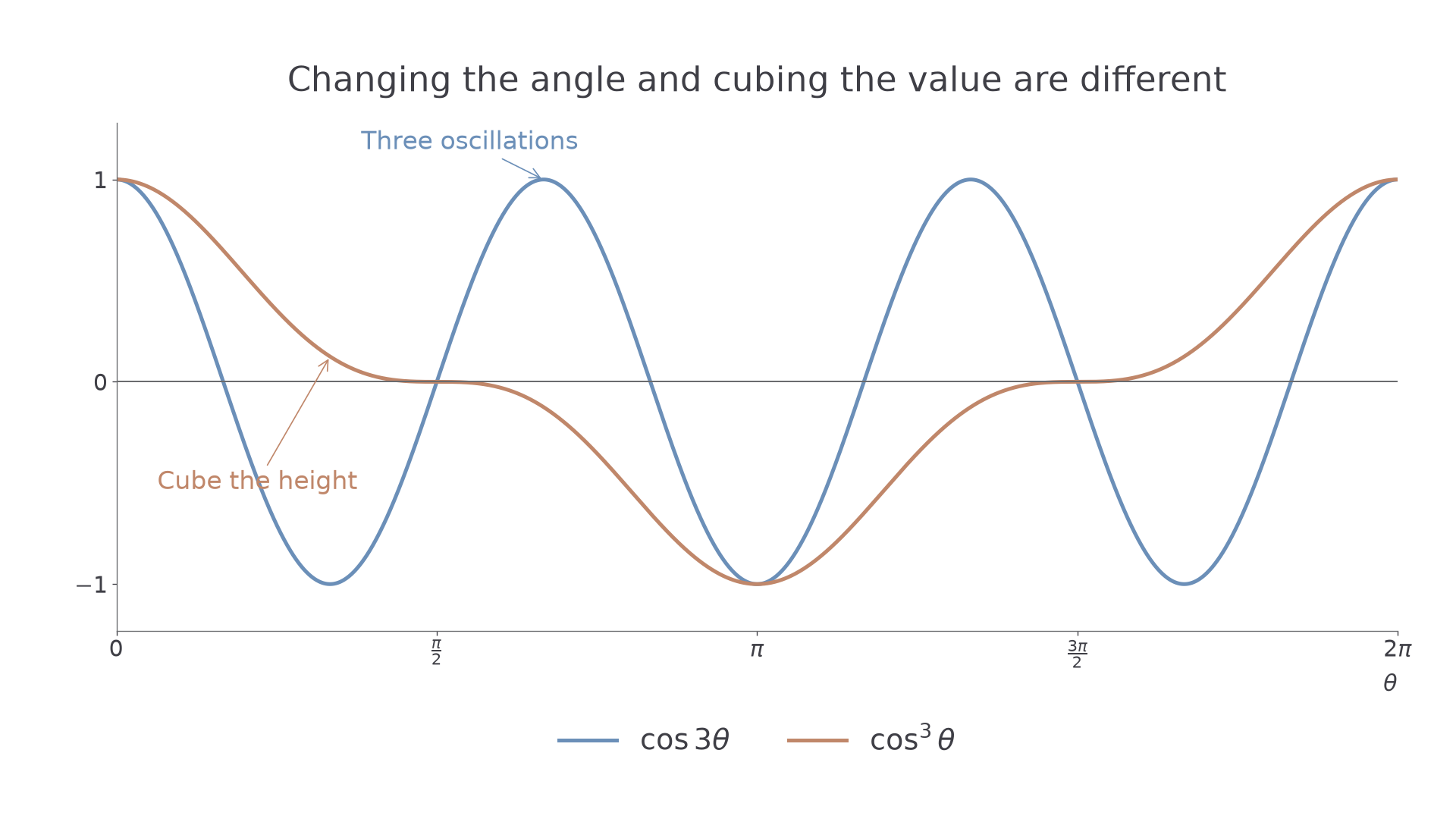
The notation carries a big difference. cos3θ means (cosθ)3; cos3θ means find the cosine after tripling the angle. Over one complete turn, cos3θ completes three oscillations while cos3θ completes one. A cubic polynomial can nevertheless connect them exactly.
[DIAGRAM: asset_name: Multiple angle compared with a power; asset_slug: 9fm0-cp09-angle-or-power; caption: Cosine of a triple angle and the cube of a cosine are different functions; description: On axes from theta equals zero to two pi and vertical values minus one to one, a blue curve cos three theta completes three oscillations and a clay curve cos cubed theta completes one. Labels identify three oscillations and cubing the height.]
Write c=cosθ and s=sinθ temporarily. Expand (c+is)n, replace the powers of i, then collect its real terms. De Moivre identifies those terms as cosnθ.
Reading the real part
For real θ and a positive integer n,
cosnθ=Re((cosθ+isinθ)n)
Even powers of i contribute to the real part. The resulting multiple-angle identities are derived from de Moivre; they are not separately printed in the formula booklet.
Not in the formula booklet: learn it.
The first example extracts the real part of a cubic expansion; its final form uses cosθ alone.
Worked example 1: the triple-angle cosine
Question. Use de Moivre's theorem to show that cos3θ=4cos3θ−3cosθ.
Plan. Expand the cube, equate real parts and replace sin2θ by 1−cos2θ.
Why this step? The coefficient 10 belongs to the term containing s2, while the coefficient 5 belongs to the term containing s4. Writing those terms before simplifying prevents a coefficient swap.
Answer.cos5θ=16cos5θ−20cos3θ+5cosθ.
Check. At θ=3π, the polynomial gives 21−25+25=21=cos35π.
The expansion is evidence in a proof. Do not start from the identity you have been asked to prove and merely rewrite it.
Watch out
Wrong: cos3θ=cos3θ. At θ=3π, the two sides would be −1 and 81. Right: cos3θ=4cos3θ−3cosθ; the cross terms supply the missing pieces.
Try an even multiplier next. There is still a real term containing no c, so expect a constant in the final polynomial.
Imaginary parts give multiple sines
The imaginary part of the same binomial expansion gives sinnθ. You have already done half the work: now keep the odd powers of i, then read their coefficient.
For example, i3s3=−is3 contributes −s3 to the imaginary part. The imaginary part is a real number; it does not retain a factor of i.
Reading the imaginary part
For real θ and a positive integer n,
sinnθ=Im((cosθ+isinθ)n)
Odd powers of i contribute, with alternating signs. The derived multiple-angle sine identities are not separately printed.
Not in the formula booklet: learn it.
Use c2=1−s2 if the question wants powers of sinθ alone. That is the same tidying decision as before, with the roles reversed.
Worked example 3: the triple-angle sine
Question. Use de Moivre's theorem to show that sin3θ=3sinθ−4sin3θ.
Plan. Take the imaginary part of the cube and replace c2 by 1−s2.
sin3θ=Im((c+is)3)=3c2s−s3=3(1−s2)s−s3=3s−4s3de Moivrecoefficient of ic2=1−s2collect powers
Why this step? The s3 term is negative because i3=−i. Its sign is decided before the trigonometric substitution.
Answer.sin3θ=3sinθ−4sin3θ, as required.
Check. At θ=6π, the right side is 23−21=1=sin2π.
Change only the multiplier from 3 to 5. The odd-index terms now have signs positive, negative, positive.
Worked example 4: the quintuple-angle sine
Question. Use de Moivre's theorem to express sin5θ as a polynomial in sinθ.
Plan. Extract the imaginary terms in the fifth-power expansion and eliminate c2.
Why this step? Keeping the mixed form 5c4s−10c2s3+s5 visible separates the complex-number step from the algebra, making both easy to check.
Answer.sin5θ=16sin5θ−20sin3θ+5sinθ.
Check. At θ=6π, the result is 21−25+25=21=sin65π.
For even multiples, an odd power of both sine and cosine remains. Do not force a square root into the answer unless the question specifically requires it.
Watch out
Wrong: Im(3c2si−s3i)=i(3c2s−s3). Right: the imaginary part is 3c2s−s3. You equate it to sin3θ, not to isin3θ.
The next expansion needs only two imaginary terms.
Dividing gives multiple tangents
Divide the imaginary part by the real part to obtain tannθ. Then divide every term by cosnθ to express the result using t=tanθ.
There are two restrictions to keep in view: t exists only when cosθ=0, and tannθ exists only when cosnθ=0. A zero denominator in the final rational expression records the second restriction.
Multiple-angle tangents
For real θ, with t=tanθ defined and the displayed denominator non-zero,
tan3θ=1−3t23t−t3tan5θ=1−10t2+5t45t−10t3+t5
These identities follow by dividing the imaginary and real parts of de Moivre's expansions.
Not in the formula booklet: learn it.
Use the mixed forms from the expansion before eliminating either sine or cosine. Each term then has the same total degree, so a single division by cn produces powers of t.
Worked example 5: a triple-angle tangent
Question. Use de Moivre's theorem to show that tan3θ=1−3t23t−t3, where t=tanθ, whenever both sides are defined.
Plan. Divide the imaginary and real parts of (c+is)3, then divide top and bottom by c3.
tan3θ=cos3θsin3θ=c3−3cs23c2s−s3=1−3(s/c)23(s/c)−(s/c)3=1−3t23t−t3definition of tangentde Moivre’s cubedivide by c3t=s/c
Why this step? Dividing by c3 turns the ratios into tangent powers directly, avoiding square roots and sign choices.
Answer. The identity holds for cosθ=0 and 1−3t2=0.
Check. At θ=4π, t=1, so the fraction is −22=−1=tan43π.
Change only the multiplier from 3 to 5. Divide by the fifth power of cosine instead of the third.
Worked example 6: a quintuple-angle tangent
Question. Express tan5θ as a rational function of t=tanθ, using de Moivre's theorem.
Plan. Use the mixed fifth-power real and imaginary parts, then divide every term by c5.
tan5θ=c5−10c3s2+5cs45c4s−10c2s3+s5=1−10(s/c)2+5(s/c)45(s/c)−10(s/c)3+(s/c)5=1−10t2+5t45t−10t3+t5imaginary over realdivide by c5t=tanθ
Why this step? Both numerator and denominator come from the same expansion; using an unrelated sine identity could mix angles or powers.
Answer.tan5θ=1−10t2+5t45t−10t3+t5, provided cosθ=0 and 1−10t2+5t4=0.
Check. At θ=4π, the fraction is −4−4=1=tan45π.
The denominator restriction is real information. For example, t=31 makes the triple-angle denominator zero: θ=6π would give 3θ=2π, where tangent is undefined.
Watch out
Wrong: cancel a factor that may be zero and conclude that an identity holds at the cancelled value. Right: state the restrictions before division. A simplified fraction cannot give a value to an undefined tannθ.
We can also finish the opening puzzle. With x=cos9π, the triple-angle cosine gives 4x3−3x=cos3π=21, so 8x3−6x−1=0. An angle calculation has produced an exact algebraic equation, without approximating the cosine.
Quick Recap
Expand (cosθ+isinθ)n and use de Moivre to identify its two parts.
Real parts give cosnθ; imaginary parts give sinnθ.
Replace sin2θ or cos2θ to obtain the requested powers of one function.
Divide imaginary by real to obtain tannθ, retaining the restrictions on both tangents.
The opening cubic follows from cos3θ=4cos3θ−3cosθ at θ=9π.
Learn faster with Nova
Ask for a simpler explanation, a quick recap, or help connecting the ideas in this lesson.