FP1 1.1 - The t-formulae
Derive and use the half-angle formulae that express sine, cosine and tangent as rational functions of (FP1 1.1). You will track their domains and recover the correct angles, including the points the substitution cannot represent.
Sine and cosine from the half-angle
How can knowing tell you that and , without first finding ? The half-angle parameter turns both functions into fractions involving only one real number.
Start with . The double-angle identities give and . Divide each by the identity , then divide numerator and denominator by . This last step requires , exactly the condition needed to define .
You already know
From A-level Mathematics, , , and . The compound-angle identities are in the formula booklet. The variable is the tangent of the half-angle, not half of .
Writing gives the derivation:
The common denominator is positive for every finite real , so neither of these rational expressions has a real denominator zero.
The sine and cosine t-formulae
If is defined, then
The substitution requires , where . Sine and cosine themselves still exist at those omitted angles.
Not in the formula booklet: learn it.
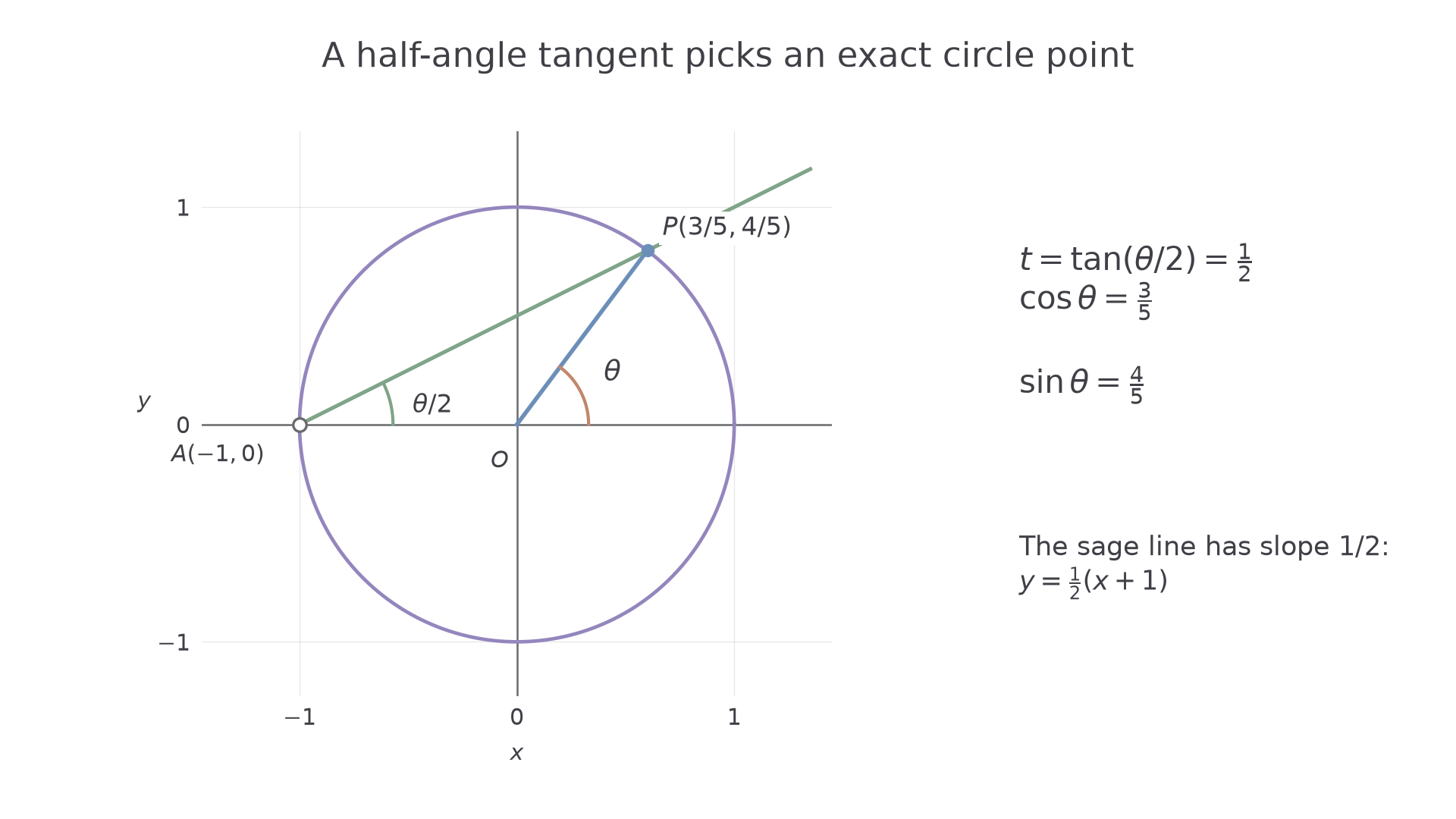
The formulae also explain a number pattern. Taking gives : a point built from the right triangle. More generally, gives
for integers with . The identity is the same unit-circle identity after clearing denominators. A rational half-angle parameter naturally builds integer right triangles.
[DIAGRAM: asset_name: A rational half-angle point on the unit circle; asset_slug: 9fm0-fp1-t-unit-circle; caption: The parameter t equals one half gives the point (three fifths, four fifths) on the unit circle; description: Equal-scale coordinate axes show the unit circle, O at the origin and P at (3/5,4/5). A blue radius OP and a sage line from the open point A at (minus 1,0) to P are shown. The sage line has slope one half and equation y equals (x plus 1) over 2. A small arc at O marks theta and a separate small arc at A marks theta over 2. Labels are offset from axes and curves, with a side note giving t equals one half, cos theta equals three fifths and sin theta equals four fifths.]
Worked example 1: exact values from a rational parameter
Question. Given , find and exactly.
Plan. Substitute the half-angle tangent directly into the two rational formulae.
Why this step? The known value is already ; finding first would introduce an unnecessary inverse tangent and rounding.
Answer. and .
Check. , and both values are positive, consistent with the first-quadrant representative of this direction.
Change only the sign of . Its square stays the same, while the numerator of sine reverses sign.
Worked example 2: reflecting the direction
Question. Given , find and exactly.
Plan. Keep the signed value in , and square it in both other places.
Why this step? Squaring removes its sign only in the squared terms. The sine numerator is linear in , so its sign remains.
Answer. and .
Check. The direction reflects the previous point in the horizontal axis: cosine is unchanged and sine reverses.
A common denominator does not mean that every numerator has the same structure.
Watch out
Wrong: . The cosine denominator is , which never vanishes for real . Keep the minus sign in its numerator alone.
Use a new rational parameter.
The tangent formula and its denominator
Dividing the sine t-formula by the cosine t-formula gives tangent, but its extra denominator zeros must be kept distinct from the half-angle substitution's own exclusions.
For ,
The common factors cancel. The remaining denominator vanishes at , corresponding to directions where .
The tangent t-formula
If is defined and , then
The conditions for and for are separate. At , the sine and cosine t-formulae are still valid, but is undefined.
Not in the formula booklet: learn it.
Do not reject from a question involving only sine or cosine. For example, gives , , and gives , . These are valid circle points even though their tangent does not exist.
Worked example 3: a positive tangent
Question. Given , find .
Plan. Check the denominator is non-zero, then use the tangent formula.
Why this step? A tangent value needs a non-zero cosine, reflected here in .
Answer. .
Check. The earlier exact sine and cosine values give .
Continue this lesson.
You’re previewing NovaLearn without an account. Create a free account to read the rest.
Create free account