FM2 1.1 - Conical pendulums and banked surfaces
Horizontal circles often hide inside three-dimensional arrangements. You will find the actual circle radius, resolve forces vertically and towards its centre, and handle conical pendulums, elastic strings and banked surfaces. You will also check when contact, friction or two taut strings can support the proposed motion.
A conical pendulum has a horizontal radius
Must a heavier bob rotate faster to make the same cone? For a light inextensible string of fixed length, the surprising answer is no. The heavier bob needs greater tension, but the required angular speed is unchanged. Geometry will explain why.
You already know
For a horizontal circle, and inward acceleration is . Resolve actual forces vertically with resultant zero, and horizontally towards the circle's centre with resultant . There is no extra “centripetal” force on the diagram.
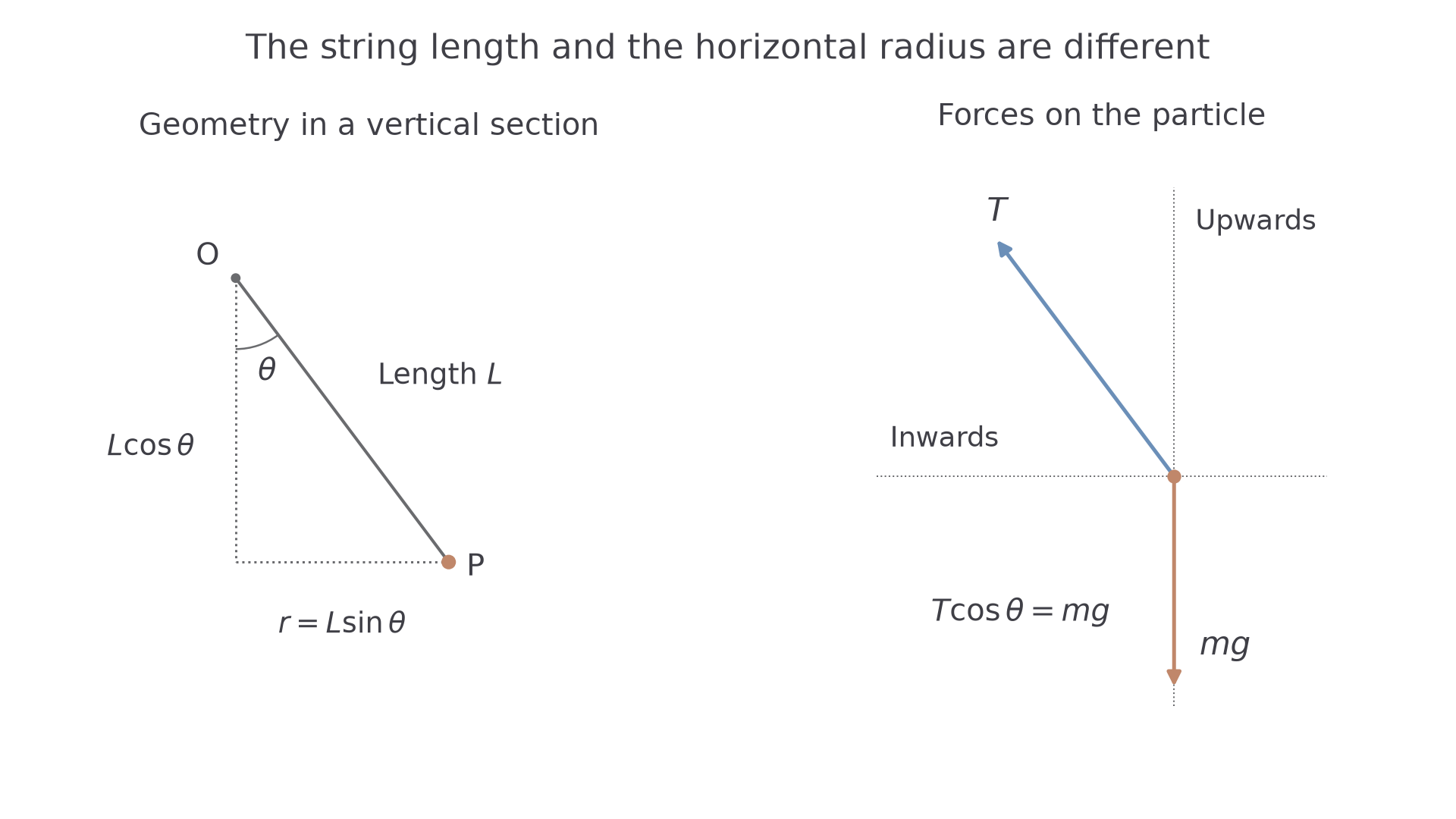
A conical pendulum consists of a particle on a light string, rotating uniformly in a horizontal circle below its fixed support. The string sweeps out a cone. If its taut length is and its angle with the downward vertical is , the circle radius is , not .
[DIAGRAM: asset_name: Geometry and forces of a conical pendulum; asset_slug: 9fm0-fm148-conical-geometry; caption: The horizontal radius is L sin theta; tension has both upward and inward components; description: A vertical section through a conical pendulum shows support O, particle P, a taut string length L making angle theta with the downward vertical, vertical drop L cos theta, and horizontal circle radius r equals L sin theta. A separate force diagram shows tension towards O, weight down, and vertical and inward resolving directions.]
Conical-pendulum equations
For a light taut string of length , a particle of mass , and ,
Thus
These last equations follow by eliminating and . They apply to this uniform horizontal-circle model, with negligible air resistance.
Not in the formula booklet: learn it.
The vertical component supports the weight; the horizontal component turns the velocity. Neither the particle nor its motion is in equilibrium along the string.
Worked example 1: a cone with known angle
Question. A particle moves as a conical pendulum on a light inextensible string of length . The string makes an acute angle with the vertical, where . Find the radius, tension and angular speed.
Plan. Find the horizontal radius, then resolve vertically and radially.
Why this step? The distance to the support is the string length; the distance to the rotation axis is the circle radius. They play different roles.
Answer. , , and .
Check. The derived form gives , agreeing with both force equations.
Change only the mass, doubling it while retaining the string length and cone angle.
Worked example 2: a heavier bob in the same cone
Question. A particle forms the same cone on a light inextensible string, with . Find the radius, tension and angular speed.
Plan. Keep the geometry and use the new mass in both force equations.
Why this step? Both weight and the required radial force scale with mass. Doubling tension supplies both changes without changing angular speed.
Answer. The radius remains , tension doubles to , and angular speed remains .
Check. Mass cancels from . It does not cancel from .
A non-zero cone needs . Equality gives and zero circle radius, the boundary of this model. An exactly horizontal single string could not support the weight with finite tension.
Watch out
Wrong: . Right: . Also, the vertical equation is equilibrium; the horizontal equation is circular motion.
Change only the mass once more.
An elastic string changes the cone's size
An elastic string has a natural length and extends when it carries tension. Its stretched length determines the cone geometry. You therefore need a relation between tension and extension before using the circular-motion equations.
Hooke's law for the elastic-string model
For a light elastic string with natural length , modulus of elasticity and extension ,
Here has units newtons and is the stretched length. The law is an ideal elastic model over the stated range. A slack string has zero tension and does not push; do not use this law to give a string negative tension.
Not in the formula booklet: learn it.
For a specified cone angle, vertical balance first gives . Hooke's law then gives , which gives and the horizontal radius. This order keeps natural length out of places where stretched length belongs.
Worked example 3: find the stretched length first
Question. A particle forms a conical pendulum on a light elastic string of natural length and modulus . Its acute angle to the vertical satisfies . Find the extension, circle radius and angular speed.
Plan. Use vertical balance, then Hooke's law, then the horizontal-circle equation.
Why this step? Using natural length as the current string length would make both the radius and angular speed wrong.
Answer. The extension is , radius , and angular speed .
Check. , so . Tension and extension are positive, as the taut model requires.
Change only the modulus, doubling it. A stiffer string extends less under the same tension.
Worked example 4: a stiffer string
Question. The same particle forms a cone with on a light elastic string of natural length . Its modulus is now . Find the extension, radius and angular speed.
Plan. Retain the tension fixed by vertical balance, then recalculate the stretched geometry.
Why this step? The same mass and angle require the same vertical force. The changed modulus affects the length, not that force balance.
Answer. , , and .
Check. Doubling modulus halves extension. The new length and angle match the inextensible example, so its angular speed agrees.
For an elastic string, changing the bob's mass generally changes the stretched length. The mass-independent result for a fixed inextensible cone must not be transferred without checking that geometry.
Watch out
Wrong: . Right: . Extension is the extra length; the particle is a full stretched length from the support.
Change only the modulus again.
A sloping normal reaction can turn the particle
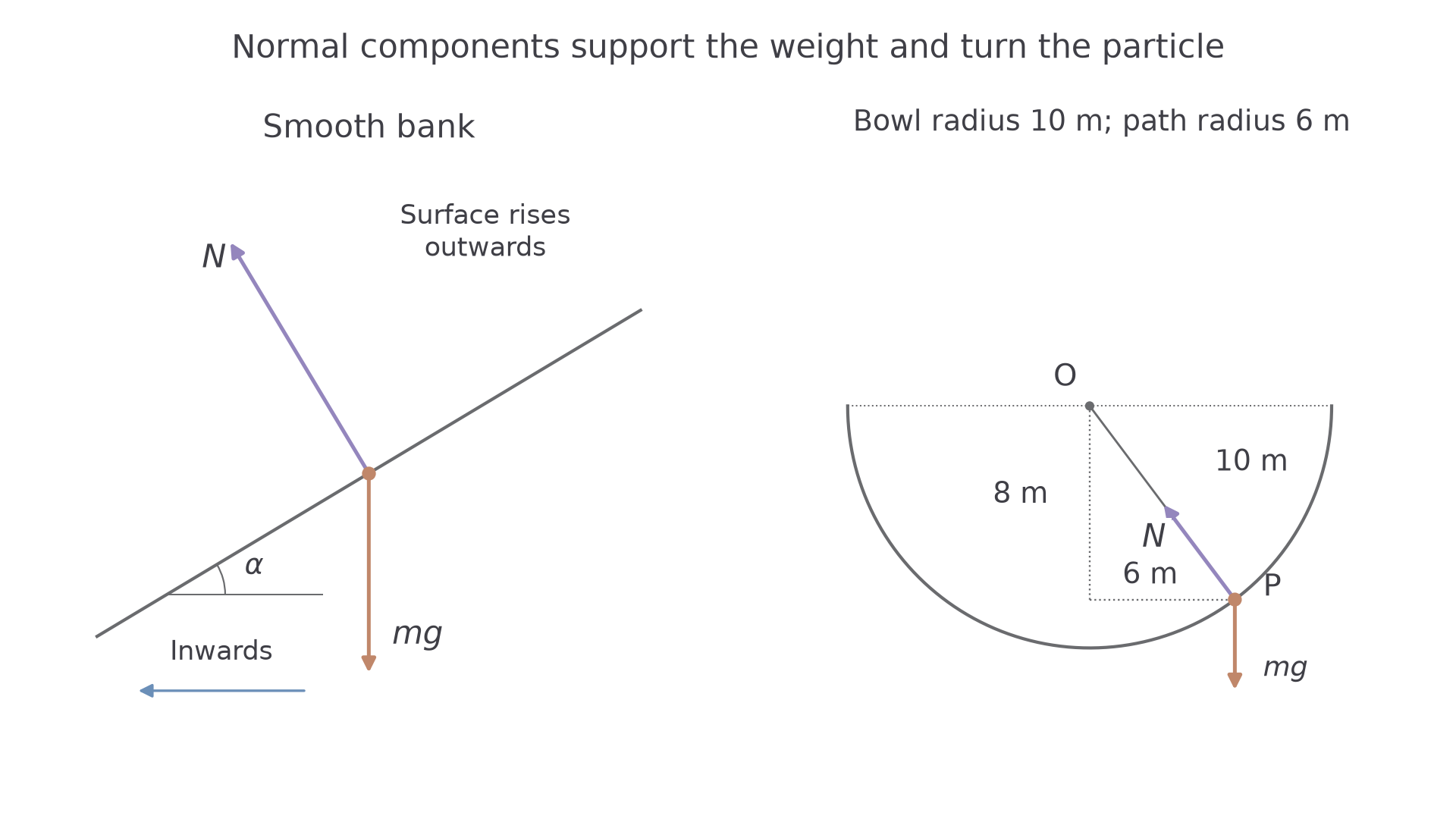
A banked surface slopes upwards away from the circle centre. Its normal reaction has an upward component and an inward component, just as the conical pendulum's tension does. For a smooth surface those components must support the weight and provide all the radial force.
A smooth banked horizontal circle
If the surface rises outwards at angle above the horizontal and the circle radius is ,
Hence
This gives one speed for the stated smooth bank and radius. The normal reaction is perpendicular to the surface, not vertical.
Not in the formula booklet: learn it.
The same resolving method works inside a smooth bowl. Find the local normal direction and the horizontal path radius from the bowl's geometry. The bowl radius itself is not usually the path radius.
[DIAGRAM: asset_name: A bank and a bowl share a resolving method; asset_slug: 9fm0-fm148-bank-bowl; caption: Resolve the normal reaction vertically and horizontally using the actual path radius; description: Left panel shows a bank rising outwards, a normal reaction tilted inward by alpha from vertical and weight down. Right panel shows a particle inside a spherical bowl of radius ten metres, horizontal path radius six metres and vertical drop eight metres below the sphere centre. The normal points along the radius towards the sphere centre. The six-eight-ten triangle labels its vertical and horizontal components.]
Worked example 5: a smooth bank
Question. A particle moves uniformly in a horizontal circle of radius on a smooth bank. The bank rises outwards at angle , where and . Find its speed.
Plan. Eliminate the normal reaction between the vertical and radial equations.
Why this step? The normal reaction is not . Its vertical component equals , while its horizontal component turns the particle.
Answer. The speed is .
Check. The acceleration is , matching the ratio of horizontal to vertical force.
Change only the supporting surface: replace the straight bank by a spherical bowl whose local normal has the same direction at the same horizontal radius.
Continue this lesson.
You’re previewing NovaLearn without an account. Create a free account to read the rest.
Create free account