FP1 4.1 - Parabolas, ellipses and hyperbolas
Recognise and use Cartesian and parametric forms of the parabola, ellipse, hyperbola and rectangular hyperbola. You will eliminate parameters, identify key features and choose parameter domains that trace the intended curve or branch.
Four curves and the signs that distinguish them
Does describe every point of ? It satisfies the equation for every real , yet it misses half the curve. By the end you will be able to repair it and include the point .
You already know
From A-level Mathematics, a parametric curve gives both coordinates in terms of one parameter; eliminate that parameter using identities or substitution. From Core Pure, , and takes every real value.
Here are positive constants. A squared coordinate on only one side gives a parabola. A sum of two positive squares gives an ellipse, while their difference gives a hyperbola:
The ellipse meets both axes. The displayed hyperbola has two branches opening along the horizontal axis and cannot have . The rectangular hyperbola has branches in the first and third quadrants.
The letters denote lengths, not their squares: has horizontal semiaxis and vertical semiaxis . If , the ellipse is a circle. Interchanging and turns the corresponding picture through a right angle; replacing coordinates by translates its centre or vertex to .
Key idea
A parametrisation must do two jobs: satisfy the Cartesian equation and trace all the points required by the question. An identity proves the first job; the parameter's domain and coordinate ranges establish the second.
Check which equation can describe a bounded curve.
The parabola and its signed parameter
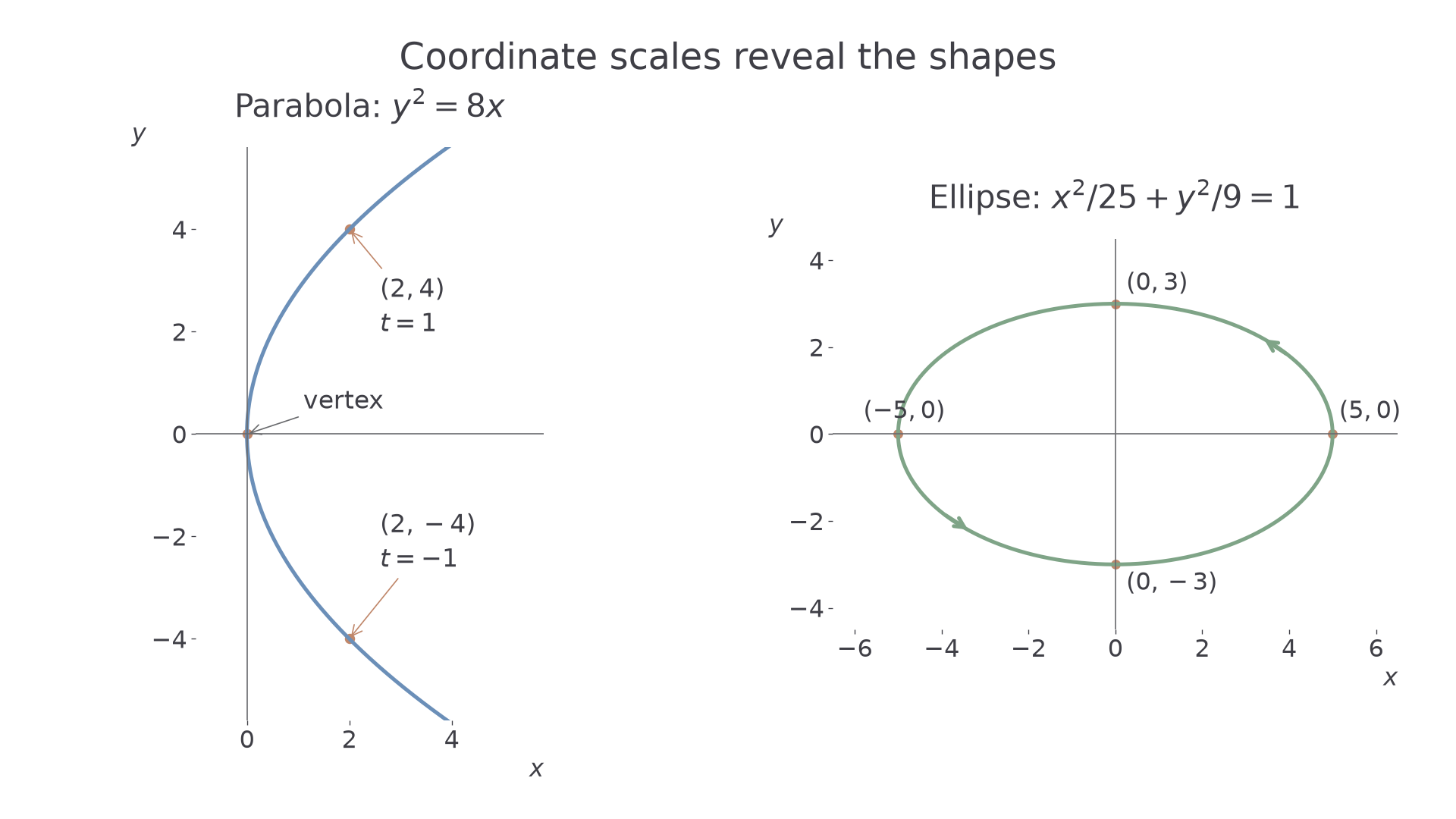
For , choose . Substitution then gives . Every real is allowed: its sign chooses the upper or lower half, while its square ensures .
Parabola coordinates
For ,
The vertex is , the symmetry axis is , and the curve opens to the right. Every point has the unique parameter .
In the formula booklet.
Read from the coefficient before using the coordinates.
[DIAGRAM: asset_name: A parabola and an ellipse in equal-scale coordinates; asset_slug: 9fm0-fp170-parabola-ellipse; caption: A signed parameter traces both halves of a parabola and one full period traces an ellipse; description: Two separate equal-scale Cartesian panels show y squared equals 8x with vertex at the origin and the points (2,4) and (2,minus 4), and x squared over 25 plus y squared over 9 equals 1 with intercepts (plus or minus 5,0) and (0,plus or minus 3). Curve equations appear above each panel. Positive and negative parameter values are labelled at the parabola points, while arrows indicate increasing trigonometric parameter around the ellipse.]
Worked example 1: finding the correct scale
Question. Write a parametrisation of , and find the point with parameter .
Plan. Identify , use the printed coordinates and check the point in the Cartesian equation.
Why this step? The coefficient is , not . Taking would create a different parabola.
Answer. , for all real ; the requested point is .
Check. , and the negative parameter puts the point below the horizontal axis.
Change only the coefficient from to . The scale changes; the parameter domain does not.
Worked example 2: a changed parabola
Question. Parametrise , and find the point with .
Plan. Read the new and use the same coordinate pattern.
Why this step? Squaring the parameter affects alone. Replacing by in would lose the lower half.
Answer. , with requested point .
Check. Eliminating gives .
The vertex and parameter-domain observations follow from the printed coordinates; they are not extra restrictions on the whole Cartesian curve.
Watch out
Wrong: restrict merely because . Right: allow every real ; the square already keeps non-negative.
Vary the scale again and use a different negative parameter.
The ellipse and a complete parameter interval
The identity suggests scaling a circle independently in its two coordinate directions. The resulting curve is an ellipse.
Ellipse coordinates
For ,
The interval traces the complete ellipse once, anticlockwise. Its centre is , with intercepts .
In the formula booklet.
The parameter is an angle on the circle before scaling. It is generally not the polar angle of the ellipse point: where defined, . For example, on an ellipse with , gives a direction with tangent , not .
Worked example 3: evaluating ellipse coordinates
Question. Parametrise , and find the point for .
Plan. Use the positive semiaxis lengths and exact trigonometric values.
Why this step? The denominators are squared semiaxis lengths, so the coordinate multipliers are .
Answer. The parametrisation is ; the point is .
Check. Substitution gives .
Change only the vertical semiaxis from to , leaving the parameter unchanged.
Worked example 4: changing one semiaxis
Question. Parametrise , and find the point for .
Plan. Change the multiplier of sine alone.
Why this step? Changing the vertical denominator does not change the horizontal coordinate for a fixed parameter.
Answer. , with point .
Check. The Cartesian equation again gives .
Including both endpoints and would repeat the point . It is harmless for checking an equation, but not a once-only parametrisation.
Watch out
Wrong: use to trace the whole ellipse. That interval gives only the upper half. Use a full period unless a question requests an arc.
Change the vertical scale and move the parameter into the second quadrant.
Continue this lesson.
You’re previewing NovaLearn without an account. Create a free account to read the rest.
Create free account