CP 2.10 - nth roots of a complex number
Taking a complex root produces a whole set of answers, arranged with striking regularity. You will find all the distinct solutions of for non-zero , give the answers in a requested form, and explain why their Argand diagram is a regular polygon.
Why a complex number has several roots
How can have four answers when a calculator's root button usually returns only one value?
First try an easier equation, . The real answer is , but works too:
So does . Cubing triples each angle, and all three triples land on the positive real axis.
You already know
For integer , . A non-zero number also has the arguments , for every integer .
A root of order is any number that gives the target when raised to the power . The point is to solve an equation, rather than choose one preferred value of a root symbol.
Distinct nth roots
For a positive integer , a root of order of is a solution of . Roots are distinct when their complex values differ. For example, the cube roots of have arguments , and . An argument of repeats the first root; it is not a fourth cube root.
Now let the target be , where , and write a root as , where . Comparing modulus and angle gives
The full turns must be included before the division by . Consecutive values of then produce different directions.
All nth roots of a non-zero complex number
For , , and positive integer , the distinct solutions of are
The formula booklet gives the special case . This general formula is not printed there. Not in the formula booklet: learn it.
The zero target is different: has only the value , a root of multiplicity . There is no argument to divide. For a non-zero target, choosing another starting argument simply cycles the same roots.
Key idea
The root modulus is the positive real value ; divide every relevant argument of the target by .
The next check diagnoses where the full turns belong in that calculation.
Finding the complete root set
List a short run of consecutive values of , convert only when needed, and check that the number of distinct answers matches the degree.
For , the root modulus is and the argument step is . Starting at angle therefore gives the four points on the axes. Changing the target's argument rotates the whole set without changing the spacing.
Worked example 1: fourth roots of a positive number
Question. Determine all roots of , giving exact Cartesian answers.
Plan. Write the target exponentially, take its fourth-root modulus, and use four consecutive arguments.
| Root angle | Cartesian root | |
|---|---|---|
Why this step? Four consecutive values of give four different directions; would return to the first point.
Answer. .
Check. Each fourth power is , since and .
Worked example 2 changes only the sign of the target. Its argument increases by , so each root angle increases by .
Worked example 2: fourth roots of a negative number
Question. Determine all roots of , first in the form , where , and then in exact Cartesian form.
Plan. Use argument for the target and add quarter-turn steps after finding the first root angle.
| Cartesian root | |
|---|---|
Why this step? The negative target is , not a negative root modulus. The angle handles the sign.
Answer. The exponential roots are , , and ; their Cartesian forms are listed above.
Check. For the first root, , hence its fourth power is . Each subsequent root differs by a factor of , whose fourth power is , so all four work.
If a question instead requests , keep the same points but replace and by and . A permitted interval chooses labels; it does not discard roots.
Watch out
Wrong: include angles and as different answers. They represent the same point. Right: use a half-open interval such as , and give exactly distinct roots. Keep in every imaginary exponent.
The final accuracy mark in a root-list question usually needs the complete set in the requested form. A correct formula with an undefined integer index leaves the set unspecified.
Exam tip
Write the values of explicitly when using a general expression. If Cartesian answers are requested, finish the conversions; an exponential list is an intermediate result.
Your turn changes the target's modulus. The directions from worked example 2 stay fixed.
The regular polygon formed by the roots
Every root has the same modulus, and successive root arguments differ by the same angle, so the complete set has a rigid geometric shape.
The roots of sit on a circle of radius , with one point in each quadrant. Join them in angular order and you get a square. This answers the opening puzzle: a fourth power folds four evenly spaced directions onto the target direction.
[DIAGRAM: asset_name: The four fourth roots of minus sixteen; asset_slug: 9fm0-cp13-fourth-roots; caption: Equal root moduli and quarter-turn argument steps produce a square centred at the origin; description: An equal-scale Argand diagram shows the circle of radius 2 centred at the origin and the four roots at the points plus or minus root 2 in each coordinate. The four points are joined to form a square, each vertex is labelled with its exponential form and its Cartesian form, a radius is labelled 2, and a central angle between neighbouring roots is labelled pi over 2]
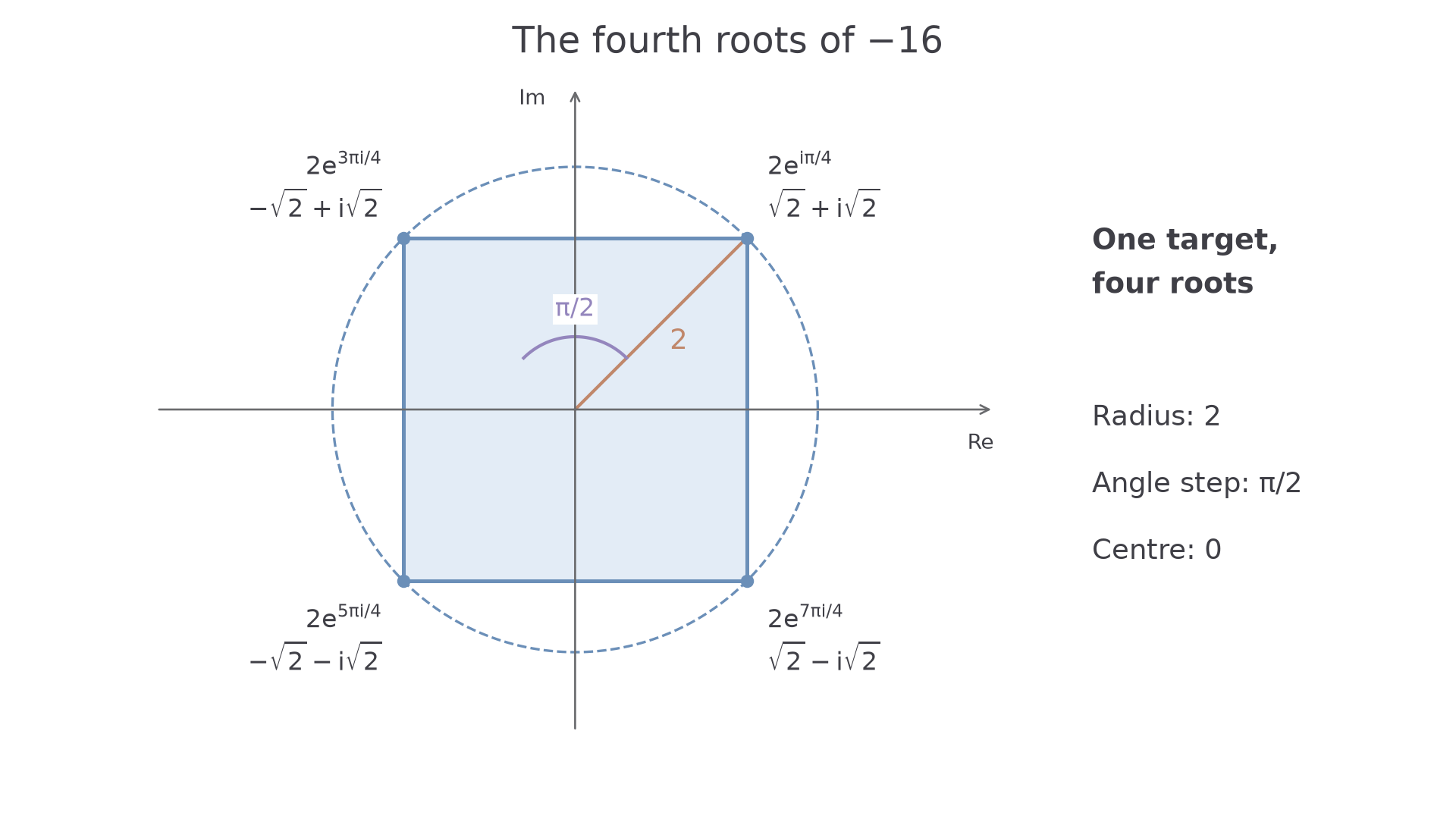
Here is why the picture works for any non-zero target. Write its roots as
All lie at distance from the origin. Their arguments advance by ; equal central angles cut equal chords from a circle. For , those equal sides and equal turns make a regular -gon centred at the origin. For , the two roots are opposite ends of a diameter; for , there is just one point.
Root polygon
For , the roots of , where , are the vertices of a regular -gon, centred at the origin, with circumradius and successive angular separation , where . For example, the fifth roots of form a regular pentagon on a circle of radius , with separation .
There cannot be an early repeat. If , their argument difference must be a whole number of full turns. For , that happens only when . Increasing by does make a full turn, so every later integer repeats one of these roots.
Even a positive target can have surprising non-real roots. The sixth roots of include and , yet none is purely imaginary: the argument steps are , which never land at or . Indeed, , with the opposite sign.
Key idea
The target's modulus controls the polygon's radius; its argument controls the polygon's orientation. The degree controls the number of vertices and their spacing.
When sketching, place any axis vertices accurately and preserve equal spacing. A regular-looking polygon drawn at the wrong orientation represents the wrong roots.
Quick Recap
- For , solve using , with .
- Include the full turns before dividing by ; otherwise you miss the other roots.
- Give all distinct answers in the requested form and argument interval.
- The roots lie on a circle of radius , separated by ; for , they form a regular -gon.
The four solutions of are , , and : the four vertices of the square in the diagram.