CP 5.2 - Improper integrals
An infinite interval or an undefined integrand needs a limiting process before an integral can have a value. You will evaluate improper integrals at infinite and finite endpoints, split at interior singularities, and decide whether each required limit converges.
When an ordinary definite integral needs a limit
The area under from to is ; from to it is . Can the region continue forever and still have a finite area? Length alone cannot decide: the height is shrinking as the interval grows.
You already know
For a continuous integrand on a finite closed interval, evaluate using an antiderivative and upper minus lower. The power rule excludes exponent ; on an interval that does not cross zero. A limit describes what values approach, without treating infinity as a number.
Two changes require care. An integration bound may be infinite, as in . Alternatively, the integrand may be undefined somewhere in the stated interval, as in . Both are improper, even though either may turn out to have a finite value.
Improper integral and convergence
An improper integral has an infinite integration range or an integrand undefined at a point in that range, including an endpoint. Replace each problematic bound or point by an appropriate one-sided limit. The integral converges if every limit required by this definition exists as a finite real number. Otherwise it diverges. “Improper” describes the situation; it does not mean “divergent”.
An undefined value at one point is not a licence to discard a neighbourhood of it. Integrate up to a nearby point where the function is defined, then examine what happens as that point approaches the difficulty. For an infinite bound, first integrate over a finite interval and then let the interval expand.
Key idea
Do ordinary integration on a safe finite interval first. Take the limit afterwards, and state whether its value is finite.
You can classify the following integrals without finding any antiderivatives.
Infinite endpoints and the rate of decay
Replace an infinite endpoint by a finite variable, integrate normally, then let that variable tend to infinity.
For an upper infinite bound, write the limiting process at the outset. An expression such as is shorthand at best; the actual justification is .
An infinite upper bound
When is integrable on every finite interval ,
The improper integral converges only if the limit is finite. Not in the formula booklet: learn it.
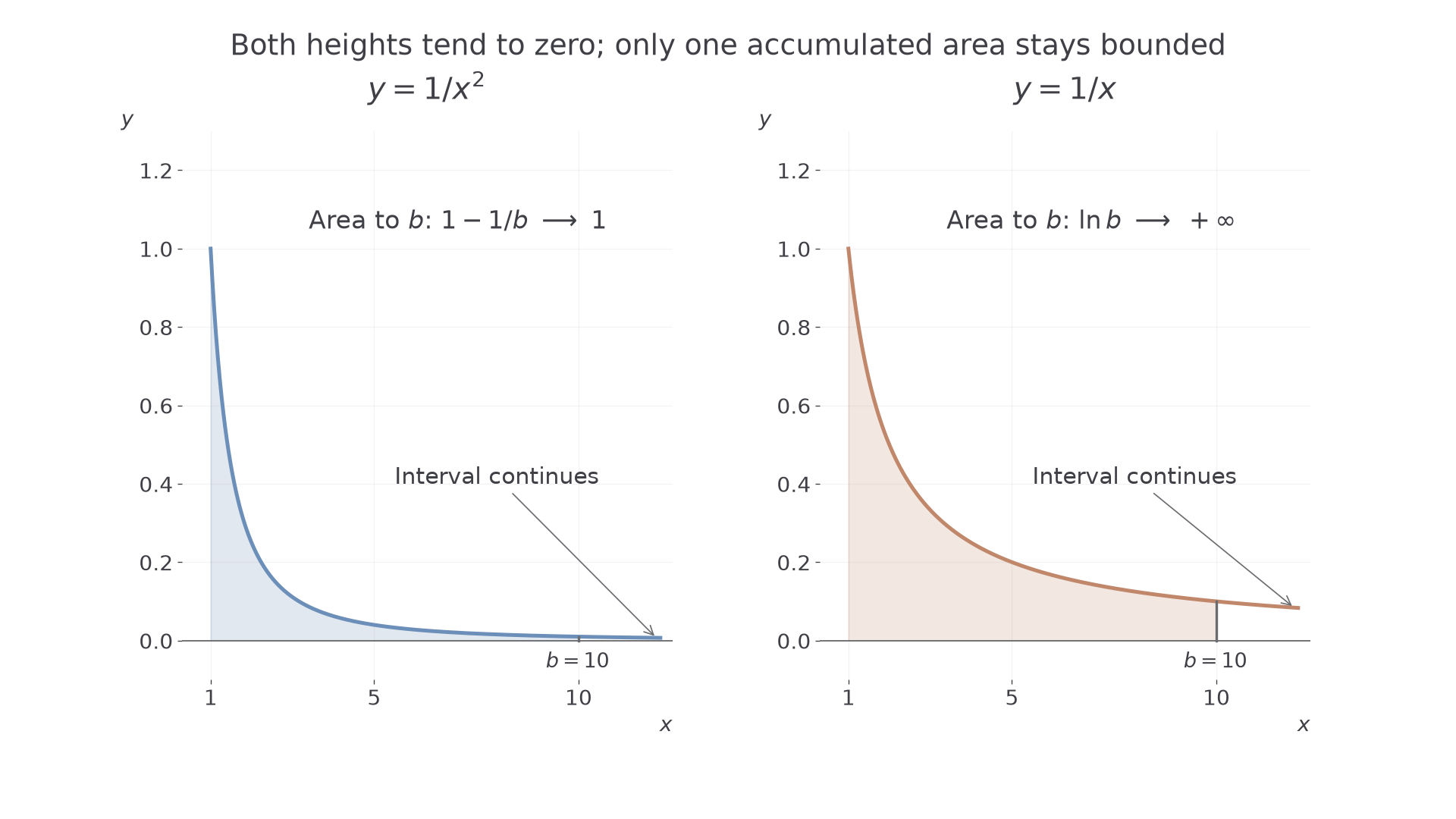
A function can approach zero while accumulating too much total area. Compare the next two examples: only the exponent changes.
Worked example 1: a finite area over an infinite interval
Question. Evaluate , showing the limiting process.
Plan. Integrate from to a finite , then examine the limit as .
Why this step? Only the finite upper value is substituted into the antiderivative. The limiting argument then explains what happens as that endpoint moves indefinitely far away.
Answer. The integral converges and equals .
Check. At , the area is ; at , it is . The remaining tail is exactly , tending to zero.
The second example changes the exponent from to . The curve still tends to zero, but it does so too slowly to leave a finite total area.
Worked example 2: decay to zero is not enough
Question. Determine whether converges.
Plan. Integrate to a finite upper endpoint and test the resulting logarithmic limit.
Why this step? The fact that concerns individual heights. Convergence concerns the accumulated area, here , which keeps increasing without bound.
Answer. The integral diverges; it has no finite value.
Check. Every interval , with , contributes . Repeated doubling therefore adds the same positive area forever.
The power family shows the exact boundary. For ,
When , the power tends to zero, leaving . For , it grows without bound; at , the logarithm diverges as above.
Power tails
For real ,
In that case its value is . Not in the formula booklet: learn it.
For a lower infinite endpoint, use . For example, . An integral with both endpoints infinite must be split at any finite point where the function is regular, and its two limits must converge separately. Thus : use on the left and on the right.
[DIAGRAM: asset_name: Two curves tending to zero with different total areas; asset_slug: 9fm0-cp34-infinite-tails; caption: Shrinking heights do not by themselves guarantee a finite accumulated area; description: Two coordinate panels show y equals one over x squared and y equals one over x for x from one to ten. Both have shaded areas up to x equals ten and arrows indicating that the integration interval continues. The first panel gives accumulated area one minus one over b, tending to one; the second gives log b, growing without bound.]
Watch out
Wrong: conclude that converges because . Shrinking height does not establish finite accumulated area. Right: , so the integral diverges.
The limit must describe the evaluated integral, not merely the integrand.
Exam tip
For an infinite endpoint, write an explicit limit and identify that endpoint when explaining why the integral is improper. Saying only “the integral is undefined” does not identify the mathematical issue or establish convergence.
An exponential gives another finite tail. Use its ordinary antiderivative before taking the limit.
An undefined integrand at a finite endpoint
If the integrand is undefined at the lower endpoint, approach that endpoint from inside the integration interval.
For , the lower bound is finite; the problem is that is undefined at zero. Cut off a small positive interval first, then let its length tend to zero. An unbounded height can still sit above a finite area.
One-sided endpoint limits
For an integrand undefined at a lower endpoint , use
For an integrand undefined at the upper endpoint , use
Each claimed value requires a finite limit. Not in the formula booklet: learn it.
The superscript in means that stays positive. That keeps each temporary endpoint inside the original interval.
Worked example 3: infinite height but finite area
Question. Evaluate , showing the limiting process.
Plan. Integrate from a positive to , then let .
Why this step? The integrand is undefined at zero, but the antiderivative approaches a finite endpoint value. The limit justifies the evaluation that direct substitution alone would leave unexplained.
Answer. The integral converges and equals .
Check. With on positive truncated intervals, . As the lower cutoff tends to zero, the transformed area tends to .
The second example changes only the power to . The stronger growth near zero now creates an infinite area.
Worked example 4: a divergent endpoint singularity
Question. Determine whether converges.
Plan. Keep the lower endpoint positive until after evaluating the logarithm.
Why this step? is not a real number. The one-sided limit shows the direction of divergence instead of pretending it is an ordinary endpoint value.
Answer. The integral diverges.
Check. The interval always contributes , however close it lies to zero. Repeated halving adds infinitely many such positive contributions.
The same power-rule calculation identifies the boundary near zero. For ,
Now when . For , it grows without bound; the logarithmic case also diverges.
Powers near zero
For real ,
In that case its value is . The same threshold applies near any finite point after a translation of the coordinate. Not in the formula booklet: learn it.
The two power tests point in opposite directions: large positive helps at infinity but makes the singularity at zero worse. Consequently, no real makes converge: splitting at would require both and .
Watch out
Wrong: apply the condition to . That condition concerns the infinite tail. Right: near zero you need . Always identify where the integral is improper first.
Try another power, with an explicit one-sided lower limit.
Splitting at an interior singularity
An undefined point inside the interval divides the problem into two independent one-sided integrals; both must converge.
For a singularity at , where , the definition is
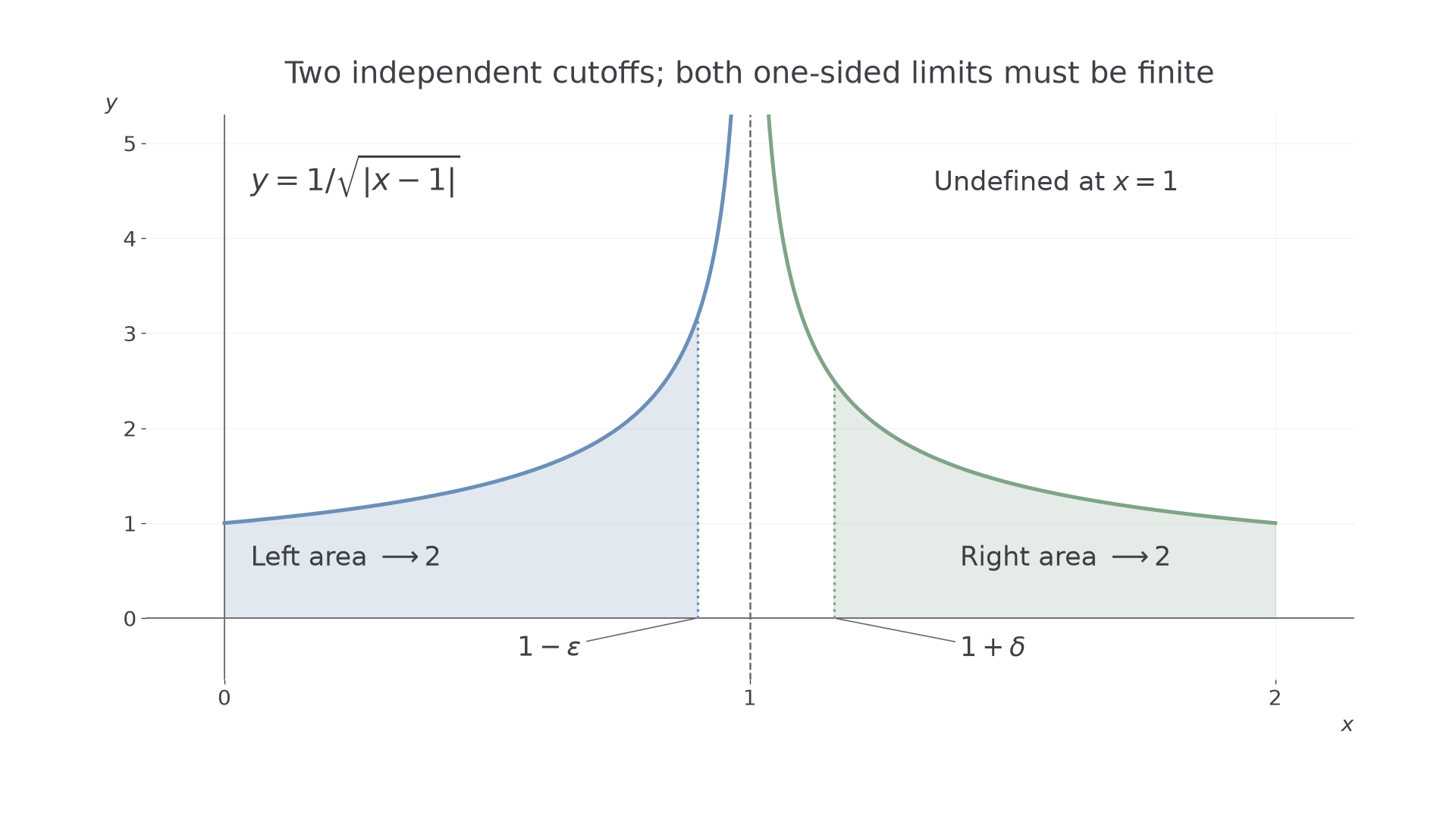
The two cutoffs are independent. This rule is not in the formula booklet: learn it. Do not subtract a single antiderivative across a point where the integrand is undefined.
Worked example 5: a divergent interior point
Question. Determine whether converges.
Plan. Split at , use on the left and on the right, and test both limits.
Why this step? The absolute value has different algebraic forms on the two sides. Splitting handles both that change and the undefined point correctly.
Answer. The integral diverges, since its required one-sided limits are not finite.
Check. The integrand is positive on both sides, and each side has the same logarithmic divergence as near zero.
The second example changes only the exponent of the distance from , from to . The singularity remains, but both one-sided areas are now finite.
Worked example 6: a convergent interior point
Question. Evaluate , showing both limiting processes.
Plan. Split at and integrate the reciprocal square root of the positive distance on each side.
Why this step? A finite answer on one side is not enough. The separate calculations establish two finite limits, so adding them is justified.
Answer. The integral converges and equals .
Check. The graph is symmetric about . Each half becomes after translating or reversing the distance coordinate.
Cancellation must not hide a failure of those independent limits. For example, has a left-hand contribution tending to and a right-hand contribution tending to . Cutting out a symmetric gap gives , but that forced cancellation does not make either one-sided limit finite. The ordinary improper integral diverges.
[DIAGRAM: asset_name: Separate limits at an interior singularity; asset_slug: 9fm0-cp34-interior-split; caption: Approach the undefined point independently from its two sides; description: The graph of one over the square root of the absolute value of x minus one is drawn on zero to two, with a dashed vertical line at x equals one. Blue left and sage right areas are cut off independently at one minus epsilon and one plus delta. The missing neighbourhood is left unshaded. Labels identify the two cutoffs and the two finite limiting half-areas of two.]
Watch out
Wrong: , so . The interval crosses an undefined point. Right: split at ; the separate divergent limits prevent the improper integral from having a value.
The opening infinite region has area , because its tail shrinks fast enough. Neither infinite length nor infinite height decides convergence by itself: the required limits do.
Quick Recap
- Identify infinite bounds and undefined points before integrating; replace each difficulty by a suitable limit.
- An improper integral converges only when every required limit is finite.
- converges for ; converges for . The boundary diverges in both cases.
- Split at every interior singularity, and split a two-sided infinite range into two independently convergent pieces. Forced cancellation is not convergence.
Yes: the region under from onwards has infinite length but finite area .