FP1 4.3 - Tangents and normals to conics
Use algebraic differentiation to find tangents and normals to the four standard conics. You will handle vertical tangents, derive the conditions for a line to touch a conic and find tangents through an external point.
A tangent direction and its perpendicular
Two lines through touch , and they are perpendicular. How can you find them when is not on the ellipse? First distinguish a tangent at a known curve point from a tangent through a point elsewhere.
You already know
From A-level Mathematics, a line of gradient through has equation . A normal is perpendicular to the tangent: finite non-zero gradients have product . Recall implicit differentiation and the parametric conic coordinates from FP1 4.1.
For an implicit equation, differentiate both coordinates as functions of ; a term becomes . Evaluate the gradient only at a point known to lie on the curve.
If the tangent is horizontal, its normal is vertical. If the tangent is vertical, its normal is horizontal. The phrase “negative reciprocal” does not give a numerical gradient in those two cases; use the directions themselves.
Key idea
At a given curve point, differentiate and use a point-line equation. Through an external point, the point is not a contact point: impose tangency as an additional condition.
Check the vertex before dividing by a coordinate that may be zero.
Parabola tangents and normals
Differentiate :
at , provided . The normal gradient is then .
Lines at a parabola parameter
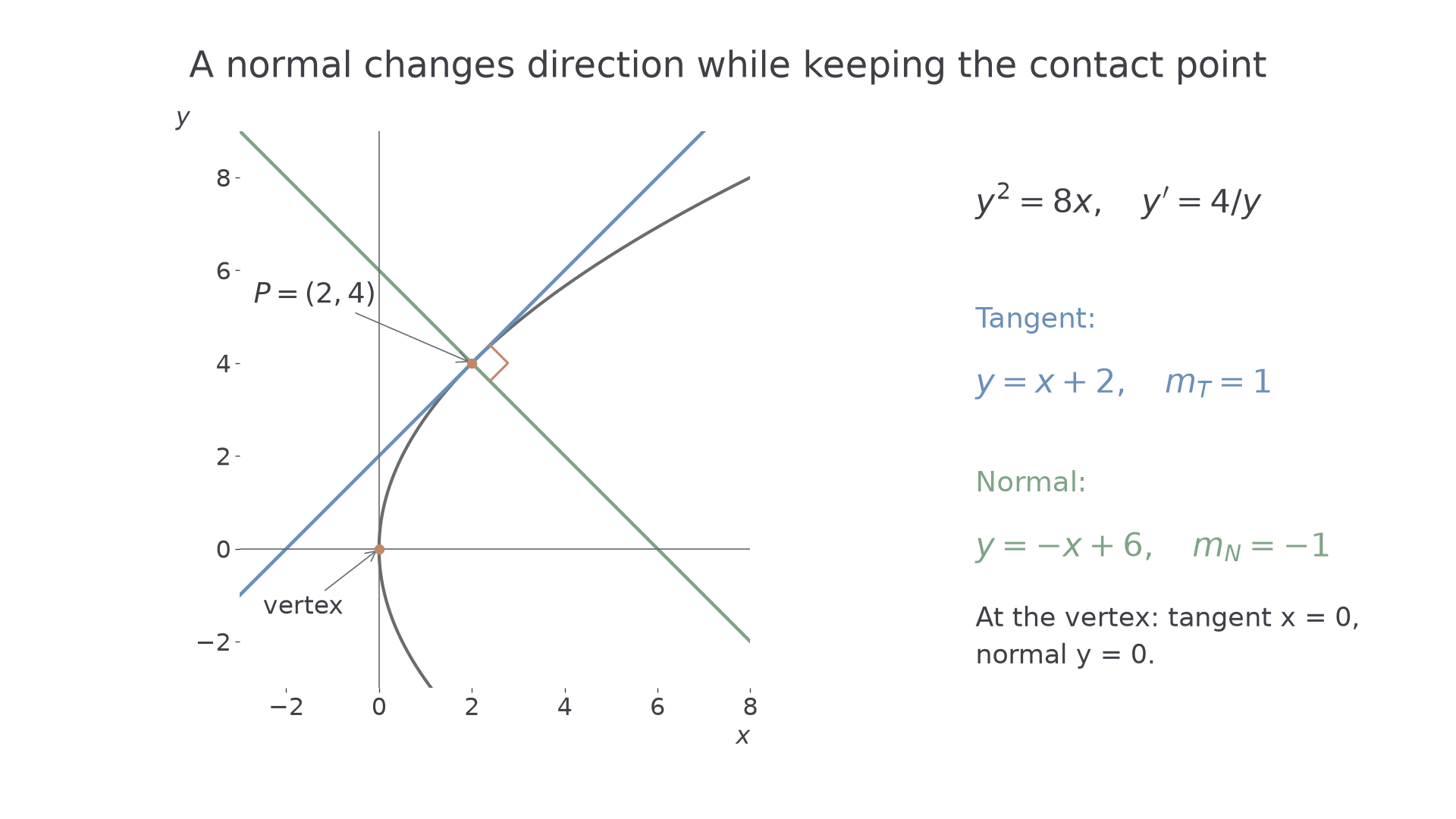
At on , ,
For , these follow by inserting gradients into point-line equations. At , they correctly give the vertex tangent and normal .
Not in the formula booklet: learn it.
The tangent equation comes from , multiplied by . Multiplication gives a useful formula that remains valid at the vertex, though its finite-gradient derivation required a separate vertex check.
[DIAGRAM: asset_name: A tangent and normal to a parabola; asset_slug: 9fm0-fp172-parabola-lines; caption: The tangent and normal pass through the same curve point and are perpendicular; description: An equal-scale plot shows y squared equals 8x, the point P at (2,4), its tangent y equals x plus 2 in blue and its normal y equals minus x plus 6 in sage. A right-angle marker at P separates the two line directions. A side panel gives the implicit derivative 4 over y, tangent gradient 1 and normal gradient minus 1. The vertex is also marked, with a note that its tangent is x equals zero and its normal y equals zero.]
Worked example 1: two lines at a positive parameter
Question. Find the tangent and normal to at .
Plan. Differentiate, evaluate the gradient, then use the point for both lines.
Why this step? The normal changes the direction, not the point: it must pass through too.
Answer. Tangent ; normal .
Check. Both contain , and their gradients multiply to .
Change only the sign of the point's vertical coordinate, reflecting it in the horizontal axis.
Worked example 2: the reflected point
Question. Find the tangent and normal to at .
Plan. Use the same derivative with the signed value of .
Why this step? The sign of survives in ; the two reflected tangents have opposite gradients.
Answer. Tangent ; normal .
Check. With , the parameter formulas give the same two equations.
For a question saying “use calculus”, show the differentiation even when you recognise a standard line formula.
Watch out
Wrong: divide by to obtain the vertex gradient. Right: use the vertical tangent direction at the vertex and write its equation directly.
Move to the point with parameter .
Ellipse tangents and normals
Differentiating gives
where . Substitution into a point-line equation and use of the point's own curve equation yield the tangent below.
Lines at an ellipse point
At on ,
The undivided normal equation includes the axis-intercept cases. At the tangent is vertical and the normal horizontal; at the directions reverse.
Not in the formula booklet: learn it.
For example, multiplying the tangent point-line equation by gives
and the curve identity supplies its right-hand constant.
Worked example 3: an exact non-axis point
Question. Find the tangent and normal to at .
Plan. Evaluate the implicit derivative and form both lines.
Why this step? The normal gradient is , not : both the sign and reciprocal change.
Answer. Tangent ; normal .
Check. The point satisfies both lines and .
Reflect the point vertically, changing only 's sign.
Worked example 4: the reflected ellipse point
Question. Find both lines at on the same ellipse.
Plan. Retain the negative vertical coordinate in the derivative and tangent formula.
Why this step? Reflection changes both line gradients; it does not merely change the sign of their constants.
Answer. The tangent and normal are as displayed.
Check. Substituting into the tangent gives , and the normal's two sides are both zero.
The point formula can be used only when is on the ellipse. An external point cannot be inserted as though it were a contact point.
Watch out
Wrong: use the ellipse's tangent gradient for its normal too. Right: take the perpendicular direction, checking horizontal or vertical cases separately.
Use a new exact point on the same ellipse.
Hyperbola lines and the changed sign
For , differentiation gives
The minus sign in the curve changes the tangent gradient's sign compared with the ellipse calculation.
Lines at a hyperbola point
At on ,
At the vertices , the tangents are and the normals .
Not in the formula booklet: learn it.
The tangent formula follows from the derivative and the identity satisfied by the contact point, just as for the ellipse. Keeping the original curve's sign through the rearrangement is essential.
Worked example 5: the right branch
Question. Find the tangent and normal to at .
Plan. Differentiate the hyperbola, evaluate its gradient and use the point.
Why this step? Both coordinates are positive, so the right upper branch has positive tangent gradient; the ellipse's extra minus sign would be wrong here.
Answer. Tangent ; normal .
Check. The point gives in the tangent and in the hyperbola.
Continue this lesson.
You’re previewing NovaLearn without an account. Create a free account to read the rest.
Create free account