CP 7.3 - Areas enclosed by polar curves
Find exact polar areas by adding narrow sectors, choosing an interval that sweeps the intended region once. You will integrate whole curves and individual loops, then compare boundaries to find areas between curves.
Adding narrow sectors gives polar area
How much of the disc lies outside the cardioid ? Both boundaries reach radius , but they enclose very different areas. We will calculate their difference exactly.
You already know
A circular sector of radius and angle radians has area . From A-level Mathematics, use definite integration and the rearrangement ; the corresponding sine-square identity has a minus sign. These double-angle rearrangements are not printed separately in the formula booklet.
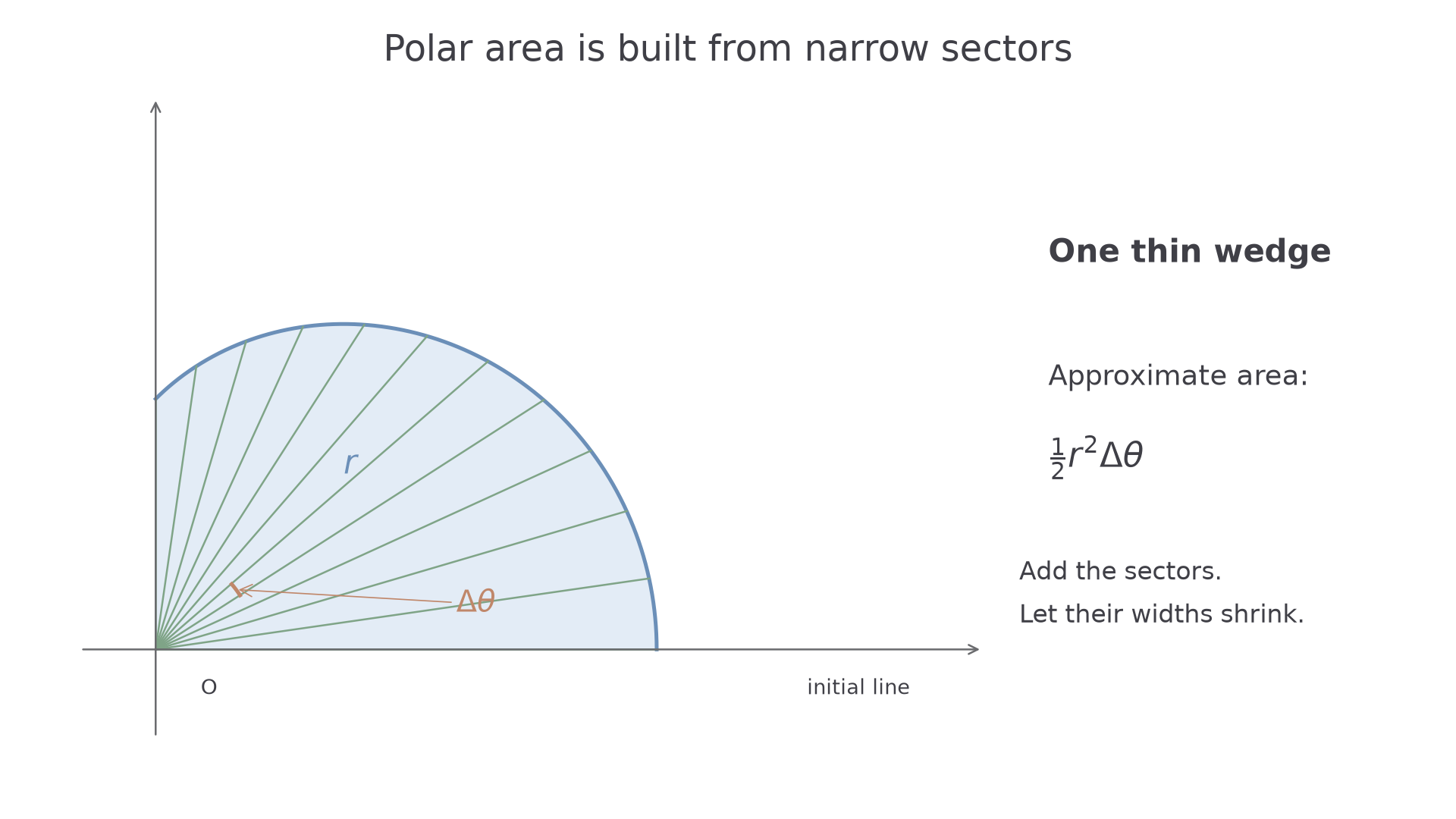
A sector of radius through angle has area . For a changing radius, divide the angular sweep into many thin wedges. Each has approximate area . As their widths tend to zero, adding them becomes integration.
[DIAGRAM: asset_name: Thin sectors approximate a polar area; asset_slug: 9fm0-cp47-sector-sweep; caption: The angular sweep is divided into narrow sectors; description: A cardioid r equals 1 plus cos theta is shown between theta zero and pi over 2. The region between the pole, the initial line and that curve segment is shaded pale blue. Several thin radial wedges show the approximation by sectors, with one radius r and a small angular width delta theta marked.]
Area swept by a polar curve
If on , and this sweep covers the intended region once, its area is
The bounding rays run from the pole to the curve. Use radians and choose limits from the geometry, not just from a convenient trigonometric period.
In the formula booklet.
The square comes from sector area, not from the length of a curve. If all radii are multiplied by , the area is multiplied by . A doubled curve therefore encloses four times the area; the integral makes that geometric fact immediate.
Key idea
Square the radius and integrate over a sweep that counts the required area exactly once.
Choose the setup before doing any integration.
Integrating a complete closed curve
For a cardioid , one complete turn traces the boundary once. Its radius is non-negative throughout, so is a valid full-area interval.
Expand the square before integrating. In particular, has three terms, including the middle term . Symmetry can reduce the limits, but only if the chosen piece is truly the corresponding fraction of the region.
Worked example 1: the area of a cardioid
Question. Find the exact area enclosed by .
Plan. Integrate half the squared radius over one complete turn, replacing by its double-angle form.
Why this step? The limits describe one full traversal of this cardioid. The period of the squared integrand alone would not justify a different geometric sweep.
Answer. square units.
Check. The curve lies inside the radius- disc, whose area is ; the computed area is smaller and positive.
Change only the radial scale, from to . The area should increase by a factor of .
Worked example 2: a larger cardioid
Question. Find the exact area enclosed by .
Plan. Keep the same full-turn limits and retain the factor when squaring the radius.
Why this step? The multiplier lies inside the square, so it contributes , not , to the area.
Answer. square units.
Check. The result is four times , as an enlargement by factor requires.
These particular cardioid areas are derived results and are not printed in the formula booklet. Set up the integral even when you recognise the scaling.
Watch out
Wrong: . Right: include . Its full-turn integral happens to be zero here, but omitting it is still incorrect algebra and fails for many partial regions.
Use the same complete sweep for the next scale.
Choosing limits for one loop
To find one loop, solve for the consecutive pole directions that enclose that loop. Check the radius stays non-negative between them. A full turn may include inadmissible angles or count a region more than once.
For either horizontal double-angle family, the right loop is swept by . The equation determines whether the integrand is a cosine square or a single cosine.
Worked example 3: a cosine loop
Question. Find the exact area of the right loop of , with .
Plan. Use the two pole directions bounding the right loop, then square .
Why this step? The same right loop straddles angle zero. Integrating from to follows it continuously and avoids joining two wrapped intervals.
Answer. Right-loop area square units; the two-loop total would be .
Check. On this interval , and the radius starts at zero, reaches , then returns to zero.
Change only the radial profile to the lemniscate with the same tip radius . The limits remain valid, while is already given directly.
Worked example 4: a lemniscate loop
Question. Find the exact area of the right loop of , with .
Plan. Substitute the given squared radius directly into the area formula.
Why this step? Squaring would use , because the equation has already supplied .
Answer. Right-loop area square units.
Check. On every intermediate ray the lemniscate extends farther than , so agrees with the sketches.
Both loop-area results are derived and are not printed in the formula booklet. The different areas also show why shared tips and pole directions do not determine an entire shape.
Watch out
Wrong: integrate over without checking admissibility. Some of that interval gives negative radius in the distance convention. Right: identify and integrate each required admissible loop once.
Keep the loop interval and change the squared-radius scale.
Subtracting areas between boundaries
Compare the two radii along each ray. Where an outer boundary has radius and the inner boundary has radius , subtract their sector areas over that same angular interval.
Area between two polar boundaries
If throughout the required once-only sweep,
Solve intersections to choose limits. Split the region if the boundary order changes. For a common interior, use the nearer boundary on each ray.
Not in the formula booklet: learn it.
The area is the difference of squares of radii, not the square of the distance between them.
[DIAGRAM: asset_name: An outer circle compared with a cardioid; asset_slug: 9fm0-cp47-between-boundaries; caption: Intersections decide where the circle is the outer boundary; description: Two panels show the cardioid r equals 1 plus cos theta. The left panel shades the part inside circle r equals 2 and outside the cardioid over a complete turn. The right panel uses circle r equals 1, shades only the part outside the cardioid on pi over 2 to three pi over 2, and marks the intersections (0,1) and (0,minus 1). Legends are outside the curves.]
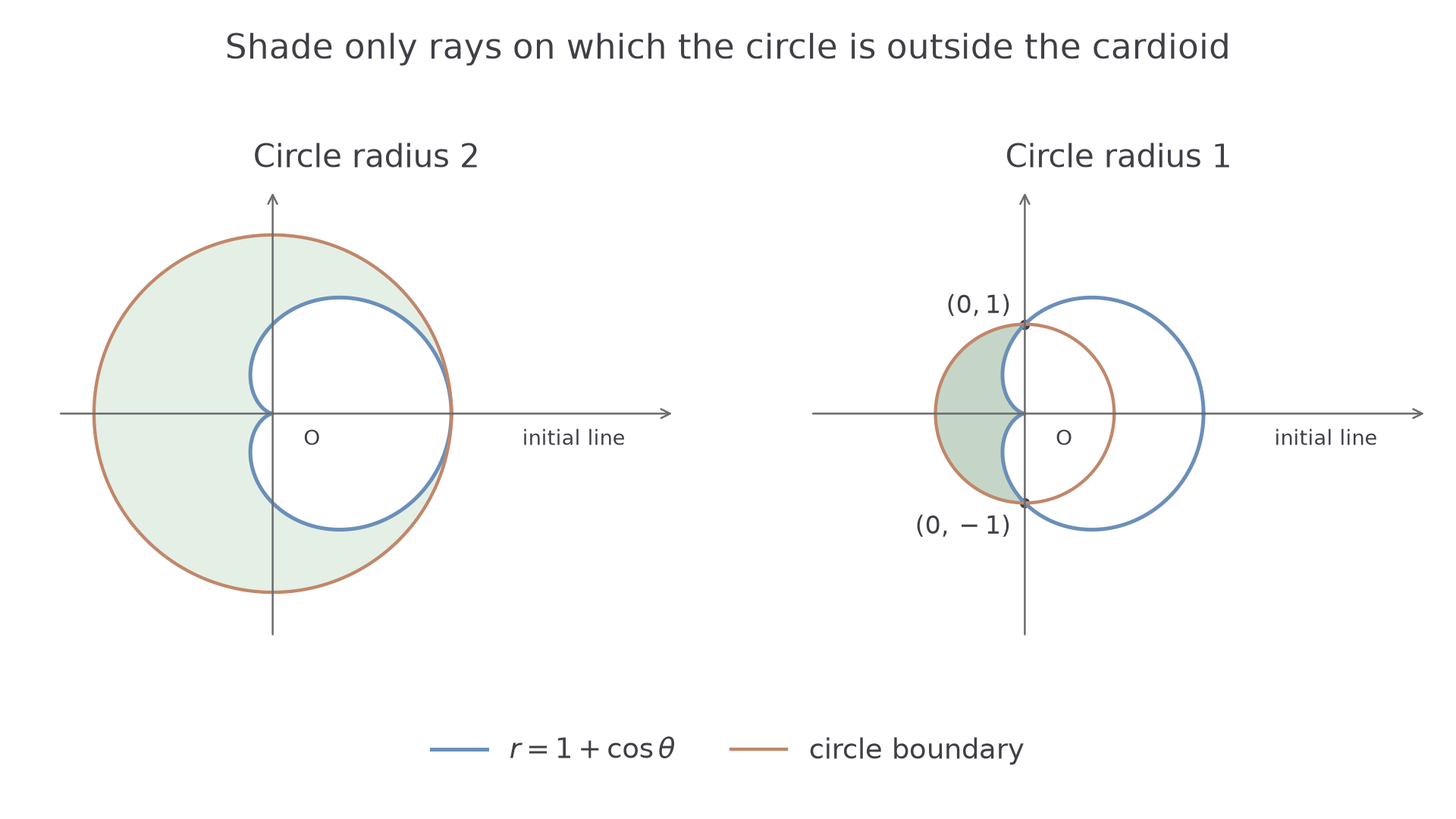
Worked example 5: the disc outside a cardioid
Question. Find the exact area inside and outside .
Plan. Show the circle is always the outer boundary, then subtract the complete enclosed areas.
Why this step? The ordering holds on every ray, so the whole cardioid can be subtracted from the whole disc. No angular split is needed.
Answer. square units, answering the opening question.
Check. Adding the removed cardioid area returns the full disc area .
Change only the circle radius from to . The boundaries now cross, so subtracting their whole enclosed areas would describe the wrong region.
Worked example 6: a smaller circle creates intersections
Question. Find the exact area inside and outside .
Plan. Find the crossing angles, retain the rays on which the circle is outer and integrate the sector difference.
Hence
Why this step? On the other rays the cardioid lies outside the circle, so there is no region simultaneously inside the circle and outside the cardioid.
Answer. square units.
Check. The integrand is non-negative on the chosen interval, and the answer is positive and less than the circle area .
These particular differences are not printed in the formula booklet. The transferable skill is deciding which radius bounds the requested region on each ray.
Watch out
Wrong: . Right: . A difference of sector areas is a difference of squares, and the limits must match the actual outer/inner ordering.
A circle of intermediate radius needs the same intersection decision.
Quick Recap
- Derive the area setup from thin sectors: .
- Square the whole radius; if is given, use it directly.
- Match the limits to one complete sweep of the required region or loop, respecting admissible angles.
- Between boundaries, compare radii and integrate outer square minus inner square, splitting where necessary.
The disc has area , the cardioid encloses , and the opening difference is .