FM2 2.2 - Composite laminas and frameworks
A plate or a framework can be replaced by a collection of simpler pieces, each acting at its own centre of mass. You will use symmetry and the formula booklet, combine pieces with different densities, and account for removed material. You will also distinguish mass proportional to area from mass proportional to wire length, without using integration.
Use uniformity and symmetry before calculating
Can removing material from a plate move its centre towards the side you leave untouched? Yes: taking mass from the right draws the centre left. You will calculate that shift rather than treating a hole as an extra piece.
You already know
For pieces with masses and centres , use and . A centre need not lie on material. All coordinates must use the same origin and axes.
A lamina is a thin sheet modelled as having negligible thickness. A uniform lamina has constant mass per unit area. A framework is made from thin rods or wires; uniform wire has constant mass per unit length. Equal areas need not mean equal masses if the materials differ.
An axis of symmetry of the mass distribution contains its centre of mass: mirrored elements have equal masses and cancelling moments perpendicular to that axis. Two intersecting mass-symmetry axes locate the centre at their intersection. Symmetry of the outline alone is insufficient if the density is not symmetric.
Centres from symmetry
A uniform rectangle's centre is the intersection of its diagonals; for corners , it is . A uniform circular disc has its centre at the circle centre. A uniform straight rod has its centre at its midpoint.
Not in the formula booklet: learn it.
For a triangle, the medians identify a different familiar point. Its centre is not generally halfway up its height.
Uniform triangular lamina
The centre lies two-thirds of the way along a median from the vertex towards the opposite side. Equivalently, it is one-third of the perpendicular height from that side. For vertices , this gives
The booklet supplies the two-thirds-along-the-median result; the coordinate form follows from it.
In the formula booklet.
You may quote the booklet's result unless a question explicitly asks for a proof. Here the geometry is enough; no integration is required.
Worked example 1: the centre of a right triangular plate
Question. A uniform triangular lamina has vertices , in metres. Find its centre of mass.
Plan. Use the triangle's median result to average its vertex coordinates.
Why this step? Each median is divided in the ratio , measured from the vertex. The centre is one-third of the height above the horizontal base.
Answer. .
Check. The median from to the base midpoint passes through , two-thirds of the way from the vertex.
Change only the vertical height, doubling it from to .
Worked example 2: change one dimension
Question. A uniform triangular lamina has vertices , in metres. Find its centre of mass.
Plan. Retain the x-coordinate calculation and update the changed vertex height.
Why this step? Changing only the height doubles the y-coordinate of every corresponding point, including the centre; it does not change the x-coordinate.
Answer. .
Check. The mass distribution is symmetric about , and the computed centre lies on that line.
A uniform triangle need not have a reflection axis, but its median result still applies. Use symmetry when it exists; do not invent it to avoid taking moments.
Watch out
Wrong: placing the triangular lamina's centre halfway up the height. Right: it is one-third of the height from the base. Also, an outline's symmetry only locates the mass centre when the mass distribution shares it.
Change only the height once more.
Use areas as masses only when density permits
Split a composite lamina into non-overlapping standard pieces. Find each piece's mass and centre, then use the particle formulas. The pieces need not have equal areas or equal densities.
Mass of lamina pieces
If a piece has constant areal density and area ,
Thus
A common density cancels, allowing areas as mass ratios. Different densities must remain in the ratios.
Not in the formula booklet: learn it.
Use a table with one row per physical piece. If two regions overlap, either split into disjoint pieces or account correctly for the extra physical layers; do not count an ordinary single-layer region twice.
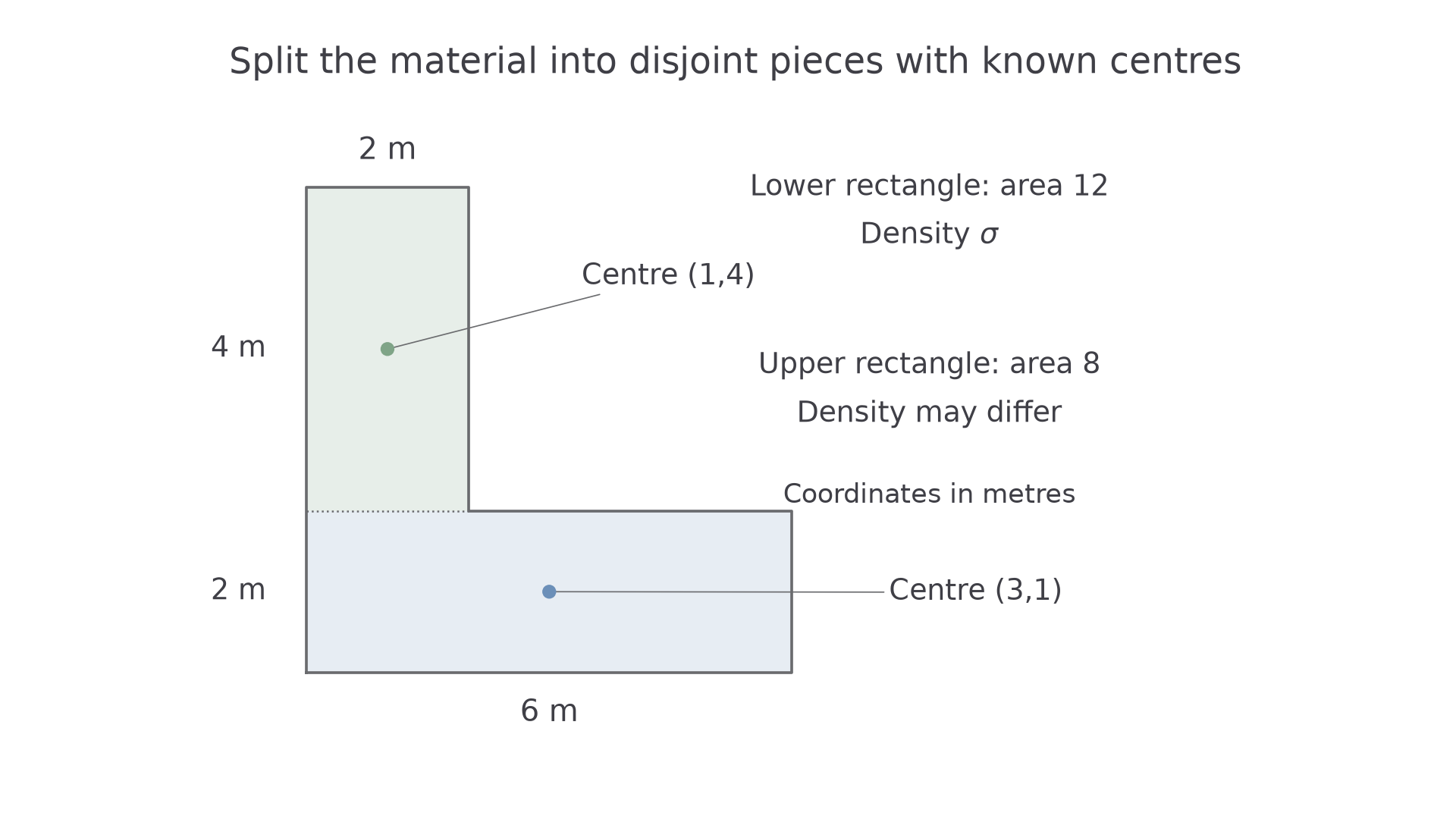
[DIAGRAM: asset_name: Splitting an L-shaped lamina into rectangles; asset_slug: 9fm0-fm151-composite-rectangles; caption: Use each rectangle's own centre and its area multiplied by its density; description: An L-shaped lamina is split into a lower rectangle from x zero to six and y zero to two, area twelve with centre three one, and an upper-left rectangle from x zero to two and y two to six, area eight with centre one four. The pieces do not overlap. A second annotation distinguishes the upper piece's density from the lower piece's.]
Worked example 3: a uniform L-shaped plate
Question. A lamina is the union of rectangles and , with coordinates in metres. Both pieces have the same uniform areal density . Find its centre of mass.
Plan. Use the two rectangle centres and their areas as mass ratios.
| Piece | Mass divided by | Centre |
|---|---|---|
| Lower rectangle | ||
| Upper-left rectangle |
Why this step? Each uniform rectangle can be replaced by its total mass acting at its own centre; the common density cancels from the whole moment equation.
Answer. .
Check. The L-shaped mass distribution is symmetric about , so the equal coordinates are consistent.
Change only the upper-left piece's density, from to . The outline stays the same.
Worked example 4: the same outline with unequal densities
Question. For the same two rectangles, the lower one has density and the upper-left one density . Find the centre of mass.
Plan. Keep the centres but double the upper piece's mass ratio.
Why this step? The outline remains symmetric, but the mass distribution no longer is. Equal-coordinate symmetry cannot be used.
Answer. .
Check. The centre moves left and up, towards the denser piece's centre , as expected.
In a mass-ratio table, you may divide all masses by one common positive factor. You may not cancel a different density independently from each row.
Watch out
Wrong: continuing to use mass ratios after the upper density doubles. Right: use . Uniformity of each piece does not imply uniformity of the composite.
Change only the upper density again.
An arc and a sector have different mass centres
A circular arc is a thin curved wire, carrying mass along a line. A circular sector is a filled lamina, carrying mass across an area. Both centres lie on the angle bisector by symmetry, but the filled sector includes material closer to the circle centre.
Uniform circular arc
For a uniform thin arc of radius , total angle radians and circle centre , its centre lies on the angle bisector a distance
from towards the arc, for . Its length is . The formula for is printed in the booklet; the arc-length relation is assumed radians geometry.
In the formula booklet.
For the corresponding filled sector the centre lies closer to . Keep the same half-angle convention when changing formulas.
Uniform circular sector
For a uniform sector of radius and total angle radians, its centre lies on the angle bisector a distance
from . Its area is . The formula for is printed in the booklet; the area relation is assumed radians geometry. For a full disc, and .
In the formula booklet.
The formulas use the half-angle , not the whole sector angle. For a semicircle, , so .
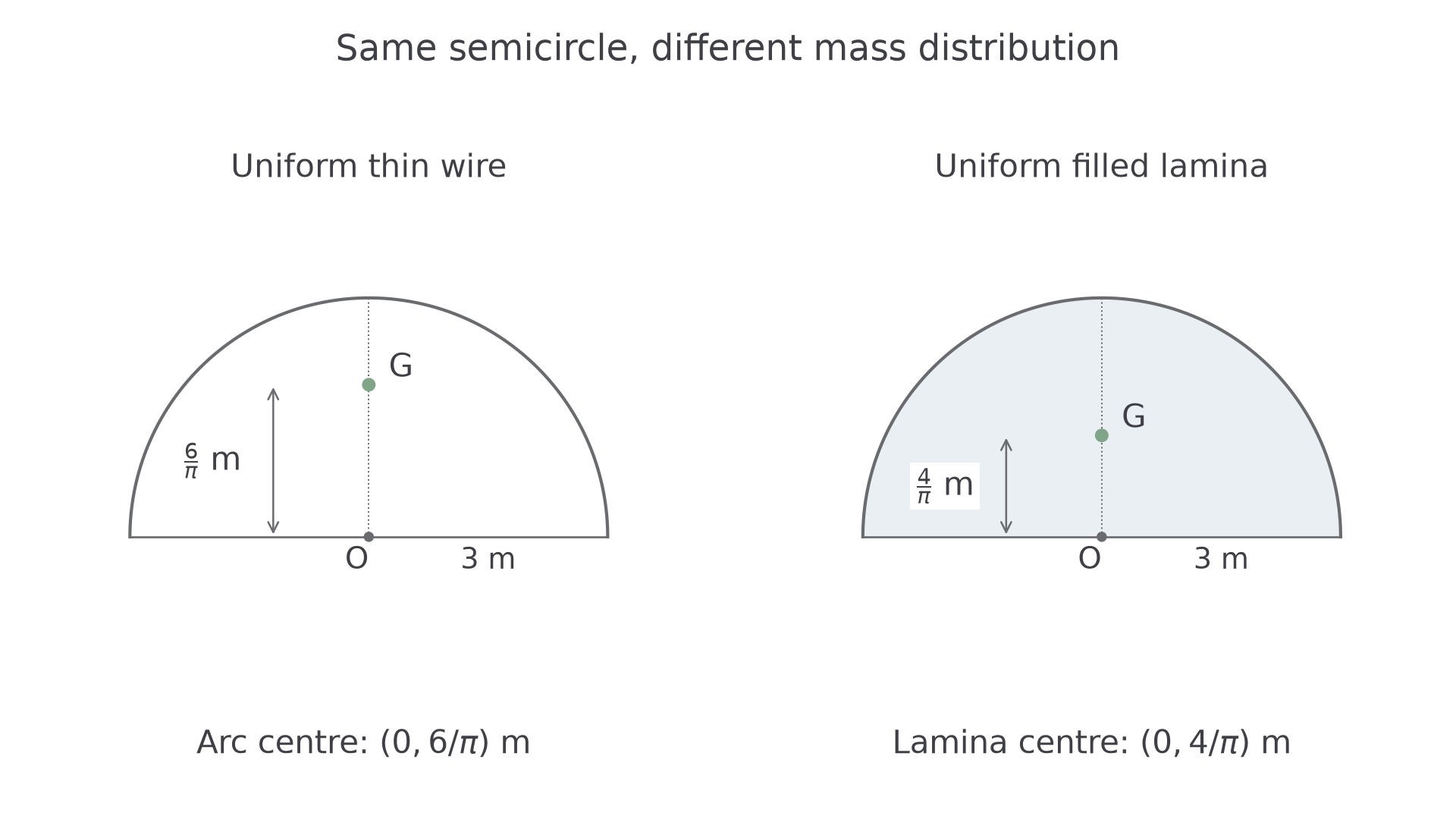
[DIAGRAM: asset_name: Semicircular wire and lamina centres; asset_slug: 9fm0-fm151-arc-sector; caption: Filling the semicircle moves its mass centre closer to the circle centre; description: Two equal-radius upper semicircles show a uniform thin arc and a uniform filled lamina. Radius is three metres. Their centres lie on the vertical symmetry axis at six over pi metres and four over pi metres above the circle centre respectively. Dimension arrows distinguish radius from centre distance.]
Worked example 5: a semicircular wire
Question. A uniform thin wire forms the upper semicircle of radius , centred at the origin. Find its centre of mass.
Plan. Use symmetry for the horizontal coordinate and the arc formula for the vertical distance.
Why this step? The material is a wire, so the arc formula applies. The empty interior carries no mass.
Answer. .
Check. , and the centre lies inside the semicircle rather than on the wire.
Change only the mass distribution: fill the same semicircular outline with a uniform lamina.
Worked example 6: a filled semicircular plate
Question. A uniform lamina fills the upper semicircle of radius , centred at the origin. Find its centre of mass.
Plan. Retain the symmetry and half-angle but use the sector formula.
Why this step? Filling the interior adds mass nearer the circle centre, reducing the centre distance to two-thirds of the arc's distance.
Answer. .
Check. , below the arc centre , as expected.
For a sector at another orientation, first locate its angle bisector, then resolve the centre-distance vector into the coordinate directions. For example, the first-quadrant quarter-disc has its bisector at .
Watch out
Wrong: substituting the full angle into , using degrees in the denominator, or using the arc result for a lamina. Right: identify wire or area, use half the total angle in radians, and locate the correct bisector.
Change only the filled sector's angle, keeping radius .
Subtract a hole's mass and its mass moment
Treat a cut-out as material that was present in a complete plate and is then removed. Its centre keeps its actual coordinates. Subtract its mass from total mass and its mass moment from total mass moment; do not move the hole to a negative coordinate.
Continue this lesson.
You’re previewing NovaLearn without an account. Create a free account to read the rest.
Create free account